
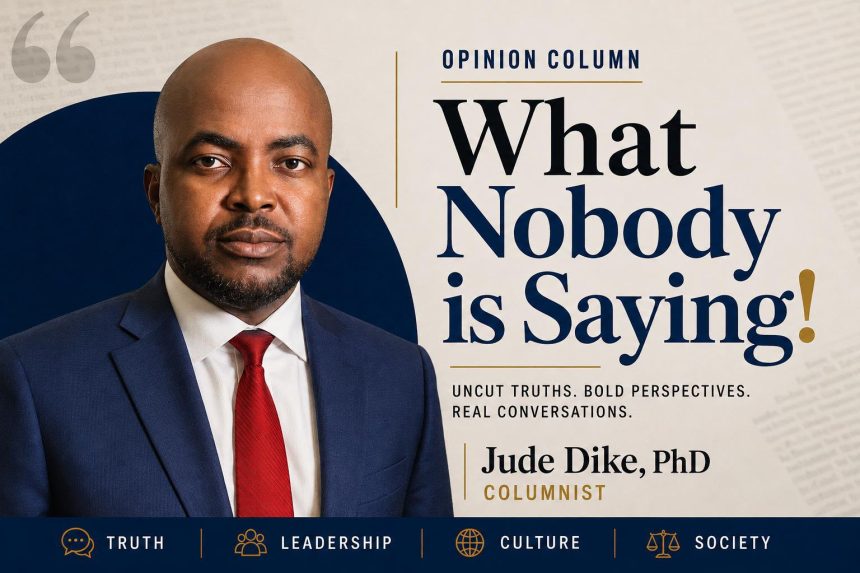
By Jude Dike, PhD
Governor Oborevwori’s reported ₦400 billion debt clearance raises a bigger question about Nigeria’s political economy: If governments can find the money to repay yesterday’s loans, why couldn’t they build economies that would not need tomorrow’s loans?
There is something almost extraordinary about the announcement from Asaba.
The Delta State Government says it has reduced the legacy debt inherited by Governor Sheriff Oborevwori from approximately ₦463 billion to ₦63 billion. In other words, it says that roughly ₦400 billion has been cleared, with the remaining balance expected to be extinguished by the first quarter of 2027.
If independently reconciled and verified, that is a significant fiscal development. It deserves attention, not political hostility.
But in Nigeria, we have developed a rather peculiar relationship with public money. We celebrate what governments announce, argue about what politicians claim, and rarely interrogate what the numbers actually mean.
And that is where this story becomes considerably more important than Delta State.
Because the question is not simply how a government paid ₦400 billion. The question is why Nigerian governments have spent decades borrowing hundreds of billions, sometimes trillions, without establishing a transparent public record of what those loans built, who benefited, what economic returns they generated, and why citizens must continue paying for decisions they never participated in.
A government should not receive a standing ovation merely for paying back money. It should also account for what happened to the money when it was borrowed.
That is the missing conversation. And it is precisely what nobody is saying.
THE FIRST THING WE MUST DO: SEPARATE THE ANNOUNCEMENT FROM THE AUDIT
Let us begin with the reported numbers.
At the 2026 budget stakeholders’ engagement in Asaba, Delta’s Commissioner for Economic Planning, Sonny Ekedayen, reportedly announced that the state’s legacy debt had fallen from ₦463 billion to ₦63 billion.
That represents a reduction of approximately 86.4 per cent. The arithmetic is straightforward:
* Reported inherited legacy debt: ₦463 billion.
* Reported amount cleared: ₦400 billion.
* Reported outstanding balance: ₦63 billion.
* Reported clearance rate: 86.4 per cent.
* Target for clearing the balance: First quarter of 2027.
There is, however, a detail that demands attention. The original headline accompanying the announcement refers to ₦465 billion, while the latest account refers to ₦463 billion. Previous government statements have also cited ₦465.3 billion.
This difference may be attributable to rounding or different accounting dates. But a public debt register should not depend on newspaper headlines to establish its opening balance.
More importantly, the Debt Management Office’s published records introduce another important question.
The DMO’s June 30, 2026 domestic debt report puts Delta’s domestic debt stock at approximately ₦369.30 billion. Its accompanying external debt report lists Delta’s external obligations at approximately $99.79 million. These are broader debt-stock classifications and cannot automatically be equated with the state’s separately described legacy-debt balance.
That distinction is critical.
It would be intellectually dishonest to declare that the two figures necessarily contradict one another. Legacy debt may refer to a particular inherited portfolio, while the DMO’s debt stock captures a wider category of recognised domestic obligations at a different reporting date.
But it would be equally irresponsible to ignore the difference. If Delta has cleared ₦400 billion in legacy liabilities, what exactly remains inside the DMO’s reported domestic debt stock?
Have new obligations been incurred? Are some liabilities excluded from the legacy-debt calculation? Are contractor arrears, guarantees, pension liabilities and other contingent obligations captured separately? Have debts been refinanced, reclassified or transferred to other public entities?
These are not accusations. They are the questions that make a fiscal achievement independently verifiable. And if the government has indeed accomplished what it says it has accomplished, publishing the supporting documentation would make the achievement even more credible.
Transparency is not the enemy of a government’s success story. It is what makes the success story believable.
THE REAL STORY IS BIGGER THAN DELTA
Nigeria’s 36 states are not merely administrative units waiting for monthly Federation Account Allocation Committee (FAAC) distributions.
They are economic territories. They control land, agriculture, urban development, local transport systems, markets, subnational infrastructure, significant public procurement and, in many cases, valuable natural and human resources.
Yet the fiscal relationship between many states and their citizens remains strangely underdeveloped. According to BudgIT’s 2025 State of States analysis, the combined recurrent revenue of the 35 states assessed rose from ₦8.66 trillion in 2023 to ₦14.4 trillion in 2024.
That is a 66.28 per cent increase.
But here is the part that should make every Nigerian pause. In 2024, 21 of those 35 states relied on FAAC for at least 70 per cent of their revenue. Read that again.
A substantial proportion of Nigeria’s subnational governments remain heavily dependent on money distributed from the centre, even after years of conversations about economic diversification, taxation and state-level development.
The same BudgIT analysis found that total expenditure by the assessed states reached ₦15.63 trillion in 2024, while their combined debt rose by 6.8 per cent to approximately ₦10.57 trillion.
The debt growth rate had slowed considerably from the 36.4 per cent increase recorded between 2022 and 2023. That is useful progress, but it does not eliminate the underlying structural problem.
The five most indebted states identified in the report – Lagos, Kaduna, Edo, Ogun and Bauchi, collectively accounted for approximately ₦5.32 trillion in debt.
That was more than the combined debt of the remaining 25 states in the comparison.
But the important question is not which state owes the most.
It is what each state has built with the money. Lagos, for example, operates on a substantially different economic scale from many states. Its commercial base, tax ecosystem, population, infrastructure requirements and revenue-generating capacity make a simple comparison of nominal debt figures inadequate.
Kaduna, Edo, Ogun and Bauchi have different economic structures and fiscal capacities.
Delta itself has a distinctive position as an oil-producing state with substantial historical access to petroleum-derived revenue.
The appropriate comparison is therefore not simply debt against debt.
It is debt against revenue, debt service against available income, borrowing against project completion, and public expenditure against measurable improvements in citizens’ lives.
The state that borrows ₦100 billion and builds an economic corridor that generates jobs and revenue may be in a different position from the state that borrows ₦100 billion and builds monuments to political ambition.
The numbers alone cannot tell us which is which. That is why we need a different kind of public accounting.
THE DELTA TEST: WHAT DOES ₦400 BILLION ACTUALLY MEAN?
Let us give the Delta announcement the seriousness it deserves. If ₦400 billion has genuinely been paid towards inherited obligations, where did the money come from?
Was it generated through increased internally generated revenue? Was it made possible by higher statutory allocations and oil-related revenue? Did the state use accumulated cash balances? Were debt repayments funded by surpluses from previous fiscal years? Was there a reduction in expenditure elsewhere? What was the contribution of each revenue source?
And perhaps the most important question: What did Delta sacrifice, if anything, to achieve this repayment?
Because debt repayment is not free. Every naira used to repay a loan is a naira that cannot simultaneously be used to build a road, equip a hospital, provide water, finance agricultural infrastructure or improve public schools.
That does not mean repayment is undesirable. Excessive debt servicing can consume the fiscal space needed for development. But it means that the public deserves to understand the trade-offs.
Consider the opportunity cost.
What would ₦400 billion invested in productive infrastructure have meant for Delta’s agricultural economy? What would it have meant for fish processing, cassava processing, palm produce, rural roads, storage facilities, irrigation, inland waterways and electricity for small industries?
How many viable enterprises could have emerged from a properly designed agricultural industrialisation programme?
How many communities could have been connected to reliable markets?
How many young people could have acquired productive skills?
We should not manufacture hypothetical project costs or pretend every naira spent on infrastructure produces an equal economic return. But we should insist that the government demonstrate the economic consequences of its choices.
This is where the reported 70:30 capital-to-recurrent expenditure structure becomes interesting. The Delta Government says approximately 70 per cent of its expenditure structure is allocated to capital projects and 30 per cent to recurrent spending.
That is an important budgetary orientation.
But a capital budget is not the same thing as completed infrastructure. A road that is budgeted for but abandoned is not development. A hospital building without doctors, medicines, electricity and functioning equipment is not a functioning health system. An agricultural programme that distributes inputs without connecting farmers to storage, processing, finance and markets is not agricultural transformation.
We must stop measuring development by the size of a government’s construction portfolio.
We should measure it by the economic activity those investments unlock.
THE MOST UNCOMFORTABLE QUESTION: DID THE BORROWING CREATE WEALTH?
This is where the conversation must go beyond Delta. Nigeria has spent decades treating public borrowing as a financing event rather than an economic investment decision.
Governments borrow. They award contracts.
They commission projects. They leave office.
Another government inherits the repayment obligations. And the citizens inherit the consequences.
But who returns to examine whether the original borrowing achieved its intended purpose? Who calculates the jobs created by the project? Who measures the additional revenue generated? Who establishes whether the infrastructure reduced transportation costs, improved agricultural productivity, increased industrial output or expanded the state’s tax base? Who determines whether the project was worth its financing cost?
In the private sector, an investor who commits ₦100 billion to a business wants to know the expected return, the cash flow, the repayment period and the risk. Why should government borrowing be exempt from the same basic economic discipline?
A loan is not development. A loan is a claim on future public revenue. The development comes only when the borrowed money creates an asset, service or productive capacity whose value justifies the cost of acquiring it.
This is the fundamental distinction Nigerian governments have failed to institutionalise.
We have become very good at announcing how much we borrowed, how much we spent and how much we repaid. We are much less interested in demonstrating how much wealth those decisions created.
And that is an expensive national habit.
THE STATISTICS THAT SHOULD KEEP GOVERNORS AWAKE
The BudgIT 2025 report offers another perspective. In 2024, the states assessed collectively budgeted approximately ₦2.41 trillion for education but spent about ₦1.61 trillion.
That represented an implementation rate of 66.9 per cent. For health, they budgeted approximately ₦1.32 trillion but spent about ₦816.64 billion, representing 61.9 per cent implementation.
The average per-capita expenditure was approximately:
* ₦6,981 on education.
* ₦3,483 on health.
These are nominal expenditure figures, not measures of the actual quality of services received. Nevertheless, they illustrate the distance between government budget announcements and the resources that reach essential public services.
Now consider the contradiction.
Governments can mobilise enormous amounts of money to service inherited financial obligations, but citizens continue to confront inadequate schools, poorly equipped hospitals, unreliable infrastructure and limited opportunities.
The issue is not that debt repayment should stop. The issue is that repayment must be accompanied by an equally serious commitment to rebuilding the productive capacity of the economy. Otherwise, we may clear yesterday’s debts only to accumulate tomorrow’s liabilities.
And the next generation will inherit the same economic argument in a different political administration.
WHAT OTHER STATES SHOULD LEARN AND WHAT THEY SHOULD NOT COPY
Delta’s reported debt reduction should become an invitation to examine the fiscal strategies of other states, not an excuse for a simplistic competition over who owes more.
Lagos illustrates the scale of subnational borrowing that can accompany a large, complex economy.
The DMO’s June 2026 records put Lagos’s domestic debt at approximately ₦1.195 trillion, compared with Delta’s ₦369.30 billion.
Rivers was at approximately ₦354.64 billion, Ogun at ₦189.05 billion and Edo at ₦214.93 billion.
These are domestic debt stocks, not comprehensive comparisons of all liabilities or debt-service capacity. The DMO separately records external obligations, which must also be considered.
The figures tell us something important: Nigeria’s states operate with very different borrowing profiles. But they do not tell us which government is managing its finances best.
For that, we need to ask:
* What percentage of annual revenue goes into debt service?
* How much of the debt is denominated in foreign currency?
* What is the maturity profile?
* How much is owed to banks, bondholders, contractors and other creditors?
* Are pension liabilities and guarantees disclosed?
* What proportion of borrowed funds went into completed, economically productive assets?
* How much internally generated revenue is available after essential operating costs and debt repayments?
The Fiscal Responsibility Commission’s 2024 analysis of subnational debt also highlights the need to assess debt relative to revenue rather than rely on nominal debt figures alone. Its report notes that states have no separate state-level GDP series suitable for conventional debt-to-GDP sustainability comparisons, making revenue-based measures particularly important.
This is why Nigeria needs a common, publicly accessible framework for evaluating state debt sustainability.
Not political propaganda.
Not governors awarding themselves fiscal medals.
Not opposition politicians converting every liability into an allegation.
Actual financial information, independently verified and accessible to citizens.
*THE INVISIBLE DEBT: THE ONE NOBODY PUTS ON THE FRONT PAGE*
There is another debt conversation Nigeria has barely begun.
It is the debt that does not always appear in the headline figure.
Unpaid contractor certificates.
Pension and gratuity obligations.
Judgment debts.
Government guarantees.
Outstanding counterpart funding commitments.
Public-private partnership obligations.
Unpaid electricity bills.
Uncompleted projects requiring additional funding.
And the cost of maintaining infrastructure that was constructed without a credible maintenance plan.
Some of these obligations may be recorded in formal financial statements, while others may appear in separate schedules or require reconciliation. They should not all be indiscriminately added together. But they must all be disclosed.
A government can report a declining conventional loan balance while other obligations remain outstanding.
That is why Nigeria must move from debt-stock announcements to a comprehensive public liability register.
Every state should publish an annual statement showing:
1. Total domestic borrowing.
2. Total external borrowing.
3. Contractor arrears.
4. Pension and gratuity obligations.
5. Guarantees and contingent liabilities.
6. Public-private partnership commitments.
7. Judgment debts.
8. Debt service paid during the year.
9. New borrowing approved and disbursed.
10. The status and economic performance of every major debt-financed project.
Without this, citizens are being asked to evaluate a government’s financial health with only part of the balance sheet.
And nobody should confuse an incomplete balance sheet with a clean bill of health.
*THE SOLUTION: NIGERIA NEEDS A PUBLIC DEBT DIVIDEND REVOLUTION*
This is where the conversation must become policy.
*_Nigeria does not need another committee that will produce a report nobody reads. It needs a new fiscal compact between governments and citizens._*
I propose a national initiative: *THE PUBLIC DEBT DIVIDEND ACT.*
It should establish a uniform framework, adopted through the appropriate federal and state legislative processes, requiring every state to demonstrate the public value of its borrowing and debt repayment decisions.
The objective should be simple:
Every naira borrowed must have a traceable economic purpose. Every naira repaid must have a traceable source. Every major project financed with public borrowing must have a measurable development outcome.
The framework should have seven pillars.
*1. The National Open Debt Ledger*
The DMO, Fiscal Responsibility Commission, state finance ministries and state auditors-general should work towards a standardised, searchable public debt database.
Citizens should be able to see, state by state, how much is owed, to whom, at what interest rate, under what terms, and for what purpose.
The database should distinguish actual loan balances from contractor arrears, guarantees and other contingent liabilities.
*2. The Debt-to-Development Certificate*
Before any major new borrowing is approved, the sponsoring government should publish a project appraisal showing:
* The economic problem being addressed.
* The expected capital cost.
* The financing cost.
* The anticipated completion date.
* The projected number of direct and indirect beneficiaries.
* The expected economic benefits.
* The maintenance cost.
* The repayment strategy.
* The risks if projected benefits fail to materialise.
A project should not become eligible for public borrowing merely because it has an attractive name or political appeal.
*3. The Independent Debt Clearance Audit*
When a government announces that it has repaid ₦400 billion, the relevant public should not have to rely solely on the government’s press conference.
The state auditor-general, supported by independent professional auditors where appropriate, should publish a reconciliation showing the opening balance, repayments, interest, exchange-rate effects, new obligations, write-offs, refinancings and closing balance.
Delta should be encouraged to lead this process by publishing the documentary evidence behind its reported ₦400 billion clearance.
*4. The Citizens’ Debt Dividend Fund*
Every state that achieves a verified reduction in debt should publish how the resulting fiscal space is being used.
A portion of the savings from reduced debt-service obligations could be committed, through transparent budgetary appropriation, to productive infrastructure and essential human development.
Not an arbitrary percentage that ignores the state’s fiscal circumstances.
A legislated and independently monitored framework that protects investment in education, healthcare, agricultural productivity, rural infrastructure and small-business development.
*5. The State Development Investment Test*
Every state should measure whether its capital expenditure produces economic returns.
For roads, measure travel time, transport costs, access to markets and economic activity.
For agriculture, measure storage capacity, post-harvest losses, processing volumes, farmer incomes and market access.
For industrial infrastructure, measure jobs, production, private investment and the growth of the tax base.
For health and education, measure service availability, quality and actual outcomes.
The important shift is from measuring what government spent to measuring what citizens gained.
*6. The Intergenerational Debt Rule*
States should adopt clear fiscal safeguards against borrowing for routine consumption where sustainable recurrent revenue is available.
Borrowing for productive investment should be subject to transparent appraisal, affordable repayment plans and proper legislative scrutiny.
Governments should also publish medium-term debt sustainability analyses, stress-testing revenue shocks, interest-rate increases and foreign-exchange movements.
*7. The Right of Citizens to Challenge Public Debt*
Citizens, journalists, civil society organisations, professional bodies and the media should have a statutory right to access relevant non-confidential debt and project information.
Public hearings should be held before major borrowing decisions.
The people who will repay the debt should have an opportunity to understand why it is being incurred.
This is not an attempt to prevent governments from borrowing.
It is an attempt to prevent borrowing from becoming a substitute for economic planning.
*THE RADICAL QUESTION: WHY SHOULD A GOVERNOR BE REMEMBERED ONLY FOR WHAT HE BUILT?*
Nigeria has become obsessed with physical projects as the principal measure of political achievement.
Flyovers.
Roads.
Bridges.
Government buildings.
Stadiums.
Markets.
These are important.
But the more profound measure of leadership is whether the economy becomes less dependent on government spending and more capable of generating independent wealth.
Can farmers earn more without depending on government intervention?
Can a young person establish a business and grow it beyond survival?
Can a manufacturer obtain reliable electricity?
Can rural communities move agricultural produce to markets at reasonable cost?
Can a local government finance basic services without waiting endlessly for federal transfers?
Can the next administration inherit functioning institutions rather than an impressive collection of financial liabilities?
These are the questions that should determine whether a state’s fiscal strategy has succeeded.
Delta’s reported 70 per cent capital expenditure orientation is therefore only the beginning of the conversation.
The real test is whether the capital investment creates an economy capable of sustaining itself.
Because there is a dangerous possibility in Nigeria’s public finance system.
A government can repay old debts, build new infrastructure, announce new projects and still leave behind an economy that cannot generate enough independent revenue to maintain what has been built.
That is not a sustainable development model.
It is a revolving door between public borrowing and public repayment.
*DELTA HAS AN OPPORTUNITY TO SET A NATIONAL STANDARD’
There is an opportunity here for Governor Sheriff Oborevwori and the Delta State Government.
Rather than allow the ₦400 billion announcement to become another political argument, Delta could turn it into a landmark public finance disclosure exercise.
Publish the original debt schedule.
Publish the repayment schedule.
Publish the sources of repayment.
Publish the creditors and amounts settled, subject to lawful confidentiality requirements.
Publish the reconciliation between the reported legacy-debt balance and the DMO’s broader domestic and external debt figures.
Publish the outstanding liabilities.
Publish the fiscal implications of the repayment programme.
And show the citizens what the state intends to do with the resources released from future reductions in debt service.
If the reported achievement stands up to independent scrutiny, it will be more than a government accomplishment.
It will become a model of public financial accountability.
Other states could adopt the same reporting standard, adapted to their own economic circumstances.
The Federal Government could support a national framework through the relevant fiscal institutions.
And the National Assembly and state assemblies could begin a serious conversation about making public debt transparency a binding governance obligation.
This is how a single state’s financial announcement can become a national policy opportunity.
*THE FINAL QUESTION NOBODY IS ASKING*
Let us return to the ₦400 billion.
Imagine what it means to clear ₦400 billion in public obligations.
Now imagine what it would mean if that same commitment to financial discipline were applied to the entire Nigerian economy.
Imagine a Nigeria where public borrowing was tied to measurable economic returns.
Where every state published its complete financial liabilities.
Where every major capital project was independently evaluated.
Where the cost of debt servicing was publicly explained.
Where savings from debt reduction translated into better hospitals, stronger schools, productive farms, functioning rural roads and expanding businesses.
Where public officials could not simply announce how much they had spent but had to demonstrate what the expenditure had achieved.
That is the real revolution.
Not the revolution of slogans.
The revolution of public accounting.
Not the revolution of political personalities.
The revolution of institutions.
Not the celebration of how much debt a government has repaid.
But the creation of an economy that no longer needs to borrow irresponsibly to survive.
If Delta has genuinely cleared ₦400 billion of its inherited legacy obligations, Nigerians should demand that the documentary evidence be published, the achievement independently verified and the remaining ₦63 billion transparently accounted for.
And then they should demand something even bigger from every other state.
Show us what you borrowed.
Show us what you built.
Show us what you repaid.
Show us what remains.
And, above all, show us what the people gained.
Because a government that repays its debts deserves to explain how it did so.
But a government that builds an economy capable of paying its own way leaves behind something far more valuable than a debt-free balance sheet.
It leaves behind a future.
*WHAT NOBODY IS SAYING:*
Nigeria does not merely have a public debt problem.
It has a public value problem.
We know how much governments borrow. We know how much they spend. We increasingly know how much they repay.
What we still do not adequately know is how much wealth they create with the money.
And until we can answer that question, we will continue mistaking financial transactions for economic transformation.
*_A debt-free government is good news. An economy that does not need to mortgage its future is the real achievement._*
*About the Columnist*
Dr. Jude Dike is a Nigerian-Canadian economist, public policy analyst, and best-selling author.
As the columnist behind What Nobody Is Saying he brings a distinctive blend of academic expertise, government experience, international development insight, and public-policy analysis to the national conversation.
With a PhD in Economics and a master’s degree in Oil and Gas Economics from the United Kingdom, the columnist has built a versatile career spanning academia, government, international development, and policy advisory. His professional experience includes serving as a college professor, World Bank consultant, senior legislative aide, senior government adviser, political strategist and public policy analyst.
Drawing on this broad experience, What Nobody Is Saying offers incisive, independent commentary on Nigeria’s economy, politics, governance, public policy, energy sector, and the forces shaping the country’s future. Styled in the tradition of serious, analytical newspaper commentary, the syndicated column seeks to examine the issues beneath the headlines, challenge conventional thinking, and give voice to perspectives that often go unspoken.
As a Nigerian-Canadian with extensive international exposure and deep knowledge of Nigeria’s political economy, Dr. Dike brings a uniquely cross-cultural perspective to the country’s most consequential debates, asking not merely what is happening, but what nobody is saying about why it is happening and where it may lead.