

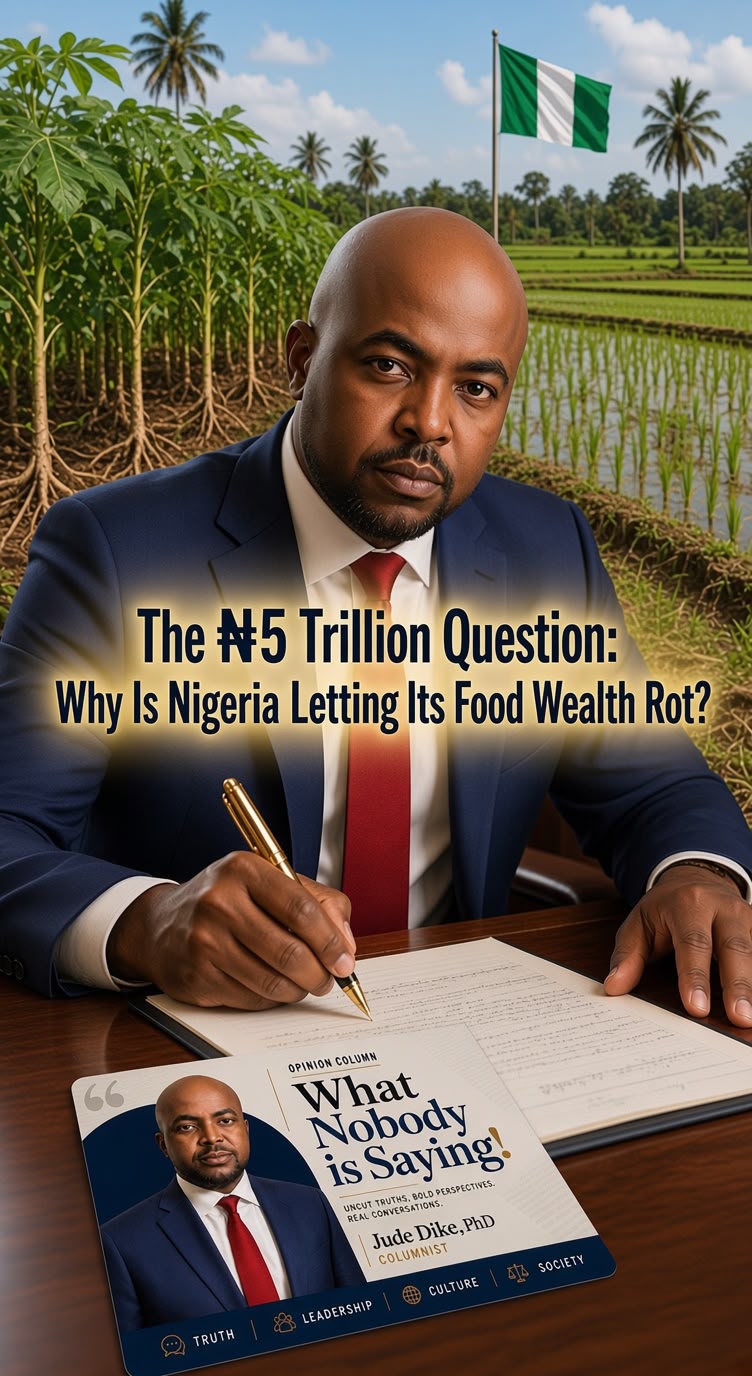
By Jude Dike, PhD
The country does not merely have a food-price crisis. It has a food-preservation crisis, a logistics crisis and a failure to protect the value of what its farmers already produce. The revolution Nigeria needs may begin not with another farm, but with the journey between the farm and the kitchen.
There is a peculiar Nigerian economic miracle that nobody should want. A farmer plants. The rain falls. Seeds germinate. Labour is supplied. Fertiliser is purchased, often at an unbearable price. A harvest arrives. Trucks are hired. Produce is loaded, transported and sent towards the market.
And then, somewhere between the farm and the dinner table, a portion of the nation’s wealth begins to disappear. Tomatoes soften in the heat. Vegetables wilt. Fish spoils. Fruits bruise. Tubers deteriorate. Traders who cannot sell quickly enough watch their capital decay in wooden crates. Farmers who have worked for months are forced to accept distress prices because they cannot preserve what they have grown.
By the time the food reaches the Nigerian consumer, the surviving produce must recover not only the cost of production, but also the cost of transportation, spoilage, unreliable electricity, expensive fuel, financing and every other inefficiency the economy has imposed on its journey.
Then the consumer arrives at the market, sees the price and asks the familiar question:
Why is food so expensive in a country that grows food?
That question is necessary. But it is no longer sufficient. The more important question is this: How much of Nigeria’s poverty is being manufactured after the harvest?
In February 2026, the Organisation for Technology Advancement of Cold Chain in West Africa reported that Nigeria lost an estimated 30 million to 40 million metric tonnes of food to post-harvest inefficiencies in 2025, putting the economic value of those losses between ₦3.5 trillion and ₦5 trillion.
Let us be precise. These are industry estimates reported in the media, not an independently audited national account. They should be verified through a transparent, commodity-by-commodity assessment. But even as estimates, they demand a level of public attention they have not received.
A country losing food on this scale has a problem far larger than poor storage. It has a problem of economic design.
And it raises an uncomfortable possibility: Nigeria may be destroying an enormous amount of wealth before that wealth has a chance to become income, employment, affordable food or export revenue.
The money is not only disappearing from government accounts. Some of it is disappearing from the national economy before anyone can count it.
The economy of what never arrives
In my previous columns, I have asked where the money went after fuel subsidy removal; why Nigerians remain poor in a resource-rich country; whether ordinary citizens can own a stake in the machinery generating their wealth; who is financing Nigeria’s growth; and why the small-business owner seems condemned to hustle without scaling.
These are not separate questions. They are chapters of the same economic story. Nigeria has repeatedly demonstrated an ability to create economic activity without building enough of the systems that convert activity into lasting prosperity.
We extract crude oil but struggle to translate oil wealth into broad-based industrial development. We produce agricultural commodities but fail to build sufficiently reliable systems for storage, processing, refrigeration and distribution. We celebrate entrepreneurs but leave many of them battling the infrastructure costs that prevent them from becoming productive, formal, job-creating enterprises.
We count what we produce. We count what we import. We count what government spends. But do we adequately count what we lose?
The World Bank’s October 2025 Nigeria Development Update found that the cost of a basic food basket had increased fivefold between 2019 and 2024. It also noted that poorer households can spend as much as 70 per cent of their income on food.
Those numbers are devastating when placed beside the reported scale of food losses. For a wealthy household, food-price inflation may mean a smaller restaurant bill or a more expensive shopping trip. For a low-income family, it can mean withdrawing a child from school, abandoning protein in favour of cheaper carbohydrates, reducing the number of meals or borrowing money to survive the month.
Food inflation is not merely a price statistic. It is a tax on the poor, paid in diminished nutrition, lost opportunities and human potential. And when food is lost after production, society pays twice: first for the resources used to produce it, and again through the scarcity and higher prices that can follow.
The relationship is not automatic. Better storage alone will not eliminate food inflation, which also reflects insecurity, exchange-rate movements, fuel and transport costs, climate shocks, market concentration and other constraints. But reducing avoidable losses is one of the few interventions that can simultaneously protect farmers’ earnings, improve market supply and reduce pressure on food prices.
Why, then, does food preservation still sit so far below the level of urgency attached to oil revenues, exchange rates and government borrowing?
The missing infrastructure between abundance and affordability
Nigeria’s agricultural debate has long been dominated by a seductive prescription: produce more. More hectares. More fertiliser. More improved seeds. More tractors. More irrigation. More loans to farmers.
These investments matter. Nigeria cannot feed its population sustainably without improving agricultural productivity. But producing more of a perishable commodity without improving the systems that preserve and distribute it can simply create more opportunities for waste.
Imagine a farmer who doubles tomato production but still has no affordable cold storage, no reliable route to market and no buyer willing to guarantee a price. The harvest may increase while the farmer’s bargaining power remains unchanged.
The country may have more tomatoes at the farm gate, yet still experience shortages in distant cities. Some produce will be sold cheaply under pressure. Some will deteriorate before reaching consumers.
Retail prices may remain stubbornly high because transport, energy and market inefficiencies have absorbed much of the potential benefit.
This is the paradox of agricultural abundance without an agricultural system.
A modern food economy is not simply a collection of farms. It is a network connecting farms to aggregation centres, warehouses, cold rooms, processors, transport operators, wholesale markets, retailers, supermarkets, restaurants and consumers.
Every broken link adds cost. Every missing link creates risk. The Nigerian government has already acknowledged the problem. In September 2025, the Federal Ministry of Information announced the Nigeria Postharvest Systems Transformation Programme, or NiPHaST, with plans involving household storage technologies, community warehouses, cold rooms and strategic national silos, including public-private partnerships.
That is a welcome policy direction. But announcing infrastructure is not the same as building a functioning market around it. A warehouse that farmers cannot afford to use is an expensive monument. A cold room without dependable maintenance and a viable operating model is a future equipment graveyard. A silo without transparent access rules can become another opportunity for political patronage.
The real test is not how many facilities the government commissions. It is how much food those facilities preserve, how many farmers use them, how much income farmers retain and whether consumers see a measurable improvement in affordability.
The question is no longer whether Nigeria needs post-harvest infrastructure. It is whether Nigeria can build it as an economic system rather than a collection of government projects.
The cold-chain revolution nobody should mistake for a luxury
There is a reason wealthy agricultural economies invest in refrigeration, controlled storage, processing facilities and reliable logistics.
They understand that time is an economic variable. A bag of grain can often be stored for a significant period under appropriate conditions. Fresh fish, leafy vegetables and ripe tomatoes operate under a much narrower window. The difference between selling today and selling tomorrow can determine whether a trader makes a profit or loses working capital.
For a smallholder farmer, the inability to preserve produce becomes a form of forced selling. The farmer must accept the price offered now, even when it is unattractive, because waiting is too expensive. Whoever controls storage, transport, information and access to buyers often enjoys a stronger negotiating position than the person who grew the food.
This is where the food-loss problem intersects with the question of ownership raised in the Dangote IPO debate. Who owns the infrastructure that turns agricultural output into durable wealth?
If the cold rooms, processing plants, warehouses, logistics platforms and distribution networks are inaccessible to small producers, the farmer remains a supplier of raw commodities with little control over the value chain.
If these systems are designed well, they can create an entirely new class of Nigerian enterprises: cold-chain operators, rural logistics companies, food processors, warehouse managers, refrigeration technicians, packaging manufacturers and technology businesses connecting farmers to buyers.
Food preservation can become an industrial policy.
And because the need exists across Nigeria and other African economies, it can also become a regional export opportunity.
This is not an argument for government to own every cold room. It is an argument for government to ensure that the infrastructure is available, competitively priced, properly regulated and accessible to the people who need it most.
A useful model already exists in miniature. ColdHubs, a Nigerian cold-chain enterprise, reported operating 58 solar-powered cold rooms in 2024, serving more than 11,100 farmers, retailers and wholesalers and using refrigerated trucks to support distribution.
Its reported impact is not proof that one company can solve a national problem. It is evidence that practical models for extending the shelf life of food can operate in Nigeria.
The policy challenge is to make such solutions easier to finance, replicate and connect to functioning markets. And this is where the revolution must become concrete.
Five reforms that could turn food loss into national wealth
Nigeria does not need another grand declaration about agricultural transformation. It needs measurable obligations, transparent financing and institutions that can be held accountable.
First, establish a National Food Loss and Waste Account.
The National Bureau of Statistics, the Federal Ministry of Agriculture and Food Security, state agriculture ministries, research institutions and independent technical organisations should jointly produce a public annual account of post-harvest losses.
The account should distinguish between crops and commodities, regions, seasons, farm-level losses, transport losses, storage losses and losses during processing and retail. It should report the methodology, uncertainty ranges and changes over time.
The reported ₦3.5 trillion–₦5 trillion estimate should be a starting hypothesis to investigate, not a number to repeat indefinitely without verification.
Nigeria cannot manage what it does not measure. Nor should it commit public money on the basis of numbers that cannot be independently examined. Every year, Nigerians should know how much food was lost, where it was lost, why it was lost and how much of that loss public policy helped prevent.
Secondly, create a national network of commercially viable, open-access food hubs.
Government should identify high-volume agricultural production zones and connect them to consumption centres through strategically located aggregation, storage, cold-chain and processing facilities.
These hubs should not be allocated as political rewards. They should be selected using transparent criteria: production volumes, existing transport routes, market demand, electricity availability, farmer access and expected reductions in spoilage.
The private sector should be allowed to build and operate facilities under transparent contracts. Cooperatives, small businesses and independent farmers should have access under published pricing rules.
Where public funds support construction or operations, contracts should disclose the subsidy, the operator, the expected number of users and the performance obligations.
No politician should be able to claim success because a building has been completed while farmers continue to lose their harvest outside its gates.
Thirdly, finance preservation as productive infrastructure, not as a charitable favour to farmers.
Many small farmers and traders cannot finance cold storage, modern packaging, quality testing or refrigerated transportation from their own balance sheets.
The government, the Nigerian Agricultural Development Fund and participating financial institutions should develop targeted financing for viable post-harvest investments, with clear eligibility rules and independent oversight.
That financing could support equipment leasing, shared cold rooms, warehouse infrastructure, refrigerated transport, processing machinery and energy-efficient storage.
Public support should be tied to demonstrated performance, not political connections. Loans and guarantees should be published in aggregate, independently audited and evaluated for additional investment and actual reductions in losses.
Solar-powered refrigeration and efficient cooling systems deserve particular attention in locations where grid electricity is unreliable or costly. But technology choices must be based on lifecycle costs, maintenance capacity, local conditions and affordability, rather than fashionable labels.
The objective is simple: make it cheaper to preserve a harvest than to lose it.
Fourthly, turn warehouse receipts and agricultural insurance into instruments of bargaining power.
A farmer who can store properly graded produce in a certified warehouse should be able to obtain a credible warehouse receipt and use it, where lenders accept it, as collateral for short-term finance.
This could reduce the pressure to sell immediately after harvest, when local markets are sometimes over supplied. But a warehouse receipt is only as valuable as the institution behind it. Nigeria needs reliable inspection, grading standards, insurance arrangements, warehouse regulation and enforceable claims against stored commodities.
Agricultural insurance should also be strengthened to cover clearly defined risks associated with storage, transport and other post-harvest operations where commercially feasible.
The goal is not to guarantee every farmer a profit. It is to reduce avoidable risks and give producers more choices about when, where and to whom they sell.
Fifthly, make food affordability a measurable test of agricultural policy.
The government should stop treating the number of tractors purchased, hectares cultivated or tonnes harvested as sufficient evidence of success.
The relevant questions are harder. Did the farmer’s share of the final selling price improve? Did the amount of food lost between harvest and sale decline? Did transportation and storage costs fall? Did more small producers obtain reliable market access? Did real consumer prices become more affordable?
Federal and state governments should publish annual food-system scorecards, with independently verified baseline figures and targets for the following year.
Public procurement and infrastructure contracts should be linked to measurable performance wherever appropriate. Projects that fail to meet their obligations should trigger corrective action, contract review or other remedies provided for in the agreements.
This is how an agricultural programme becomes an economic institution rather than a political announcement.
The political economy of a rotten tomato
There is another dimension to this problem, and it is less comfortable than the discussion of warehouses.
Inefficiency creates beneficiaries. When a market is fragmented, information is poor and farmers have few alternatives, some intermediaries can exploit the imbalance.
When access to storage depends on connections, those connections become valuable. When transport is unreliable, those who control scarce logistics capacity can acquire greater pricing power.
This does not mean that every trader is exploiting farmers. Traders perform essential functions and often absorb genuine risks. Nor does it mean that high prices are evidence of collusion. It means that the structure of the market matters.
An efficient food system should reward people for preserving quality, reducing risk, improving logistics and connecting supply to demand. It should not make a farmer’s lack of alternatives the foundation of somebody else’s advantage.
Nigeria therefore needs competition policy alongside infrastructure investment. Authorities should investigate credible evidence of anticompetitive conduct, improve market-price information and make it easier for farmers and cooperatives to compare buyers. Digital platforms can help, but only if the information is accurate and farmers can access the technology without prohibitive costs.
The objective is not to abolish middlemen. It is to make the market contestable enough that farmers have alternatives and consumers are not forced to pay for avoidable inefficiency.
There is a profound difference between a trader earning a legitimate margin for moving food efficiently and an entire economy being organised around the absence of better choices.
What this has to do with Nigeria’s debt?
Everything.
In the column on Nigeria’s borrowed-money economy, the essential question was whether the country could keep financing obligations without generating enough productive capacity to support them.
Food loss presents the same question from the other side of the ledger. Nigeria cannot borrow its way into prosperity if it continually wastes productive resources. Nor can it solve every cost-of-living crisis through transfers and temporary interventions while the systems that generate and distribute food remain inefficient.
Social protection is indispensable for households facing hunger. Emergency food assistance can be necessary. Cash transfers can help families manage shocks. But relief cannot substitute for a productive food economy.
If Nigeria invests in infrastructure that measurably reduces losses, it can potentially protect existing agricultural output, improve the reliability of supply, expand processing and support employment.
Those benefits must be demonstrated, not assumed. Not every cold room will be profitable. Not every warehouse will reduce consumer prices. Poorly designed projects can waste public funds just as readily as the losses they were intended to prevent.
That is precisely why transparent evaluation matters.
The country needs to compare the cost of prevention with the cost of continuing to lose food, including the consequences for farmer income, nutrition, public support programmes and domestic production.
The correct question is not whether every naira invested in storage will pay for itself. It is whether Nigeria can identify the investments with the highest verified social and economic returns and fund them without creating another opaque spending programme.
A country that borrows to finance consumption while neglecting productive infrastructure is leaving tomorrow to pay for today’s avoidable losses.
Africa’s opportunity is larger than Nigeria’s problem
The implications extend beyond Nigeria.
Across Africa, agricultural transformation is often discussed in terms of yields, improved seeds, fertiliser, irrigation and access to credit. These remain essential. But the journey from production to consumption deserves equal attention.
The African Continental Free Trade Area creates a framework for expanding regional commerce. Yet regional agricultural trade cannot reach its potential if producers cannot preserve food long enough to transport it, meet quality standards or aggregate sufficient volumes for reliable buyers.
A farmer in one African country should be able to sell to a processor or distributor in another without losing a large share of the shipment to inadequate storage and logistics.
That requires more than trade agreements. It requires compatible standards, reliable border procedures, regional transport infrastructure, quality certification, cold-chain investment and predictable rules.
Nigeria, with its large domestic market and entrepreneurial base, could help develop commercially viable models that other African markets can adapt. But leadership will not come from declaring Nigeria the food basket of Africa. It will come from demonstrating that African food can move across African markets efficiently, safely and profitably.
The opportunity is not only to sell more food. It is to build the industries that preserve, process, package, finance and distribute it.
That is how a harvest becomes industrial capacity.
The revolutionary demand
Let us be clear about what the revolution should be. It is not a demand for another slogan. It is not an excuse for another emergency committee. And it is not a call to throw public money at anyone who promises to build a warehouse. It is a demand to change what Nigeria considers an economic achievement.
For too long, the public has been asked to celebrate production figures, budget allocations, projects commissioned and growth rates without always being shown the value that survives the journey from public spending to private prosperity.
The next phase of reform must insist on outcomes.
I propose a national five-year Food Preservation and Market Access Compact, jointly implemented by federal and state governments, with participation from farmers’ cooperatives, private investors, processors, logistics operators, research institutions and development partners.
The compact should begin with a verified national baseline. It should select pilot commodity corridors according to evidence. It should publish project costs and contracts. It should set independently evaluated targets for reducing losses, improving farmer incomes and expanding market access. It should publish annual results, including failures.
Where public support is justified, it should prioritise underserved agricultural communities and open access rather than political patronage.
Where private operators can provide the service competitively, they should be allowed to do so under clear rules.
Where a project repeatedly fails to deliver, the public should know why and what corrective action follows.
And where the evidence shows that a model works, government should help replicate it without pretending that every region requires the same solution.
The federal government should publish the first national food-loss baseline and implementation framework within 12 months. States should identify priority commodity corridors, while independent evaluators should report annually on the results.
The National Assembly should require public reporting on the money allocated, the infrastructure delivered, the facilities actually used and the food preserved.
This is not an invitation to create another bureaucracy. It is a demand that existing institutions become accountable for a problem that affects nearly every household.
The public should also insist that farmers’ organisations and market traders have a formal voice in the design of these policies. Too many development programmes fail because they are designed around what officials believe farmers need rather than what producers and traders can realistically use.
The revolution begins when the people who grow and move food stop being treated as the last beneficiaries of agricultural policy and become its central decision-makers.
What nobody is saying
There is something almost tragic about a country in which a farmer can do everything society asks of him and still remain poor because the systems around him do not work.
He can cultivate the land, purchase the inputs, endure the weather, survive insecurity and produce a harvest. Yet without storage, transport, affordable finance and reliable buyers, the economic value of his labour can evaporate before he receives a fair return.
Then the consumer pays a higher price. The trader loses capital. The processor struggles to secure consistent supply. The government faces another demand for intervention.
And the economy calls this normal. It is not normal. It is a development failure.
Nigeria’s economic argument has spent years asking how to distribute the proceeds of growth, how to stabilise the currency, how to finance government and how to encourage investment.
Those questions remain essential.
But we must also ask why so much of the value created by ordinary Nigerians fails to survive long enough to become prosperity.
A nation does not become wealthy merely by producing more. It becomes wealthy by building the institutions that preserve, multiply and fairly distribute the value of what it produces.
The tomato that rots in Jos is not merely a tomato. It is the farmer’s lost income, the trader’s lost capital, the consumer’s lost opportunity and the country’s lost productive capacity.
The fish that spoils in Onuaboh – Delta State, is not merely wasted food. It is wasted fuel, labour, equipment, finance and time.
The grain that deteriorates is not merely a storage problem. It is a failure to protect the economic value of an entire production cycle.
And the child who goes to bed hungry in a country that could have preserved more of its harvest is a reminder that economic inefficiency is never merely technical. It has a human cost.
Nigeria has spent decades searching for the next engine of growth. Perhaps part of that engine is already sitting in our farms, markets and warehouses, waiting for us to stop wasting it.
We have debated who owns the oil. We have debated who benefits from subsidy removal. We have debated who owns the refineries, who finances government and why small businesses fail to grow.
Now we must ask who owns the systems between the harvest and the household.
Because the next great Nigerian economic reform may not begin by discovering another resource.
It may begin by refusing to lose the value of the resources we already have. A country that cannot preserve its harvest cannot fully preserve its wealth. And a government that wants citizens to believe in economic reform must prove that the food they grow will reach a market, that the market will reward their labour, and that the food on the table will no longer carry the hidden price of a broken system.
That is the question nobody is saying loudly enough. It is time to say it.
*Jude Dike, PhD, writes the “What Nobody Is Saying” column on Nigeria’s political economy, public accountability, wealth creation and inclusive development.