

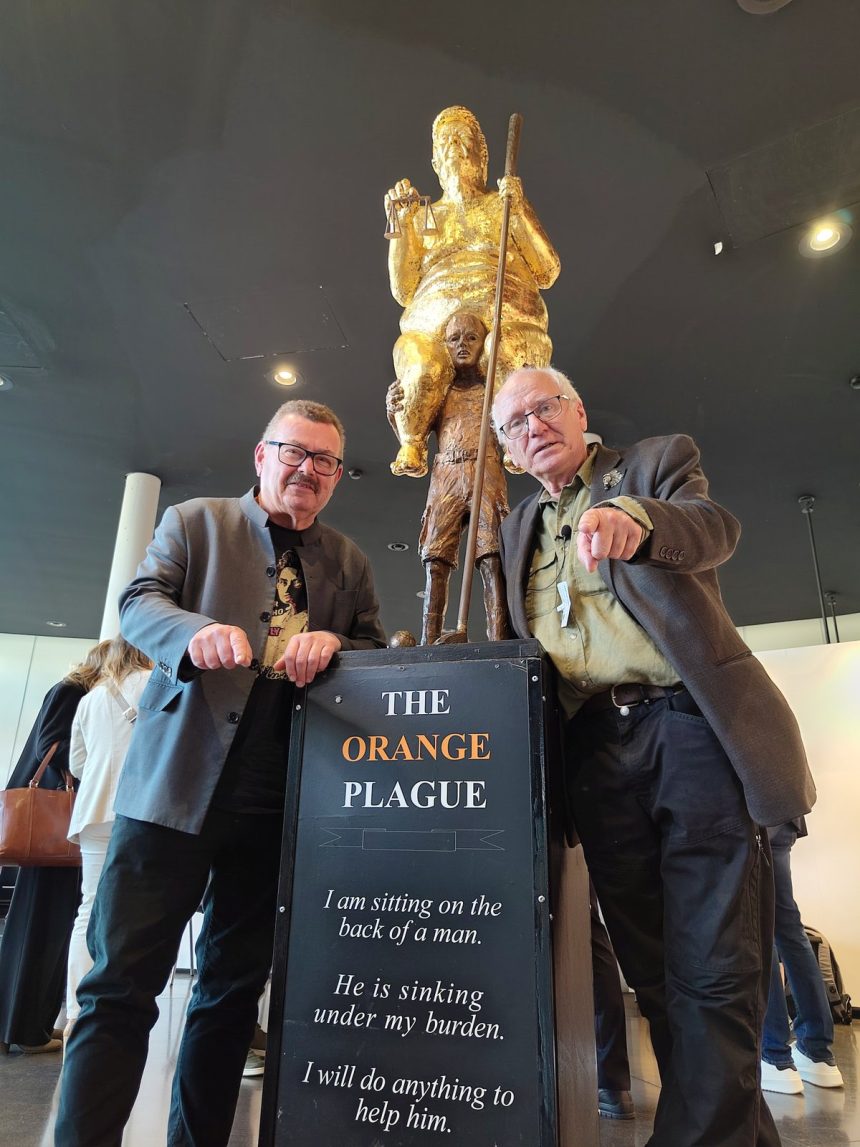
*Per Clausen (left), a Danish MEP, and the artist Jens Galschiøt (right) pose with the The Orange Plague sculpture at the European Parliament building in Strasbourg, France
Photo courtesy Jens Galschiøt
Danish artist Jens Galschiøt has unveiled The Orange Plague, a 2.6m-tall sculpture depicting US President Donald Trump in the nude and sitted atop the shoulders of a frail man, inside the European Parliament building in Strasbourg, France.
In an oblique reference to the US President love of gold, the sculpture is covered in 23-carat gold leaf and depicts the Trump figure holding tiny scales of justice in one hand and a golf club in the other. A golf-ball-sized globe sits at the feet of the smaller, frail man below him, who is rendered in bronze.
Galschiøt also gave out 3D-printed miniatures of the sculpture to visitors of the Strasbourg exhibition.
The sculpture was installed on a plinth labelled with the work’s title and a caption that reads: “I am sitting on the back of a man. He is sinking under my burden. I will do anything to help him. Except stepping down from his back.”
The artist told journalists that the work was inspired by Hans Christian Andersen’s The Emperor’s New Clothes, a fairy tale in which an emperor is convinced to buy “invisible” clothing that is in fact non-existent.
While people applaud the naked king, “a little boy says, ‘He has no clothes on,’ and then everyone begins to laugh at him”, Galschiøt tells The Art Newspaper. He adds that when he unveiled The Golden Plague, the sculpture was also met with laughter and applause.
The sculpture is the centrepiece of a three-day exhibition hosted by Per Clausen, a Danish member of the European Parliament (MEP). All visitors receive a 3D-printed miniature of the sculpture to take home. Galschiøt says he printed around 20,000 sculptures that he distributed not only to visitors but also to staff throughout the European Parliament.
Galschiøt has also made the design files free for anyone who wants to print their own.
The artist said he was inspired to distribute the miniatures by the Democracy Movement in Hong Kong, which 3D-scanned and printed hundreds of miniature versions of his 1997 sculpture The Pillar of Shame, which commemorates human rights violations including the Tiananmen Square massacre. These miniature pillars appeared across Hong Kong after the original sculpture was seized and disassembled.
“Normally I attack systems, but in this case, I will attack Trump personally,” Galschiøt says. “Now we put the gold on him,” the artist says, adding that the resulting image is “even more ridiculous than before.
“Trump is shining so much that nobody can see other people.”
The Orange Plague was previously displayed at the “hands off Greenland” demonstrations in Copenhagen earlier this year and the CopP30 UN Climate Summit in Belém, Brazil last year. After the present installation in Strasbourg, Galschiøt plans to exhibit The Orange Plague again at the Cop31 UN Climate Conference next month Antalya, Türkiye.
“Nations as well as NGOs are afraid to openly raise the subject [of] how to deal with Trump and his policies, fearing tariffs, fund-cuts, deportations or the like,” Galschiøt wrote on his website. “As an independent art workshop we are not restricted by such bonds. This sculpture has been made to address ‘the elephant in the room’ and start a necessary debate [about] how the US is destroying the world’s only chance to counter the climate catastrophe.”
A spokesperson for the European Parliament told CNN that the exhibition of Galschiøt’s sculpture had been approved by the parliament’s quaestors, a cross-party group of MEPs that handles administrative decisions. “Each MEP is entitled to sponsor two cultural events or exhibitions per parliamentary term in dedicated areas,” the spokesperson added.
Galschiøt’s work follows in a long line of protest art targeting Trump in the decade since he launched his 2016 presidential campaign, much of it brightly gilded, depicting him fully or nearly nude—and, occasionally, both.
Galschiøt, who said he feared the application to exhibit the sculpture would be rejected, said he considers the green-light to be a form of tacit approval from Europe’s parliamentarians.
“I think a lot of American people say, ‘OK, this is our president, but he’s also ridiculous in a way.’ And I think most Europeans see him like that, too,” he said.
Clausen, the exhibition’s sponsor and a member of Denmark’s MEP contingent, said the response to the show has been good.
“I think we need to have a discussion about power in the world and how this power is used,” he told CNN on the phone from Strasbourg. “The way Trump acts is a very, very big problem for people in Europe. I want to raise the discussion in Europe about how we can make our self-defense against Trump, and how can we make politics that is not dependent on him.”