
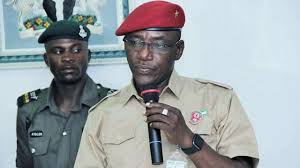
ADC chieftain Solomon Dalung’s penchant for attacking and ridiculing his successors in office and President Bola Tinubu’s Renewed Hope Agenda strains the descriptive power of any single adjective. Olukayode Thomas reminds Dalung, whose performance as Sports Minister was widely criticised and marked by numerous controversies, that those who live in glass houses should not throw stones.
Introduction
Thirteen years after it was written, The Hypocrisy of Yesterday’s Men, an article by my senior colleague Reuben Abati, published in Premium Times on February 2, 2013, remains remarkably relevant. Abati’s observations aptly capture Dalung’s fierce and often unreasonable criticism of virtually every policy associated with President Tinubu, particularly the Renewed Hope Agenda in sports and Tinubu’s leading figures in the sector, Shehu Dikko, Chairman of the National Sports Commission (NSC), and Bukola Olopade.
What makes Dalung’s criticism even more striking is that it comes from a former Sports Minister whose record in office, seven years after leaving power, continues to evoke memories of administrative blunders, controversies and missed opportunities.
His latest attack followed Nigeria’s failure to secure the hosting rights for the 2031 African Games, which were awarded to Uganda.
Abati, then Special Adviser on Media and Publicity to President Goodluck Jonathan, wrote:
“A loosely bound group of yesterday’s men and women seems to be on the offensive against the Jonathan administration. They pick issues with virtually every effort of the administration, pretending to do so in the public interest, positing that they alone know it all.
“Arrogantly, they claim to be better and smarter than everyone else in the current government. They are ever so censorious, contrarian and supercilious.
“They have no original claim to their pretensions other than they were privileged to have been in the corridors of power once upon a time in their lives. They obviously got so engrossed with their own sense of importance that they began to imagine themselves indispensable to Nigeria.
“It is dangerous to have such a navel-gazing, narcissistic group inflict themselves with so much ferocity on an otherwise impressionable public. We are, in reality, dealing with a bunch of hypocrites.”
Dalung’s latest outburst
In an interview with The Guardian on June 8, 2026, following the announcement that Uganda would host the 2031 African Games, Dalung launched a blistering attack on the National Sports Commission.
For a man named after the biblical King Solomon, one would expect a more measured assessment of a process as complex and politically nuanced as international sports bidding.
Listen to Dalung: “Bidding to host an international competition is not strange to us.
“We’ve done it before, and so there is a precedent for how these things are done.
“All we needed to do was to update it to the contemporary situation. But if we decided to embarrass the country this way, then what is manifest is that incompetence has been reenacted at a monumental stage, and it’s sad and embarrassing that such a thing could happen to Nigeria.
“But I am not that disappointed at the performance of the NSC because they were blackmailing the ministry that the performance of the ministry was abysmal because of the absence of the NSC; the absence of professionals, the absence of this and the absence of that.
“So that is the peak of the incompetence, and I think that the President needs to understand the significance of the ministry because when the ministry supervised, it kept them on their toes.”
The comments were vintage Dalung: sweeping, accusatory and delivered with absolute certainty. Yet they also raised an obvious question: does a former Sports Minister whose tenure was dogged by crises, disputes and international embarrassments possess the moral authority to lecture others on competence?
Dalung’s penchant for attacking successors and benefactors
For those familiar with his public conduct, it was hardly surprising that Dalung turned his guns on Dikko and Olopade. As one of the most vocal critics of the Tinubu administration’s sports agenda, he rarely misses an opportunity to attack those currently entrusted with managing the sector.
Since President Muhammadu Buhari elevated him from his position as a legal officer in the Correctional Service to national prominence in 2015, Dalung has cultivated a reputation for publicly criticising both his successors and, at times, even his benefactors.
Sunday Dare, who succeeded him as Sports Minister, endured repeated attacks. During the AFN leadership crisis, while Dare supervised the process that produced Tonobok Okowa in Abuja, Dalung was in Birnin Kebbi backing Ibrahim Gusau as a rival president.
John Owan Enoh, who succeeded Dare, has also not escaped Dalung’s criticism.
Nor were his contemporaries spared. While in office, Dalung frequently clashed with former NFF president Amaju Pinnick. The same pattern played out with outgoing Basketball Federation president Musa Kida.
Even Buhari, the man who appointed him minister, has found himself on the receiving end of Dalung’s sharp tongue.
In an interview cited by Leadership newspaper on June 5, 2026, under the headline “We Lied to Nigerians, Buhari’s Ex-Minister Dalung Reveals,” Dalung admitted that the Buhari administration misled Nigerians during its eight years in office.
According to the report, he made the comments during an appearance on the Mic On Podcast hosted by television presenter Seun Okinbaloye.
Embarrassing Nigeria with public gaffes
If there was one area in which Dalung excelled during his tenure, it was generating headlines through public gaffes.
Many Nigerians still remember his description of the country as the “United States of Nigeria” instead of the Federal Republic of Nigeria.
There was also his memorable defence before the House of Representatives Committee:
“The funds spended was properly spended because we got them from intervention funds from Mr. President.”
Ahead of the 2018 FIFA World Cup in Russia, Dalung declared after a Federal Executive Council meeting that:
“Argentina is one of the highly ranked football associations of Nigeria.”
The statement quickly became the subject of widespread ridicule.
Dalung will also be remembered as the Sports Minister who failed to make adequate provision for the allowances of the Super Falcons despite the team entering a continental tournament as defending champions.
When questioned, he responded:
“Don’t forget that nobody even knew the team would emerge victorious; if we were confident they would emerge victorious, all the Federation would have done is to plan for the process of participation and entitlement.”
Similarly, after Nigeria’s Paralympians excelled at the Rio Olympics, he remarked during an interview with Brila FM:
“The disabled athletes have shown that all you need is a winning mentality and not too much preparation.”
On the appointment of Gernot Rohr as Super Eagles coach, Dalung again raised eyebrows when he declared: “I am not aware we have a new coach.”
On April 6, 2016, he generated another controversy when he posted photographs from a football match at an IDP camp and referred to the location as Gongola State—a state that ceased to exist in 1991 following the creation of Adamawa and Taraba States.
Before Buhari’s cabinet was dissolved ahead of a second term, Dalung had confidently declared:
“No, there is nobody born of a woman that can stop my appointment if God wants it to be. I am not carried away by such sentiments.”
History, of course, had other ideas.
Dalung and the IAAF’s ‘missing’ $135,000
Dalung described the current leadership of the NSC as incompetent. That criticism, however, inevitably invites scrutiny of his own stewardship of Nigerian sports.
One episode that continues to cast a shadow over his tenure was the controversy surrounding the disappearance of funds mistakenly transferred to the AFN by the IAAF, now known as World Athletics.
How does one describe a Sports Minister under whose watch the world governing body for athletics mistakenly transferred $150,000 to the AFN instead of the intended $20,000 grant, only for the excess funds to become the subject of an international dispute?
The embarrassing episode began in 2017 when the IAAF said it had overpaid the AFN by $130,000.
In a letter to the federation, the IAAF’s Senior Manager for Governance, Jee Isram, wrote:
“You were informed on 18 March 2018 by our CEO of a payment made by the IAAF to the bank account of your federation on 17 May 2017. A sum of 150,000 US Dollars was transferred by the IAAF, of which 130,000 US Dollars were wrongfully credited.
“We promptly notified you of this overpayment and followed up with several written correspondences as well as a meeting with you in November 2017, requesting that you reverse the bank transfer for the overpaid amount, to no avail.”
The controversy quickly escalated and threatened Nigeria’s standing in international athletics.
Yet when World Athletics demanded answers and threatened sanctions, Dalung appeared more concerned about the channel through which the complaint was communicated than the substance of the allegation itself.
He responded: “If the IAAF are writing a letter raising an issue affecting my office, it is fair that they send a copy of that letter to me. All they did was go and post a letter on social media. Does the government communicate or run its business on social media?”
For many observers, that response missed the point entirely. The issue was not social media. The issue was the whereabouts of funds that an international federation had repeatedly requested to be returned.
Sources later revealed that the money was eventually paid back during the tenure of Dalung’s successor, Dare.
It is therefore difficult to reconcile Dalung’s present-day lectures on competence with controversies such as this, which unfolded under his direct watch as Sports Minister.
Russia 2018 World Cup and the contradictions of Dalung
If there is one episode that best illustrates what critics describe as Dalung’s inconsistency, it is Nigeria’s participation at the 2018 FIFA World Cup in Russia.
Before the Super Eagles secured qualification, Dalung’s view of the competition was unambiguous.
He declared: “That competition stinks of corruption; Nigeria is too poor to waste money on it.
“The cup that we can win is the African Cup of Nations. There is nothing again that will take us to another man’s balcony in the name of the World Cup. We already have the Commonwealth Games and the Olympics. For these, we can attend such meetings. But I am opposed to the World Cup. We don’t agree to it. Conspiracy in the World Cup is too much.”
It was a remarkable position for the Sports Minister of a football-loving nation whose greatest moments on the global stage have often come through the game.
Yet almost immediately after the Super Eagles qualified for Russia 2018, Dalung’s tone changed dramatically.
The same tournament he had dismissed as corrupt and unworthy of Nigeria’s participation suddenly became important enough to justify significant government spending.
Dalung announced that Nigeria’s participation would cost approximately N3 billion, with FIFA expected to provide N900 million, sponsors contributing N600 million and the Federal Government making up the balance.
The obvious question was: what changed?
If the competition was truly riddled with corruption and not worth attending, why was the government suddenly expected to commit billions of naira to it?
If Nigeria was too poor to participate before qualification, what made participation financially sensible after qualification?
Those questions were never satisfactorily answered.
Even after being reminded by football buffs that the World Cup is largely an expenses-paid tournament for participating countries, Dalung pressed ahead with plans to raise additional funds.
He also proposed a fundraising dinner for the Super Eagles without securing the consent of the football authorities responsible for managing the national team.
The contradiction was difficult to ignore.
Before qualification, the World Cup was portrayed as a wasteful venture. After qualification, it became an event worthy of government expenditure, fundraising campaigns and extensive official attention.
That inconsistency remains one of the clearest examples cited by those who accuse Dalung of saying whatever is politically convenient at a particular moment.
The years of the locust
An article of this nature cannot fully capture the controversies, disputes and administrative failures that characterised Dalung’s years as Sports Minister.
To comprehensively document them would require far more than a single opinion piece.
His tenure was repeatedly overshadowed by unresolved disputes involving sports federations, athlete welfare concerns and unpaid allowances.
The issue of welfare alone—particularly as it affected elite athletes representing Nigeria at international competitions—would deserve a chapter of its own.
The women’s national basketball team, D’Tigress, repeatedly battled issues relating to funding and welfare.
Several sports federations operated in an atmosphere of uncertainty and conflict.
There were recurring complaints about inadequate planning, poor coordination and insufficient funding, resulting in withdrawals, sanctions threats and avoidable embarrassments on the international stage.
Perhaps no episode symbolised the dysfunction of the period more than Team Nigeria’s participation at the 2016 Rio Olympics.
What should have been a celebration of Nigerian sporting excellence became a global public relations disaster.
The Nigerian U-23 football team, popularly known as the Dream Team, was stranded in Atlanta, Georgia, after problems arose over transportation arrangements and funding.
For days, the story dominated international headlines.
The image of a Nigerian team struggling to reach the Olympic Games because of administrative failures became a source of national embarrassment.
Yet when Dalung was asked why emergency funds had not been released quickly to assist the team, his response stunned many Nigerians.
He asked: “Who took them there? What are they there for? Because they are under 23 and they went to the US. Now they are having problems; does that become our business?”
Ironically, the same team that struggled for support from the authorities went on to win Nigeria’s only medal at the Rio Olympics—a bronze medal in football.
The episode remains one of the most enduring symbols of a ministry often accused of reacting to crises rather than preventing them.
Nor was Rio an isolated incident.
Nigeria’s failure to qualify for the Africa Cup of Nations during parts of Dalung’s tenure, persistent disputes across sports federations and recurring complaints from athletes all contributed to a period many sports stakeholders would rather forget.
One could continue listing the controversies associated with the era. The point, however, is not merely to revisit old failures.
It is to ask whether a former minister whose tenure generated so many controversies should be so eager to position himself as the ultimate judge of those currently managing Nigerian sports.
Abati’s last words for hypocrites and the reality of losing hosting bids
Whether Nigeria lost the bid for the 2031 African Games or ultimately withdrew from the process is a matter that deserves scrutiny.
However, a sports journalist genuinely interested in the progress of Nigerian sports under the Tinubu administration should be more concerned with whether Dikko and Olopade are laying the foundation for a sustainable sports economy than with turning a failed bid into evidence of national catastrophe.
This reporter does not possess all the details surrounding Nigeria’s bid. Equally, The Guardian report that portrayed the bid as poorly prepared relied heavily on anonymous sources and offered little verifiable evidence to support its conclusions.
More importantly, the history of international sports hosting demonstrates that losing a bid is not, in itself, proof of incompetence.
Even a casual student of sports politics understands that the quality of a bid does not always determine the winner.
Qatar and Russia famously defeated the United States and England respectively in the race to host the FIFA World Cup.
Subsequent investigations revealed that the bidding process was deeply compromised, leading to one of the biggest scandals in football history and contributing to the downfall of several powerful figures within FIFA.
Morocco, despite possessing some of Africa’s finest sporting infrastructure, failed in its bids to host the FIFA World Cup in 1994, 1998, 2006 and 2010 before eventually becoming part of the successful 2030 hosting arrangement.
Turkey suffered repeated disappointment in its quest to host the Olympic Games, losing bids for the 2000, 2004, 2008, 2012 and 2020 editions.
South Korea’s city of PyeongChang failed in its attempts to host the 2010 and 2014 Winter Olympics before finally succeeding with the 2018 Games.
Paris, one of the world’s most iconic cities, endured unsuccessful Olympic bids for both the 2008 and 2012 Summer Games before eventually securing the rights to host the 2024 Olympics.
The lesson is obvious. Losing a hosting bid is not unusual. Many countries with stronger economies, superior infrastructure and greater experience have lost multiple bids before eventually succeeding.
That reality makes Dalung’s attempt to portray Nigeria’s failure to secure the 2031 African Games as definitive proof of incompetence look more like political point-scoring than serious analysis.
The more important question is whether the current leadership of the NSC is building structures capable of transforming sports into a major contributor to the national economy.
That is where the real conversation should be.
Hosting rights come and go. Sports infrastructure, athlete development programmes, private-sector investment and sustainable governance are what ultimately determine whether a country’s sports sector succeeds.
As for Dalung and other members of what Abati memorably described as “yesterday’s men”—individuals whose records in public office remain highly contested but who now present themselves as guardians of public morality—the advice offered by Abati more than a decade ago remains relevant today.
Hear him: “The quantity surveyor returns to his or her quantity surveying or some other decent work; the lawyer to his or her wig and gown; the university teacher to the classroom, glad to have been found worthy of national service.
“When and where necessary, as private citizens, they are entitled to use the benefit of this experience to contribute to national development; they speak up on matters of public importance, not as a full-time job, as is the case in Nigeria currently.
“These yesterday men and women certainly don’t seem to care very much about the Nigerian taxpayer who has had to bear the brunt of the many scandals this administration is exposing in its bid to clear out the Augean stable. Our advice caveat to their audience is the same old line: ‘Let the buyer beware!’”
Those words are perhaps even more relevant today than when they were first written.
Criticism is an essential part of democracy, and former public officials have every right to comment on national affairs. But criticism carries greater weight when it comes from individuals whose own records can withstand scrutiny.
That is the challenge facing Dalung.
Before casting himself as the chief prosecutor of those currently running Nigerian sports, he must contend with the legacy of a tenure remembered for administrative controversies, athlete welfare disputes, public gaffes, funding crises and international embarrassment.
On a final note, Dalung need not search far for an example to emulate. Babatunde Raji Fashola, his former colleague in the Buhari cabinet, has quietly returned to legal practice after leaving public office.
Dalung, also a lawyer, may find similar fulfilment in dusting off his wig and gown rather than risking the fate Abati warned against more than a decade ago—that of yesterday’s men who refuse to leave yesterday behind.