
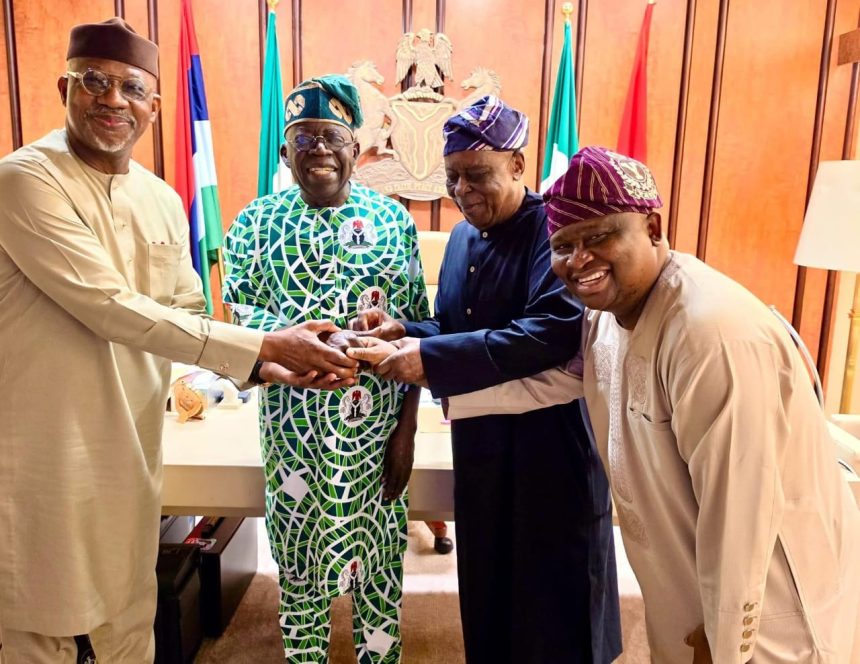
*(L-R) Governor Dapo Abiodun, President Tinubu, Chief Segun Osoba and Solomon Olamilekan Adeola
By Mikail Mumuni
Politics in Nigeria, and particularly in Ogun State, has a curious habit of transforming questions that ought to be settled by facts, records and the law into emotional battles over identity. The latest controversy being stirred against Senator Solomon Olamilekan Adeola, popularly known as Yayi, over his state of origin falls squarely into this familiar pattern.
As the 2027 governorship election approaches, some political actors and groups have questioned Yayi’s claim to Ogun indigeneship. They argue that his long political association with Lagos renders his roots in Ogun West suspect. Others, including the Ogun State chapter of the All Progressives Congress (APC) and various groups supporting the senator—who has emerged as the party’s governorship candidate—have dismissed the allegation as politically motivated.
There is no dispute that Yayi’s political career was largely built in Lagos. He represented Alimosho in the Lagos State House of Assembly, later served as member representing Alimosho Federal Constituency in the House of Representatives, and subsequently became senator for Lagos West. In 2023, however, he successfully contested and won the Ogun West senatorial seat. He currently represents that district and has secured the APC ticket for the 2027 Ogun governorship election, in which he is widely regarded as a frontrunner.
It is understandable that his growing acceptance among the Ogun electorate has unsettled opponents. They appear prepared to deploy every available weapon against him, including the questioning of his indigene status. Yet political history is not, by itself, proof of ancestry. A politician can build a career in one state and later return to, or seek office in, another state to which he has legitimate familial or ancestral ties. Nigeria’s political landscape is replete with such examples. One notable case is that of Ogbeni Rauf Aregbesola, a long-serving former Lagos State Commissioner for Works, who later returned home to become Governor of Osun State.
The APC has maintained that Yayi possesses both maternal and paternal connections to Ogun, including links to Abeokuta and Yewaland. An Ogun group has publicly reaffirmed his claim to Ilaro and described him as a bona fide indigene. Several prominent stakeholders in the state, among them the Alake of Egbaland, Oba Adedotun Aremu Gbadebo III and the Olu of Ilaro and Paramount Ruler of Yewaland is Oba Kehinde Gbadewole Olugbenle, who have embraced him as their son.
More importantly, there is a clear legal dimension that should not be lost in the noise. Section 177 of the 1999 Constitution (as amended) sets out the qualifications for election as governor. A candidate must be a Nigerian citizen by birth, at least 35 years old, sponsored by a political party, and educated up to at least School Certificate level or its equivalent. The Constitution does not treat a history of political representation in another state as an automatic disqualification from seeking the governorship of a state to which the candidate is otherwise legally entitled to belong. This is the position of the law. It cannot be subverted by social-media agitation, however vociferous.
Ogun is not an ethnically homogeneous political territory. It comprises diverse historical communities—the Egba, Yewa, Ijebu and Remo peoples—each with its own identity and political traditions. Reducing the governorship contest to the exclusive preserve of those who have spent their entire political careers within the state’s borders is an unhealthy and ultimately self-limiting mindset.
The real questions for 2027 in Ogun State should centre on competence and vision. Who can meaningfully address the state’s infrastructure deficit? How will the next administration attract investment and create sustainable jobs? What concrete agenda exists for education, healthcare, agriculture and industrial development? How will security be improved? What will the candidate do differently from previous administrations? And, perhaps most critically, can he unite Ogun’s varied political and social interests?
These are the issues that ought to dominate the conversation. The indigeneship question is legitimate only if there is credible evidence of a legal impediment. If, however, it is merely a political device designed to portray a formidable opponent as an outsider, then the Ogun electorate deserves better.
Senator Adeola is not the first contender for the Ogun governorship to be branded a “non-indigene” by opponents. Critics once claimed that Chief Olusegun Osoba, the Akinrogun of Egbaland and a former governor of the state, was from Osogbo in Osun State. Senator Ibikunle Amosun, who governed for eight years and had earlier represented Ogun Central in the Senate, was equally portrayed by some adversaries as a Fulani man. Senator Gbenga Daniel, who preceded Amosun, has also been labelled by political historians of convenience as being of Delta State extraction. The “non-indigene” tag has become a recurring weapon deployed against any serious contender for the highest elective office in the Gateway State.
Political opponents have every right to challenge a candidate’s ambition. Elections are contests, and every aspirant must be prepared for scrutiny. The pertinent question is whether the current indigeneship controversy is being used to address a genuine constitutional issue or simply to construct a narrative aimed at diminishing a strong opponent.
Ogun politics must rise above pettiness. Calling a candidate a stranger does not make him one. Calling someone an indigene does not, by itself, establish the claim. What matters is evidence—and there is none that demonstrates Senator Adeola is not from Ogun State.
Ultimately, it is the voters of Ogun, not self-appointed registrars of indigene status, who will decide whether Yayi is the person they want to govern them in 2027. That decision will rest on far more consequential questions than the ones currently being amplified for political effect.
*Mikail Adegoke Mumuni, journalist and historian, is from Abeokuta, the Ogun State capital.