

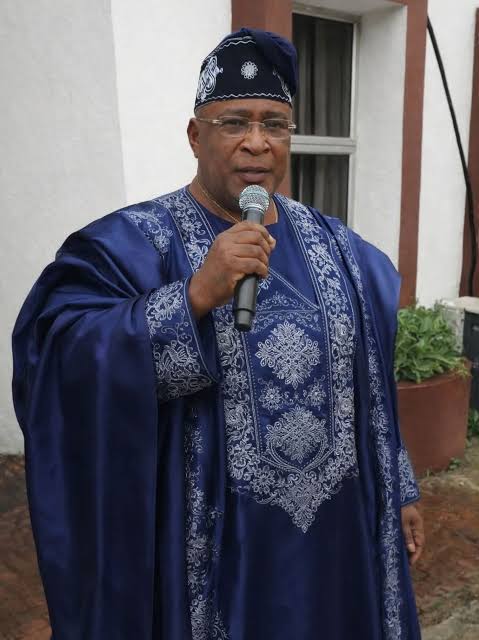
By Aliyu Bala Aliyu
Yesterday, 20 August, General Kollington Ayinla turned seventy-seven. Born Abdulrasaq Kolawole Ilori in Ilota, a modest town on the outskirts of Ilorin, Kwara State, he has spent well over half a century turning talking drums, bàtá and gángan into a language that Nigerians of every tribe and tongue somehow understand. To his devotees he is simply Kèbé-n-Kwárà, Baba Alatika, Baba Alagbado the — boy from Kwara who marched into Lagos, planted his flag in its nightclubs; sundry social gatherings, and never left.
Fújì historians and the passionate foot soldiers of both classical Fújì camps will continue to argue over paternity. The late Sikiru Ayinde Barrister, who coined the very word ” Fújì” and is widely credited by scholars and fans alike as the genre’s originator, remains for many the undisputed father of the sound. Kollington’s own admirers make a different case: that he and Barrister emerged from the same ajísàrí Ramadan-chanting tradition at almost exactly the same historical moment, recording commercially within a few years of one another, and that Kollington’s parallel development of the style — not derivative of Barrister’s — earns him something closer to co-creator status than history has allowed him. There is also a third, quieter argument, one that does not require Kollington to win the naming dispute at all: that his enduring contribution was as Fújì’s great modernizer, the man who in 1978 introduced the powerful bàtá drum into a sound that had until then relied almost exclusively on talking drums, and who spent the 1980s fusing that innovation with funk and disco textures years before fusion became fashionable. Whichever reading one prefers, both men built the house that Fújì music now lives in, and one of its two builders is still with us, still singing, still waiting for his country to notice.
That builder’s own beginnings were, fittingly, disciplined ones. He enlisted in the Nigerian Army at the Abeokuta depot in 1967, serving in the signals corps before finding his way into the military band — the same uniformed years that, decades later, would give his friendship with Barrister its peculiar depth. He began recording for EMI records in 1974, and by 1978, with the bàtá innovation and the sharply worded commentary on his early albums; and with his unique voice, had pulled the genre’s centre of gravity briefly his way. In 1982 he founded Kollington Records and, over the following five years, released some thirty albums, an output that speaks to a discipline too often flattened into mere rivalry-narrative in the retelling. It was in 1990, at the National Theatre in Lagos, that General Sani Abacha, standing in for President Ibrahim Babangida, conferred on him the title “General in music,” — formal recognition of a stage name the streets had already been using for years.
What is most instructive about Kollington’s catalogue, once you lay it out end to end, is how faithfully it tracks the Nigerian news cycle of the last five decades. This was never a musician occasionally dipping a toe into current affairs; it was a running ledger. In 1978 he recorded “Africa Apartheid,” lending his voice to the South African liberation struggle years before it became a fashionable Nigerian cause. In 1982, as the Shagari government’s belt-tightening bit into ordinary households, he released “Austerity Measure,” a title that needed no further explanation to anyone living through it, alongside “Ọ̀sìṣẹ́ Dá’Ṣe Sílẹ̀” (Workers have gone on strike or literally speaking, “Workers have down tooled”) where he sang about the paralyzed economy, empty offices, the struggles of the ordinary Nigerian worker, and appealed to the government to resolve the industrial conflict, pay salaries, and restore stability to the nation
In 1983, the year of Nigeria’s general election, he put out an entire album titled “Ọ̀rọ̀ Ìdìbò Nàìjíríà 1983,” (The Matter of Nigeria’s 1983 Election) alongside “Owó Tuntun” (New Money / New Currency) a commentary on the military government’s abrupt decision to redesign the Nigerian Naira and replace all old banknotes to combat corruption, hoarding, and inflation. A year later came “Ìjọba Titun,” (New Government), greeting the military administration of General Muhammadu Buhari that had overthrown the Shagari government. The very first track on that album “Ká Dúpẹ́ Lọ́wọ́ Ológun” (Let us thank the military) was an expression of relief over the change of power. “Food Tí Dínwó” (Food prices have dropped) another track from the album, celebrated the immediate, aggressive price-control measures implemented by the Buhari-Idiagbon regime to combat the inflation they inherited from the Shagari regime. And then there was “Nigeria Kò Lè Kú” (Nigeria Cannot Die”) — a title he would let stand as a permanent statement of national faith.
Mẹ́kùnnú Ńjìyà (The Masses Are Suffering) was in a class of his own; the primary theme of the track being a direct cry against inflation, economic neglect, and the worsening quality of life for everyday Nigerians. In the lyrics, Kollington boldly criticized the country’s governance, and breaks down the crisis in terms the average person could relate to, complaining about how food staples had grown too expensive for the poor to afford. He noted that the prices of essential staples like yam and garri had skyrocketed; lamenting that a small bunch of vegetables that used to cost mere kobo has jumped sharply to Naira prices. He openly called on Nigerian political leaders and policy makers to rescue the economy and preventing it from drifting into famine.
In 1990, the year Nelson Mandela walked free, Kollington’s “Fújì Ròpòpò” album carried a track saluting that freedom directly, on the same record that included a song simply titled “Census,” marking that year’s national headcount. In 1993, in the shadow of the annulled June 12 election, his “Ìjò mbẹ” (“There is a dance” or “A dance is happening”) album carried tributes to M. K. O. Abiola. In 1994 he recorded on the Bakassi Peninsula dispute; in 1995, on the nationalist fever of that year’s FIFA U-17 World Cup; in 1998, on the democratic transition that followed Abacha’s death, with an album titled, simply, “Democracy”; and in 1999, on his “Survival” album, he greeted the new republic directly, with tracks including “President Obasanjo,” marking the inauguration, and “Abuja Tea,” a wry look at the new capital’s emerging political class. Few Nigerian musicians of any genre have kept so consistent a diary of the country’s moods across so many decades, and fewer still have done it in a form ordinary people could dance to.
Following the military regime of Gen Ibrahim Babangida’s annulment of the June 12 1993 presidential election, Nigeria was plunged into deep political turmoil; the country faced intense tribal divisions, riots, and fears of a second civil war. Kollington used the title track to make a passionate, patriotic plea for peace with his “Unity”. He sang directly to different ethnic groups, urging Nigerians not to tear the country apart and emphasizing that national progress is impossible without togetherness.
He did the same service for grief. When Ayinla Omowura, the Apala king and Kollington’s own early mentor-figure, was killed in a bar-room brawl in Abeokuta in 1980, Kollington released “Late Chief Ayinla Omowura” that same year, an elegy that stands alongside Barrister’s own tribute to Omowura as one of the era’s most affecting musical eulogies. Thirty years later, when Barrister himself died in London in December 2010, Kollington did not merely mourn from a distance. He put out a tribute, an emotion-laden piece of work in which he reached back to their earliest days in the army, recounting the marches, the barracks life and the friendship that outlasted every public quarrel the two men were goaded into by their respective camps. Between those two elegies sits the full arc of a man who buried his rivals with the same tenderness he once used to needle them on record — Omowura in 1980, Barrister thirty years later, and in between them a catalogue thick with love songs to the country itself, from the 1989 “Nigeria” album, its sleeve lettering rendered pointedly in the green of the flag, to the record collectors still trade today. And then there was the “Late Chief Obafemi Awolowo” released in 1987 shortly after Awolowo’s passing. In the emotional track, Kollington honors Awolowo’s immense contributions to Nigerian politics, free education, and the Yoruba nation; mourning him as an irreplaceable leader.
But it was not all philosophy, industrial action, inflation, delayed salaries, low purchasing power, new currency, melancholy and death. He gave the gyration, Gbé body ẹ́ (shake/carry your body) and Fújì discography its due with albums like Ìjọ Yoyo, Lákúkúlálá, Megastar and the earlier mentioned “Fújì Ròpòpò”.
However, it is sad to note that the industry he contributed in building has sometimes been slow to return the favour. In 2013, when Kollington marked fifty years on stage with a celebration at Eko FM’s premises in Ikeja, his own contemporaries turned out in force — King Sunny Ade and Ebenezer Obey among them — but a newer generation of Fújì stars, several of whom owe their careers to the ground he broke, were conspicuously absent. It was a small, telling preview of the larger neglect this piece is about: a man capable of filling a room with elder statesmen still finding himself, at the moments that should matter most, treated as an afterthought by those who came after him.
And there lies the injury at the heart of this piece. In 2006, President Olusegun Obasanjo conferred on Sikiru Ayinde Barrister the national honour of Member of the Order of the Federal Republic (MFR), recognizing a body of work that had, by then, spoken for the nation’s conscience for decades. That was twenty years ago this year. Barrister wore the honour for four years before his death and has, quite rightly, been celebrated posthumously ever since. Kollington, his equal in longevity, in output and in service to the culture, has received no comparable national recognition. He has been given chieftaincy titles by traditional rulers who understand his worth and a Lifetime Achievement Award from an industry function in 2018, gestures that are gracious but modest set against what the man has actually given the country. Twenty years after his friend and rival was honoured by the state, Kollington remains, in the official record of national gratitude, something close to a footnote.
Even though General Kollington Ayinla has not been going to the studio to make records as he did in his prime, he occasionally serenades with his sonorous voice. President Bola Tinubu was not left out in this casually recorded pre-election (2023) song as seen on YouTube: “Kollington sings for Asiwaju of the Universe”
see: https://www.youtube.com/watch?v=xy-ZkbBKa9M
It should not take a death to produce a national honour. Nigeria has an unfortunate habit of discovering its icons only in eulogies, of finding the words of praise only when they can no longer be heard by the person who earned them. Kollington Ayinla clocked 77 yesterday, not gone, not fading quietly, still capable of receiving thanks in a form he can actually enjoy. He has paid his dues to his country and to its entertainment industry in a currency that cannot be faked: five decades of consistency, of showing up, of turning the raw material of Yoruba oral tradition, and of the nation’s own headlines, into a soundtrack the whole country could dance to. The Federal Government does not need to wait for a funeral to do what it has already done once for a man of Kollington’s stature. A national honour, whether the Member of the Order of the Niger, the Officer of the Order of the Federal Republic, or whatever category befits a living legend of his rank, would cost the state nothing it cannot afford and would mean everything to a man who has never asked for much beyond an audience and a drum. The General in what appears to be a recent recording in Daar communications studio celebrates himself here:
Gilbert Chagoury, Sam Omatseye, Babajide Kolade-Otitoju, Dele Alake, among others have been given national awards in private and special category considerations and yet one of the most consequential foundations of the Fújì genre has been left out year in year out. Give Kèbé-n-Kwárà his flowers while he can still smell them. Give him, at last, his national honours. Happy Birthday GKA