

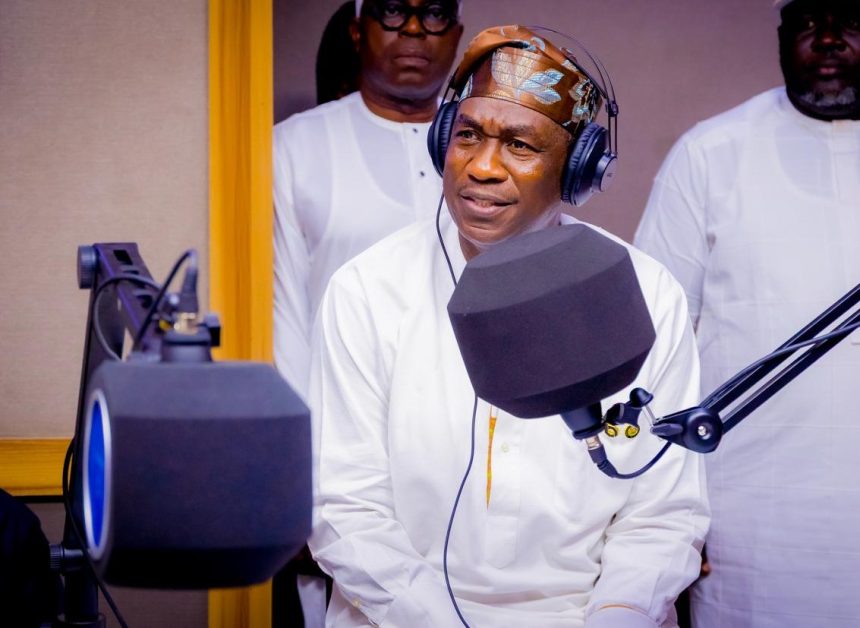
Lagos State Deputy Governor and All Progressives Congress (APC) Governorship Candidate, Dr. Kadri Obafemi Hamzat, has assured to build a more interconnected Lagos, decentralise government services, and develop the distinctive economic advantages of the five divisions of the state, namely: Ikeja, Badagry, Ikorodu, Lagos Island and Epe (IBILE).
Speaking on Thursday during an interview at IKD 106.1 FM titled “KOH Unscripted in Ikorodu,” Hamzat said the growth of the State must be driven by a deliberate effort to harness the comparative advantages of each division, adding that his vision is to create a Lagos where residents would not have to travel to Alausa for services that could be provided within their respective divisions.
The Deputy Governor stated that strategic government presence in Ikorodu, Epe, and other divisions would bring governance closer to the people and make public services more accessible, elucidating that residents must have easier access to government services, efficient transportation, and other essential infrastructure closer to their communities.
“We must decentralise Lagos. Alausa should not be the only place where people can access government services. We should have mini-secretariats in Ikorodu, Badagry, and Epe, so that perhaps 80 per cent of the services people need can be resolved within their divisions, while matters requiring further attention can be escalated to Alausa. Also, each division of the state needs to develop around its unique economic strengths, and the government must deliberately “plug into” the opportunities available in different parts of Lagos,” Hamzat said.
Furthermore, Hamzat identified Ikorodu’s potential in agriculture, food processing and transportation, promising to develop infrastructure around emerging institutions and economic activities in other divisions.
He emphasised the importance of organisation within the state, noting that reorganisation of local government administration must cover both physical and financial structures, with effective systems put in place to improve accountability, eliminate leakages and identify issues such as ghost workers.
The Deputy Governor further stressed the importance of planning Lagos as a borderless metropolitan city, noting that residents of neighbouring states also depend heavily on the State’s infrastructure and public services. He cited the example of Orile Agege General Hospital, where a significant proportion of patients come from outside Lagos, saying such realities must be taken into account in planning healthcare, transportation, water and other public infrastructure.
Hamzat assured stakeholders that the development of the State must remain inclusive, with the specific needs and opportunities of each division reflected in government planning.
While outlining plans for major transport interchanges within the state with connectivity between buses, rail and ferries, the Deputy Governor stated that such facilities would make it easier for residents in the hinterlands to move across the State and access economic opportunities. He added that Lagos, being a city blessed with water, must maximise its waterways alongside road and rail infrastructure to create a truly integrated transport system.
Hamzat further disclosed Hamzat further disclosed that 77 electric buses, including 30- and 40-seater models, were being introduced into the State’s transport system, stating that the use of electric vehicles would help reduce operating costs associated with diesel and petrol and could ultimately contribute to more affordable transportation for commuters.
He proposed a transport network that would connect strategic routes and terminals across the State, including Ikorodu, Badore, Victoria Island, Marina and other areas. At the same time, the expansion of rail and water transportation would provide residents with more options for daily commuting.
Speaking on healthcare, Hamzat said the growing population of the state required a corresponding expansion of healthcare infrastructure, highlighting that the Ikorodu General Hospital and other major hospitals in the State would be expanded to cope with increasing demand.
The Deputy Governor explained that such expansion would go beyond buildings to include providing adequate accommodation for doctors, nurses and other health workers, underscoring that healthcare facilities must be positioned to provide quality and accessible services to residents.
On water supply, he acknowledged the challenges confronting residents and explained that Lagos’ dependence on water sources located in neighbouring Ogun State required cooperation and compensation arrangements.
Hamzat noted that the completion of the Adiyan water project and associated pipeline infrastructure would significantly increase the State’s water supply capacity and extend access to millions more residents.
Speaking further, the Deputy Governor also called for greater citizen participation in the development of Lagos, emphasizing that the government alone could not build every institution or solve every problem. He cited that “Individuals and organisations in developed countries contribute to education and other areas of development. So we as citizens of this great nation must see ourselves as partners in building a better society,” he concluded.