

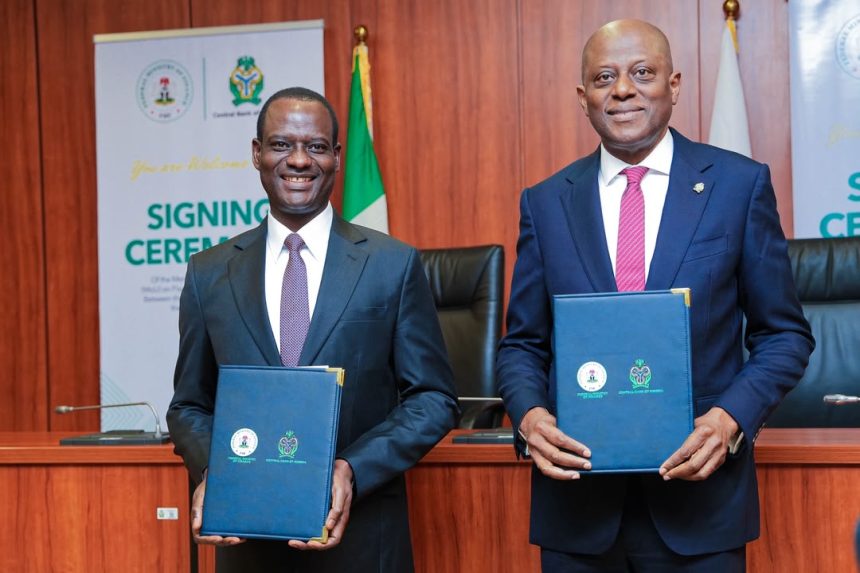
*L-R: Oyedele and Cardoso
The Federal Government, through sign MOU to theFederal Ministry of Finance, and the Central Bank of Nigeria (CBN) have signed a Memorandum of Understanding (MoU) to institutionalise fiscal and monetary policy coordination, strengthening Nigeria’s macroeconomic management framework and supporting greater economic stability.
The MoU, signed in Abuja by the Minister of Finance and Coordinating Minister of the Economy, Mr. Taiwo Oyedele, and the Governor of the Central Bank of Nigeria, Mr. Olayemi Cardoso, provides a structured framework for regular consultation, information sharing and coordinated policy assessment between the two institutions.
The agreement formalises an existing relationship between the Ministry and the CBN, which have worked together over the years on critical issues including inflation management, debt sustainability, budget financing, exchange-rate stability, economic reforms and responses to domestic and global economic shocks.
Under the new framework, both institutions will strengthen collaboration on government cash management, debt issuance planning, liquidity forecasting, macroeconomic analysis and periodic policy consultations. This is expected to improve the consistency of macroeconomic assumptions and forecasts, enhance policy coherence and reduce uncertainty in economic decision-making.
Speaking at the signing ceremony, Mr. Oyedele said the agreement was designed to ensure that coordination between fiscal and monetary authorities is anchored on clear structures, data and accountability rather than personalities.
He emphasised that institutional independence and policy coordination are complementary, noting that the operational independence of the CBN remains fully protected under the framework.
“Independent institutions do not have to operate in isolation. Our mandates are distinct, but our outcomes are interconnected,” the Minister said, stressing the need for both institutions to work from a common evidence base while maintaining clear accountability.
The Minister further noted that the framework would support Nigeria’s transition towards an inflation-targeting regime by improving the quality and timeliness of fiscal and monetary data, including information on cash positions, financing plans, credit growth and foreign exchange flows.
He said sustainable price stability requires a whole government approach, combining disciplined fiscal policy, sound cash and liquidity management, efficient government financing and reforms that address structural drivers of inflation, including food, energy, logistics and imported costs.
The Minister also highlighted recent improvements in Nigeria’s external position and investor confidence, including a balance-of-payments surplus of more than US$5 billion recorded in 2025 and external reserves exceeding US$54 billion. He noted that the Government’s objective extends beyond short-term portfolio flows to attracting patient capital that supports investment, infrastructure, technology and job creation.
The CBN Governor, Mr. Olayemi Cardoso, described the MoU as a significant milestone in Nigeria’s pursuit of stronger macroeconomic management, lasting economic stability and sustainable prosperity.
He noted that the framework would transform a longstanding institutional relationship into one anchored by clear processes and enduring commitments, providing predictable mechanisms for engagement and improving the capacity of both institutions to respond to emerging economic challenges.
The MoU reinforces the Federal Government’s commitment to sound fiscal management, stronger institutions, policy consistency and evidence-based economic decision-making.
Through closer coordination, the Federal Ministry of Finance and the Central Bank of Nigeria will continue to pursue complementary policies that strengthen macroeconomic stability, support investment and create the conditions for sustainable and inclusive economic growth.