

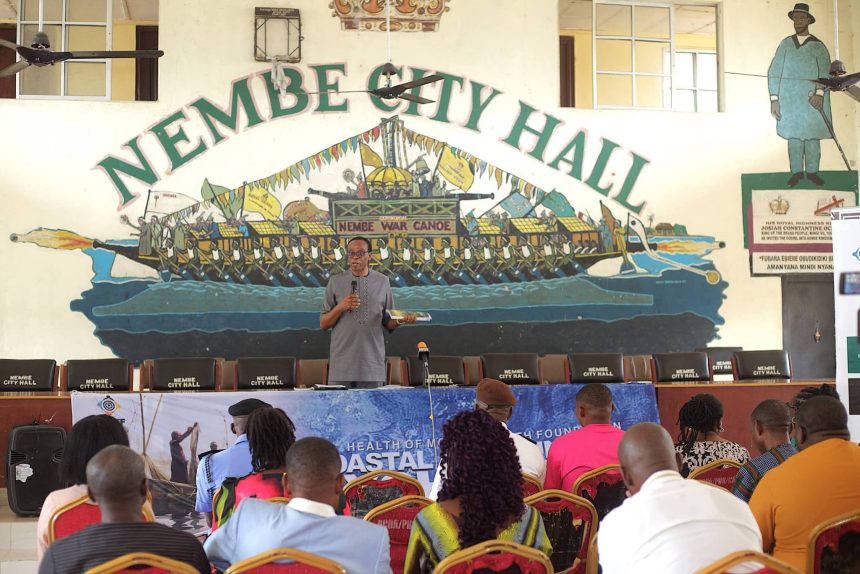
The Health of Mother Earth Foundation (HOMEF) has called for urgent action to address growing environmental, livelihood and health concerns raised by residents of Nembe, Bayelsa State, following a community capacity-sharing dialogue held in the community.
The dialogue, organised under HOMEF’s Justice Through Communities-Centred Policy Advocacy project, brought together traditional leaders, women, youth, farmers, fishers, local government representatives and other stakeholders to examine environmental changes and identify priorities for policy action.
The people of Nembe at the dialogue reported declining fish stocks, the disappearance and reduction of aquatic species, concerns over water quality and changes in traditional resource use. They linked many of these changes to oil exploitation, pollution and other extractive pressures, while expressing concern over weak environmental monitoring and enforcement.
For a community heavily dependent on fishing, farming and other natural resources, HOMEF’s Executive Director, Rev Nnimmo Bassey, said the reported environmental changes represent not only an ecological concern but also a threat to livelihoods, food security, health and cultural heritage.
According to him, “Communities cannot continue to bear the environmental and economic costs of extraction while being treated as spectators in decisions about their own environment.”
HOMEF demands a comprehensive and transparent environmental audit of Nembe, including assessment of water, soil and air quality, fish and other aquatic organisms, heavy metals and other contaminants. It also urged regular food-safety and environmental health monitoring because of concerns about the movement of pollutants through the food chain.
Health concerns featured prominently during the dialogue. Participants raised concerns about possible impacts of environmental pollution on women, children, newborns and future generations, including reproductive health concerns.
The Director of Primary Health Care, Nembe LGA, Chief Jude Pulemote, said oil exploration activities had contributed to health challenges among rural residents. He specifically raised concerns about anaemia among pregnant women and the disruption of livelihoods by oil activities.
HOMEF stressed that environmental monitoring must therefore be linked to public health interventions, particularly for vulnerable groups.
Communities demand a voice in environmental decisions
Another major concern raised during the dialogue was the limited involvement of communities in environmental assessments and Joint Investigation Visits (JIVs). Participants argued that affected communities must be actively involved in environmental assessments, evidence gathering, JIVs, decision-making, remediation monitoring and evaluation of cleanup activities, rather than being consulted only after environmental damage has occurred.
“Consultation is not participation,” HOMEF said. “Meaningful participation means that communities have a voice throughout the process; from determining what is investigated to monitoring whether remediation has actually restored their environment.”
Participants also called for traditional and indigenous knowledge to be recognized alongside scientific evidence in environmental governance, noting that traditional systems historically helped regulate the use of forests, rivers, fishing grounds and other natural resources.
From reports to remediation, HOMEF’s demands
HOMEF noted that the concerns raised in Nembe must be considered alongside existing evidence of environmental degradation across the Niger Delta, including the UNEP Report on Ogoniland, the Bayelsa State Oil and Environmental Commission (BSOEC) Report, Niger Delta women’s health audit report by the Kebetkache Women Development and Resource Centre; all of which have been summarily documented in HOMEF’s Disasters Foretold and Retold publication.
It was established that the region does not need another cycle of environmental assessments without corresponding action. “Existing evidence must translate into remediation, restoration, accountability and protection of livelihoods,” HOMEF said.
HOMEF therefore called on the Bayelsa State and Federal Governments, regulatory agencies and oil companies operating in the region to conduct transparent and independent environmental and health assessments in Nembe, while also ensuring meaningful community participation in JIVs, environmental assessments, remediation and monitoring.
The group also called for strengthening of enforcement of environmental laws and hold polluters accountable. Implement relevant BSOEC recommendations, including the proposed environmental recovery fund and agency.
It also called for decommissioning of abandoned oil wells and address their environmental risks, accelerate remediation and ecological restoration of degraded areas.
Government, is says, would also protect and restore fishing, farming and other community livelihoods, establish appropriate mechanisms for compensation and livelihood recovery, strengthen environmental health monitoring and public health interventions, and recognize indigenous and community knowledge in environmental governance.
“The people of Nembe and Niger Delta at large, are not asking to be heard after decisions have been made. They are demanding the right to participate in decisions that determine the health of their environment, their livelihoods and the future of generations to come,” HOMEF noted.