

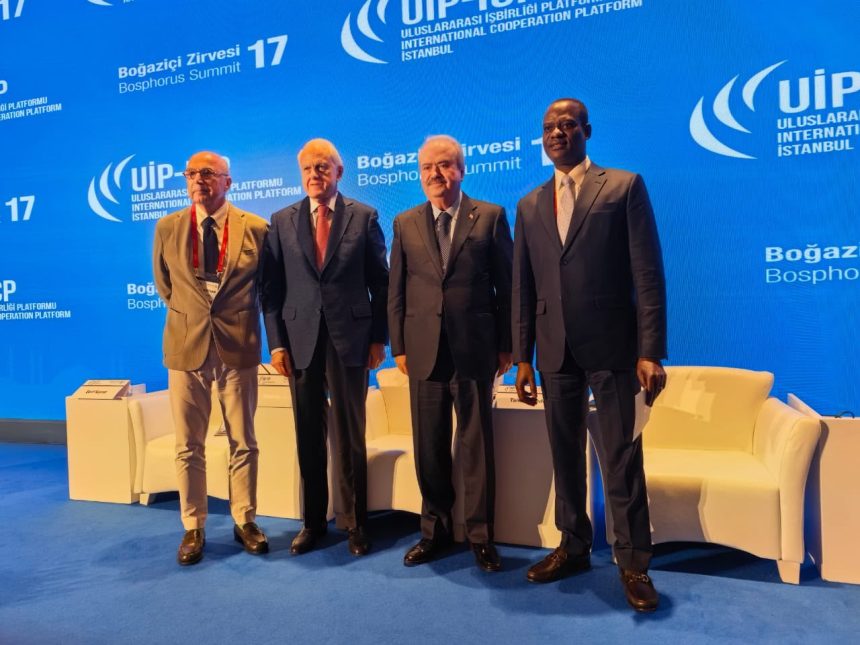
The Minister of Finance and Coordinating Minister of the Economy, Mr Taiwo Oyedele, has called for reforms to the global financial system to ensure fairer access to capital, lower borrowing costs and increased investment in developing economies, stressing that financial stability must translate into jobs and shared prosperity.
Speaking at the Global Financial System Session of the 17th Bosphorus Summit in Istanbul, Türkiye, on Friday, Oyedele said the existing global financial architecture must evolve to address inequalities in access to finance, noting that developing countries collectively pay an estimated $500 billion more annually in borrowing costs than advanced economies.
He described this disparity as a “prejudice premium”, arguing that countries must be assessed on credible economic fundamentals rather than perceptions that exaggerate investment risks.
Highlighting Nigeria’s economic reforms under President Bola Ahmed Tinubu, the Minister cited exchange rate unification, fuel subsidy removal and comprehensive tax reforms as difficult but necessary measures yielding encouraging results.
Oyedele reported that Nigeria recorded about 4.43 percent growth in the second quarter of 2026, four consecutive months of moderating inflation, foreign reserves above $55 billion, and an increase in private capital inflows from about $300 million in 2023 to nearly $6 billion in 2026.
The Minister emphasized that the ultimate measure of economic stability is its ability to generate jobs, improve incomes and expand opportunities, noting that Nigeria’s new seven-pillar Economic Policy Framework is designed to institutionalize sound economic policies beyond individual administrations.
Drawing on five priorities reinforced at the G-24 Ministers and Governors meeting in Bangkok, which he chaired, Oyedele called for a more representative International Monetary Fund (IMF), stronger private capital mobilization by multilateral development banks, fairer credit assessments, faster and more predictable debt resolution, and climate financing that does not deepen debt vulnerabilities. He also reiterated the G-24’s call for at least $300 billion in annual climate finance by 2035.
The Minister warned that employment pressures pose a growing threat to global stability, citing World Bank projections that approximately 1.2 billion young people will enter developing economies’ labor markets over the next decade, against an estimated 400 million new jobs.
On investment partnerships, he said Nigeria and Türkiye are working to expand bilateral trade to $5 billion. He also highlighted the Projects Nigeria initiative, which has identified 65 investment opportunities valued at approximately $78.5 billion, structured to attract genuine risk-sharing partnerships rather than additional sovereign borrowing.
Oyedele urged developing countries to sustain credible domestic reforms while calling on international financial institutions to provide fairer access to capital and more objective assessments of investment risks.
He maintained that the global financial system must be modernized to support investment, productive economic activity and inclusive prosperity.
“For Nigeria, stability was our first test; growth that creates jobs is our next,” he said.