
“The Dangote Refinery IPO is not simply another stock-market event. It could be Nigeria’s most important experiment yet in turning ordinary citizens from consumers of industrial wealth into owners of it”
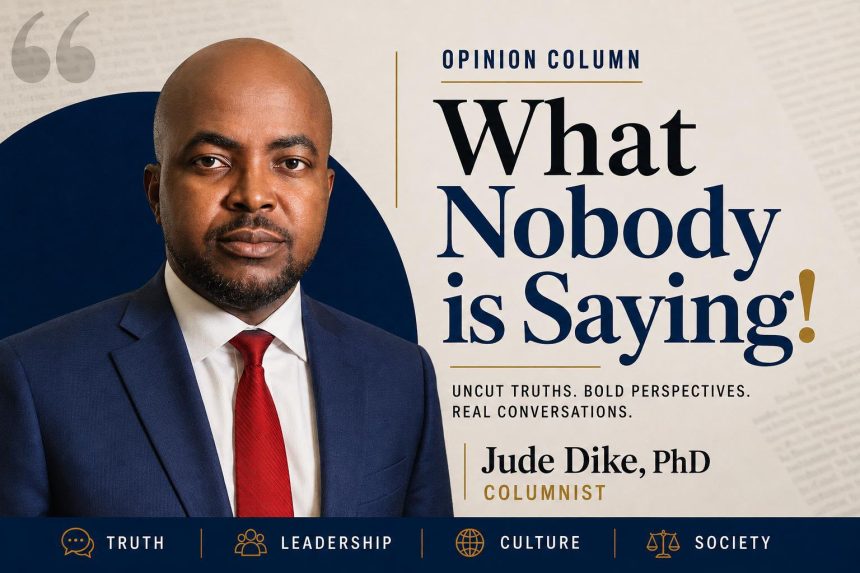
By Jude Dike, PhD
There are some economic events that arrive with a press release. Others arrive quietly and only later reveal that they changed a country.
September 14, 2026 could be one of those days for Nigeria.
Next week, the Dangote Petroleum Refinery is scheduled to open its much-anticipated initial public offering, offering 4.1 billion shares at ₦525 apiece and seeking roughly ₦2.15 trillion – about $1.63 billion – in what is expected to be Africa’s largest-ever IPO.
But the real story is not the money Dangote wants to raise.
The real story is who gets to own what that money is buying. And what that ownership could mean for the next Nigerian generation.
Stop thinking of Dangote as a refinery
Nigeria has become accustomed to seeing the Dangote refinery through the narrowest possible lens: Petrol. Diesel. Jet fuel. Pump prices. Imported crude. Fuel queues.
But that is like looking at an airport and seeing only the parking lot.
This is an industrial machine.
The refinery has a nameplate capacity of 650,000 barrels per day and has already demonstrated production of about 700,000 barrels per day. It was built at a cost of roughly $20 billion and is now supplying Nigeria and exporting refined products into international markets.
And now comes the part that should make Nigerians sit up.
Dangote plans to spend another $14.3 billion to take the complex to 1.4 million barrels per day by 2029.
At that scale, the refinery could become the largest single-site refinery in the world.
Think about that.
The largest refinery on Earth could be sitting in Nigeria – and Nigerians are being invited to buy shares in it.
That is not just an energy story. That is an ownership story.
The sentence Nigerians should remember
Here is the sentence that may matter more than any prediction about the share price:
A poor country does not become rich merely by producing more. It becomes rich when its people own more of what it produces.
Nigeria has spent generations exporting crude oil and importing refined petroleum.
Now, potentially, it can refine at home, export refined products abroad and through a public listing distribute ownership of part of that industrial capacity across the market.
That is the economic bridge nobody talks about enough.
From oil producer to industrial producer.
From consumer to owner.
From today’s income to tomorrow’s capital.
*And the numbers are already talking*
The refinery reported an after-tax profit of approximately $1.82 billion in the first half of 2026, compared with a $476 million loss for all of 2025.
That turnaround deserves attention.
Not because six months of profit proves what the next decade will look like.
It does not.
Refining is cyclical.
Oil prices move.
Margins move.
Wars distort markets.
Exchange rates move.
Plants break.
Maintenance costs money.
Feedstock availability matters.
And investors should understand every one of those risks.
But the numbers demonstrate something important:
*The gigantic machine has moved from construction project to operating business*.
That changes the conversation.
*Now imagine Nigeria owning the growth*
The IPO is being explicitly positioned as a “people’s IPO,” with the stated goal of widening participation among Nigerians, the diaspora and Africans more broadly.
That phrase deserves scrutiny.
Because “people’s IPO” should mean more than a marketing slogan.
It should mean the market trader can participate.
The teacher can participate.
The mechanic can participate.
The software developer can participate.
The self-employed entrepreneur can participate.
The young Nigerian earning irregular income can eventually learn what it means to own a productive asset.
And yes, even the millions of Nigerians who have historically lived outside formal banking and investment systems should be asking a different question:
*Why shouldn’t the next generation own part of the factories that produce their country’s wealth?*
That is the real revolution.
Not everybody will become rich.
But everybody should have the opportunity to understand ownership.
*The Dangote precedent matters*
There is another reason this moment deserves a longer historical lens.
Dangote has already taken pieces of his industrial empire into public ownership.
Dangote Sugar has been publicly traded for years.
Dangote Cement became a landmark Nigerian listing in 2010.
The lesson is not that a new Dangote share must repeat the performance of an older Dangote share.
It cannot be guaranteed.
The lesson is that Nigeria has already seen what happens when an enormous private industrial enterprise becomes a publicly traded company.
The refinery IPO is simply a much bigger test.
*What if this is the beginning of a Nigerian ownership culture?*
Imagine a Nigerian teenager opening an account and buying a small number of shares.
Not because somebody promised instant riches.
Not because TikTok said the stock was going to “moon.”
But because that teenager finally understands something that economics textbooks rarely make emotionally real:
A factory can belong to you.
A refinery can belong to you.
A cement company can belong to you.
A bank can belong to you.
An agricultural processor can belong to you.
A technology company can belong to you.
And when those businesses grow, the potential economic benefit does not have to belong exclusively to the original founders.
That is what a functioning capital market is supposed to accomplish.
It converts companies into institutions.
And institutions into assets that can be owned across generations.
*But here is what nobody should do*
*Do not turn this into another Nigerian get-rich-quick story*.
There is no guaranteed wealth here.
There is no guaranteed share-price appreciation.
There is no guarantee that the refinery’s expansion will be completed on schedule.
There is no guarantee that today’s refining margins will persist.
There is no guarantee that the ₦525 IPO price is cheap.
In fact, analysts have already questioned the valuation by comparing the refinery with other listed refining companies.
That debate is healthy.
A serious IPO deserves serious scrutiny.
And Nigerians should be especially careful of anyone promising guaranteed allocations or guaranteed profits.
*This column is not financial or investment advice. It is not a recommendation to buy Dangote Refinery shares. It is not sponsored content or a paid advertisement for Dangote Industries*.
Read the prospectus.
Understand the risks.
Verify information with the appropriate Nigerian regulatory and capital-market authorities.
And never send money to someone simply because they promise to make you rich.
*But don’t miss the bigger picture*
There is a temptation in Nigeria to measure every economic event by what it does to the price of petrol.
That is understandable.
But it is too small a way to think about what is happening.
Nigeria is attempting something much bigger.
It is trying to build industrial capacity at a scale that can serve a domestic market of more than 200 million people while competing internationally.
The U.S. Energy Information Administration says Nigeria’s seaborne petroleum-product exports have increased sevenfold since 2023, with Dangote’s refinery driving much of the change.
The refinery has also become a major supplier of jet fuel into Africa and Europe.
That means Nigeria is no longer simply asking the world to buy its crude.
It is increasingly asking the world to buy what Nigeria made from its crude.
That is a different economic proposition.
*The generational wealth question*
This brings us back to the question at the heart of *What Nobody Is Saying*:
*Why are Nigerians poor when Nigeria is not poor?*
Part of the answer has always been that natural resources alone do not create broadly distributed wealth.
Ownership does.
Productivity does.
Industrial capacity does.
Capital formation does.
Compounding does.
And participation does.
The Dangote refinery cannot solve Nigeria’s poverty problem.
No company can.
But it could become a case study in whether a massive African industrial asset can evolve from the private vision of one entrepreneur into a publicly owned wealth-generating institution.
That is the experiment.
And it begins next week.
*The headline everyone is missing*
Forget, for a moment, whether Dangote’s IPO becomes Africa’s biggest.
Forget whether the shares rise on the first day.
Forget the inevitable social-media arguments about Aliko Dangote.
Ask a more fundamental question:
What happens when millions of Nigerians begin to see productive assets as something they can own rather than something other people own?
That could change Nigeria.
Because wealth is not merely what you earn.
Wealth is what you can own, preserve, grow and pass on.
The refinery may become the world’s largest single-site refinery if the planned expansion reaches 1.4 million barrels per day by 2029.
But its most important achievement may have nothing to do with barrels.
It may be measured in owners.
And if Nigeria gets this right, the most important product coming out of Lekki may not be petrol, diesel or jet fuel.
It may be a new Nigerian idea of ownership.
About the Columnist
Dr. Jude Dike is a Nigerian-Canadian economist, public policy analyst, and best-selling author.
As the columnist behind What Nobody Is Saying he brings a distinctive blend of academic expertise, government experience, international development insight, and public-policy analysis to the national conversation.
With a PhD in Economics and a master’s degree in Oil and Gas Economics from the United Kingdom, the columnist has built a versatile career spanning academia, government, international development, and policy advisory. His professional experience includes serving as a college professor, World Bank consultant, senior legislative aide, senior government adviser, political strategist and public policy analyst.
Drawing on this broad experience, What Nobody Is Saying offers incisive, independent commentary on Nigeria’s economy, politics, governance, public policy, energy sector, and the forces shaping the country’s future. Styled in the tradition of serious, analytical newspaper commentary, the syndicated column seeks to examine the issues beneath the headlines, challenge conventional thinking, and give voice to perspectives that often go unspoken.
As a Nigerian-Canadian with extensive international exposure and deep knowledge of Nigeria’s political economy, Dr. Dike brings a uniquely cross-cultural perspective to the country’s most consequential debates—asking not merely what is happening, but what nobody is saying about why it is happening and where it may lead.