
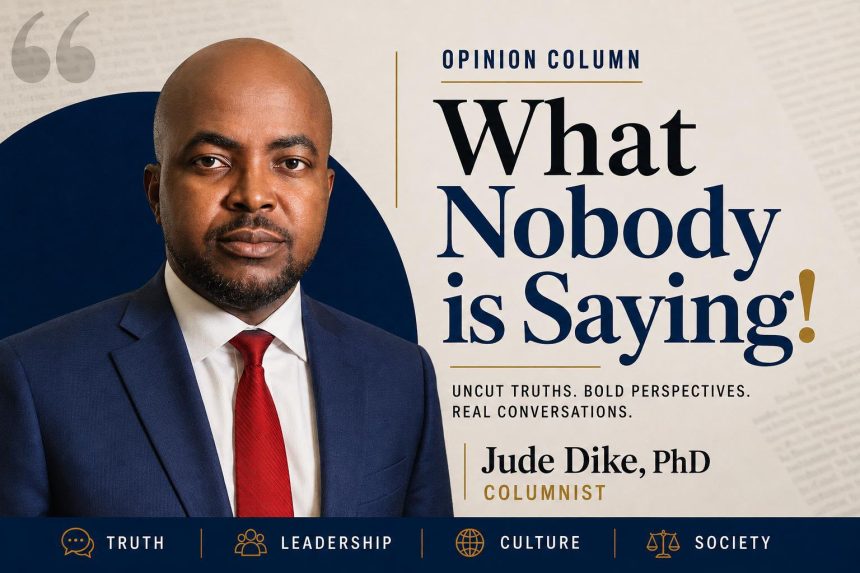
By Jude Dike, PhD
October 1, 2026
My fellow Nigerians,
Today, Nigeria is 66 years old.
At 66, a person is old enough to have grandchildren, a pension plan, and strong opinions about the price of tomatoes.
A country, apparently, is old enough to still be promising that next year will be different.
So, fellow Nigerians, let us begin with congratulations.
Congratulations to you.
Not necessarily to the government.
Not necessarily to the opposition.
Certainly not to the people who have spent 66 years discovering that the national cake has somehow become a national biscuit.
I mean you.
The Nigerian who wakes up before dawn.
The trader who calculates exchange rates before calculating breakfast.
The farmer who wonders whether the road to his farm is safer than the road to the bank.
The young graduate who has discovered that “entry-level position” can require five years of experience, three professional certifications and the spiritual gift of knowing somebody.
The mother who has become an economist because she must decide which child eats what.
The father who has become an engineer because he owns a generator.
And the entrepreneur who has become a power-grid operator, accountant, customs officer, marketer, security consultant and motivational speaker simply because he owns a small business in Nigeria.
You have kept this country alive.
That is the first thing nobody is saying loudly enough.
THE COUNTRY IS NOT A SPREADSHEET
My government will present you with numbers today.
There will be percentages.
There will be graphs.
There will be roads.
There will be investment figures.
There will be production figures.
There will be words like macroeconomic stability, fiscal consolidation, structural reform and shared prosperity.
These things matter.
But there is another economic indicator that does not appear easily on a PowerPoint slide.
It is called:
“Can I afford dinner?”
That is also an economic indicator.
So is:
“Can my child get to school safely?”
So is:
“Can I travel from Kaduna to Abuja without becoming a kidnapping statistic?”
So is:
“Can my business operate for eight hours without switching between public electricity and diesel?”
So is:
“If I become sick tonight, can I afford the hospital?”
A country cannot be declared prosperous merely because the spreadsheet has improved while the family refrigerator remains empty.
Numbers tell us what happened to the economy.
Nigerians tell us what happened to them.
Both accounts must be heard.
YES, REFORMS HAVE A COST
Let me say something unfashionable on Independence Day:
Some reforms really were necessary.
Nigeria could not indefinitely maintain systems that were draining public finances, discouraging investment and rewarding arbitrage.
But here is what governments sometimes forget when they become enamoured of the word reform:
A reform is not a religious ceremony.
It is not automatically good because it is painful.
Pain is not proof of policy wisdom.
If a government breaks a leg and says, “Do not worry, this is structural adjustment,” the citizen is entitled to ask when the ambulance is coming.
Nigerians have endured enormous increases in the cost of living.
The government can point to improved revenues, investment, refining capacity, infrastructure and other indicators of progress. It should.
But citizens can point to their markets, their rent receipts, their transport fares and their children’s school bills.
They should.
The two realities can exist simultaneously.
That is what nobody is saying.
THE FUEL SUBSIDY QUESTION
We were told the subsidy had to go.
It went.
And Nigerians learned something remarkable:
Removing a subsidy is easier than removing the consequences of removing it.
We have talked about CNG.
We have talked about domestic refining.
We have talked about energy transition.
We have talked about transportation.
All of these are important.
But the Nigerian commuter has a simpler question:
“How much does it cost me to get to work?”
History will not remember the number of presidential speeches devoted to affordable transportation.
History will remember whether transportation actually became affordable.
THE NAIRA HAS ALSO BECOME A TEACHER
The naira has taught Nigerians an advanced course in economics.
It has taught grandmothers about foreign exchange.
It has taught schoolchildren that the price of imported biscuits can change before they finish eating the packet.
It has taught businesses that a quotation can expire before the customer approves it.
And it has taught the rest of us that “stable” can be a wonderfully elastic word.
Government says the foreign-exchange market is becoming more credible.
Fine.
Then credibility must eventually arrive at the supermarket.
A successful economic reform should not merely impress investors.
It should eventually impress the woman buying rice.
SECURITY: THE TEST THAT CANNOT BE SPUN
Now let us discuss security.
Our soldiers and police officers deserve our respect.
Thousands of Nigerians in uniform have made extraordinary sacrifices.
We must never confuse criticism of government with disrespect for those who risk their lives protecting the country.
But we must also never confuse praise for the security forces with proof that the security problem has been solved.
If a farmer is afraid to reach his farm, the security problem is not solved.
If a family is afraid to travel at night, the security problem is not solved.
If parents must ask whether a school is safe before sending their children there, the security problem is not solved.
The enemy is not always a flag planted in a territory.
Sometimes it is fear.
And fear is one territory the Nigerian state must reclaim.
CORRUPTION: THE ELEPHANT THAT HAS A GOVERNMENT ID
Every administration promises to fight corruption.
Every administration discovers that corruption is complicated.
Every administration creates committees.
Every administration launches initiatives.
And somewhere, somehow, somebody is still explaining why a road costing ₦10 billion requires ₦20 billion.
This country does not suffer from a shortage of anti-corruption slogans.
We suffer from a shortage of consequences.
The real anti-corruption policy is remarkably simple:
If public money is stolen, somebody must lose the ability to steal public money again.
Not after three television interviews.
Not after years of adjournments.
Not after the country has forgotten the case.
Quick, transparent and credible consequences are better than a thousand conferences about integrity.
AND THEN THERE IS POLITICS
Every four years, politicians suddenly rediscover the Nigerian people.
We become:
“My people.”
“Our brothers and sisters.”
“The masses.”
“The youth.”
“The ordinary Nigerian.”
This is a wonderful transformation.
Unfortunately, it tends to occur shortly before an election.
So perhaps we should try something new.
Let us regard Nigerians as citizens between elections too.
Let the citizen matter on January 17.
Let the citizen matter on April 9.
Let the citizen matter on August 22.
Let the citizen matter when there are no cameras.
Democracy is not merely the day we count votes.
Democracy is every day the government remembers that the people are watching.
TO THE YOUNG
To Nigeria’s young people, I will not tell you that you are “the leaders of tomorrow.”
You have heard that speech before.
Some of you have been hearing it since primary school.
Tomorrow has become suspiciously late.
You are leaders today.
You are building companies.
Writing software.
Making films.
Farming.
Designing.
Trading.
Researching.
Creating music.
Building communities.
Leaving the country.
Returning to the country.
And sometimes leaving because you believe the country has left you first.
We must not romanticise your resilience.
A nation should not require its young people to be heroic merely to survive ordinary life.
The goal of government should not be to make Nigerians extraordinarily resilient.
The goal should be to make ordinary life less extraordinarily difficult.
WHAT NOBODY IS SAYING ABOUT PATRIOTISM
Patriotism is not pretending that Nigeria is perfect.
Patriotism is caring enough to demand that Nigeria become better.
You can love Nigeria and complain about Nigeria.
You can wave the flag and question the budget.
You can sing the anthem and ask where the money went.
You can support the government on Monday and criticise it on Tuesday.
That is not betrayal.
That is citizenship.
The country does not belong to the president.
It does not belong to the ruling party.
It does not belong to the opposition.
It does not belong to Abuja.
It belongs to the Nigerian people.
And government is not the owner.
Government is the employee.
That distinction has been missing from too many Nigerian conversations.
AT 66, WE NEED LESS MAGIC
We have spent decades looking for the great Nigerian solution.
The great leader.
The great reform.
The great project.
The great speech.
The great transformation.
Perhaps there is no magic.
Perhaps nation-building is more boring than that.
Perhaps it is:
A working electricity system.
A functioning court.
A safe road.
A decent public school.
A hospital that does not require begging.
A police force people trust.
A civil service that answers the telephone.
A passport office that behaves like a passport office.
A government contract that actually produces what it promised.
A tax system citizens can understand.
A country where talent does not need a godfather before it can breathe.
These things are not glamorous.
They are civilization.
MY PROMISE TO NIGERIANS
So, on this 66th Independence Day, I will not ask you to clap for statistics.
I will not ask you to pretend hardship is prosperity.
I will not ask you to call every criticism hatred and every compliment patriotism.
I will ask for something harder:
Judge us by what changes in your life.
Judge us by the price of food.
Judge us by jobs.
Judge us by electricity.
Judge us by security.
Judge us by schools.
Judge us by hospitals.
Judge us by the roads you travel.
Judge us by whether public money produces public value.
Judge us by whether the Nigerian passport is respected abroad because Nigeria is respected at home.
And judge us not by what we promise at Independence Day, but by what we deliver on the other 364 days.
NIGERIA, AT 66
We have survived military rule.
We have survived civil war.
We have survived oil booms and oil crashes.
We have survived coups, corruption scandals, currency crises, fuel queues, power cuts and political prophecies announcing our imminent collapse.
Nigeria is still here.
That is both our achievement and our warning.
Survival is not the same thing as success.
At 66, Nigeria deserves more than survival.
And Nigerians deserve more than speeches explaining why survival should feel like prosperity.
So let us stop asking only:
“How can Nigeria survive?”
Let us ask:
“How can Nigeria finally work?”
For the trader.
For the farmer.
For the nurse.
For the teacher.
For the mechanic.
For the student.
For the soldier.
For the civil servant.
For the entrepreneur.
For the unemployed graduate.
For the pensioner.
For the Nigerian abroad who still sends money home.
For the Nigerian at home who wonders whether there will still be a reason to stay.
And for the child who knows nothing about GDP, inflation or fiscal deficits but deserves, without negotiation, a safe childhood and a future worth inheriting.
That is the Nigeria we should be building.
Not a Nigeria that merely survives another year.
A Nigeria that finally gives its citizens a reason to believe that independence means more than independence from Britain.
It means independence from fear.
Independence from impunity.
Independence from preventable poverty.
Independence from the politics of permanent excuses.
And perhaps, finally, independence from the national habit of saying:
“It will be better tomorrow.”
At 66, tomorrow has had enough time.
Happy Independence Day, Nigeria.
May the next 66 years require fewer speeches, and more receipts.
About the Columnist
Dr. Jude Dike is a Nigerian-Canadian economist, public policy analyst, and best-selling author.
As the columnist behind What Nobody Is Saying he brings a distinctive blend of academic expertise, government experience, international development insight, and public-policy analysis to the national conversation.
With a PhD in Economics and a master’s degree in Oil and Gas Economics from the United Kingdom, the columnist has built a versatile career spanning academia, government, international development, and policy advisory. His professional experience includes serving as a college professor, World Bank consultant, senior legislative aide, senior government adviser, political strategist and public policy analyst.
Drawing on this broad experience, What Nobody Is Saying offers incisive, independent commentary on Nigeria’s economy, politics, governance, public policy, energy sector, and the forces shaping the country’s future. Styled in the tradition of serious, analytical newspaper commentary, the syndicated column seeks to examine the issues beneath the headlines, challenge conventional thinking, and give voice to perspectives that often go unspoken.
As a Nigerian-Canadian with extensive international exposure and deep knowledge of Nigeria’s political economy, Dr. Dike brings a uniquely cross-cultural perspective to the country’s most consequential debates, asking not merely what is happening, but what nobody is saying about why it is happening and where it may lead.