
”Nigeria’s fake-agency scandal is not really about a fake agency. It is about what happens when the machinery of the state stops checking who is allowed to operate it”.
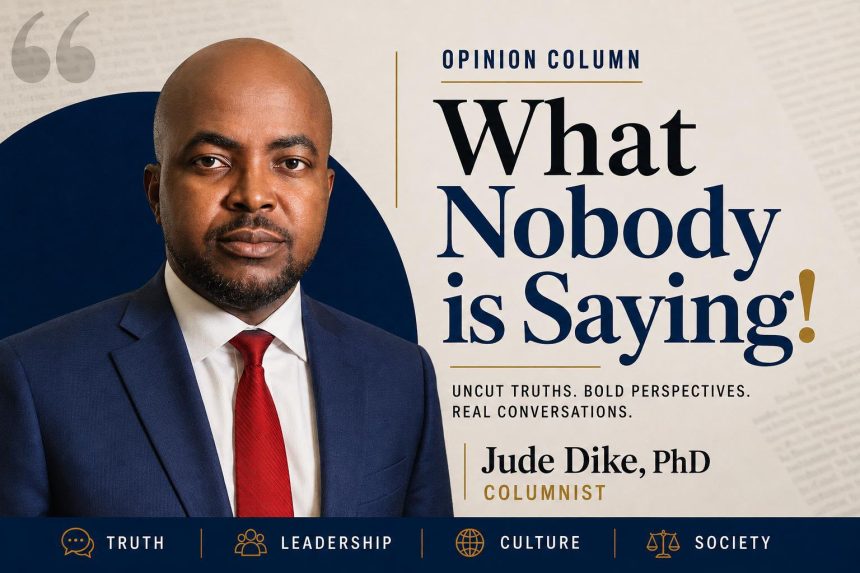
By Jude Dike, PhD
There are scams that steal your money.
And then there are scams that make you wonder whether the people guarding the money know who is standing at the door.
Nigeria may have just discovered the second kind.
The story began with a government agency that, according to investigators, did not exist.
Not metaphorically. Not politically. Legally.
The Presidential Foreign Investment Promotion Council – PFIPC, presented itself as part of the Nigerian government. It obtained official-looking documents. It secured government correspondence. It occupied space in a federal government complex. It moved through the corridors of the public service as though it belonged there.
Except, according to the Independent Corrupt Practices and Other Related Offences Commission – ICPC, it had no law, Executive Order or other valid government instrument establishing it. Its purported Director-General, Adeniyi Adeyemi, was never appointed by the Federal Government, the ICPC says. The commission also says the appointment letter, gazette and other documents used to support the organisation were forged.
Then comes the detail that makes this story much bigger than one alleged fraud.
The ICPC says it found no evidence that Federal Government money was approved or disbursed to PFIPC.
So where, exactly, is the scandal? It is hiding in plain sight. The scandal is that an institution that did not legally exist managed to become sufficiently real to the Nigerian state that government systems began treating it as though it did.
And that raises a question nobody should be able to walk away from: How many doors inside government have to open before a fake agency starts looking real?
That is the story. Not the man who allegedly forged the documents. The doors. Because a government is not just its President. It is a chain of permissions.
Someone checks the law. Someone checks the appointment. Someone checks the establishment instrument. Someone checks the organisational structure. Someone checks the account. Someone checks the budget. Someone checks the office. Someone checks the signatures. Someone checks the authority. Someone, somewhere, is supposed to say: “Stop. This institution does not exist.”
But in the PFIPC case, the alleged fiction travelled much further than that first stop.
And that is where Nigeria’s economic story gets uncomfortable.
Because the country is currently asking citizens to trust the state with more money, more taxes, more borrowing and more painful reforms.
Yet the same state is now having to ask itself a very basic question: Can we reliably verify who is part of the state?
That is not a corruption question. It is a public-finance question. It is an economic question. And ultimately, it is a question about whether the Nigerian state knows what it is doing.
The ₦1.3 billion that became a question mark
The PFIPC story gets stranger when it reaches the budget. According to the ICPC investigation as reported by Premium Times, the Budget Office processed the purported council into the 2026 federal budget despite gaps in its documentation and without independently verifying the legal instrument establishing it.
A purported administrative code had been conveyed by the Office of the Accountant-General of the Federation. Documents attributed to the Office of the Head of the Civil Service were also involved.
But the ICPC says the Budget Office did not independently establish that the council actually existed in law.
Then came the budget proposal. The purported PFIPC initially submitted personnel expenditure of ₦3.85 billion. The Budget Office did not accept that figure. Instead, after recalculating the personnel costs and determining overhead and capital allocations, the amount became approximately ₦1.3 billion.
And here is the truly remarkable part: According to the ICPC, there was no evidence that the ₦1.3 billion was actually released, cash-backed, paid or spent.
In other words, the most revealing number in this story may not be money that disappeared. It may be money that almost entered the machinery because nobody had firmly established that the machine should be there in the first place.
That distinction matters. Because the easiest Nigerian corruption story is: “Someone stole ₦1.3 billion.”
The harder story is: “Why did a non-existent institution get far enough into the budget process to receive a ₦1.3 billion provision?”
The second question takes us somewhere much more uncomfortable. It takes us inside the system.
The Nigerian state has a bigger accounting problem
Here is where PFIPC collides with something far more consequential. The International Monetary Fund’s 2026 assessment of Nigeria estimates a 2.7 percent of GDP statistical discrepancy in the 2025 consolidated government accounts.
The IMF says this could reflect spending not captured by the Office of the Accountant-General of the Federation.
It also notes that some expenditures were incorporated into budgets after the fact, having already been executed outside the budget perimeter.
Stop there.
A fake agency getting into a budget is one problem. A government having a material gap between what is recorded and what appears to have been spent is another.
Put the two together and the question becomes much larger: Does Nigeria have a spending problem, or does Nigeria have a problem knowing exactly what it has spent?
The distinction is enormous. Because you cannot properly control what you cannot properly identify. You cannot audit what you cannot trace. You cannot sanction responsibility that cannot be established. And you cannot build fiscal discipline on paperwork that different parts of government are not independently verifying.
This is the part of the Nigerian economic conversation that gets remarkably little attention. Everybody wants to know how much government borrowed. Everybody wants to know how much tax government collected. Everybody wants to know how much petrol costs. Everybody wants to know the size of the budget.
But before any of those numbers can mean what we think they mean, somebody has to make sure the underlying machinery is real.
Who created this institution? Under which law?Who appointed its head?Who supervises it?Who can spend its money?
Who audits it?
These sound like boring bureaucratic questions. They are not. They are the first line of defence between a government’s balance sheet and chaos.
And then the second fake agency appeared. If PFIPC were an isolated oddity, perhaps Nigeria could file it under “one extraordinary case.” But it wasn’t.
In August, the ICPC announced the discovery of another purported fake government entity: the National Brands Development and Made-in-Nigeria Special Project Office.
This one was allegedly operating within the premises of the Office of the Secretary to the Government of the Federation.
The President subsequently directed the arrest of its alleged promoter and the suspension of three permanent secretaries, according to the ICPC and contemporaneous reporting.
Now the story changes shape. One fake agency might be a fraud. Two cases penetrating government structures start looking like a systems question.
And the ICPC itself has identified weaknesses in verification procedures and inter-agency oversight as part of the PFIPC problem. That should worry anyone who cares about the Nigerian economy. Because the modern economy is built on trust in institutions.
An investor needs to know that an agency speaking for Nigeria actually speaks for Nigeria. A contractor needs to know that the person issuing an instruction has authority. A bank needs to know that the government entity opening an account actually exists. A citizen needs to know that the person collecting money in the name of government is actually authorised to do so. And a taxpayer needs to know that when government says: “This is where your money is going,”
There is a functioning system behind the sentence.
The politician is not the whole story
This is where Nigeria’s favourite argument becomes too easy. Politicians or civil servants? Who is accountable?
The answer is more uncomfortable than either camp wants. Politicians make political decisions. Civil servants make the machinery work. The politician can announce an agency. But somebody has to establish its legal basis. A minister can approve a policy. But somebody has to process the paperwork. A budget can be presented to Parliament. But somebody has to validate the entities asking for allocations. A government can announce reform. But somebody has to make sure the numbers reconcile.
That is why institutional failure is different from political failure.
A political system can change overnight. An institution cannot. Presidents come and go. Permanent secretaries rotate. Ministers leave. But the administrative process is supposed to survive all of them. Its job is precisely to prevent the state from becoming dependent on the memory, integrity or vigilance of whichever individual happens to occupy an office.
That is what procedures are for. That is what internal controls are for. That is what audit trails are for. That is what public financial management is for. And that is why the PFIPC story should not end with the arrest of one alleged promoter.
If the only lesson is “catch the bad guy,” Nigeria will have learned almost nothing.
The harder lesson is: Fix the doors.
Because Nigeria cannot afford a government that runs on trust alone
There is another number sitting quietly inside Nigeria’s fiscal story.
*mThe IMF estimates that Federal Government interest payments consumed 53.2 percent of Federal Government revenue in 2025.
More than half. That means the question of institutional efficiency is no longer an academic discussion for civil servants and auditors.
Every failed control has an economic cost. Every duplicated institution has a cost. Every unexplained expenditure has a cost. Every process that allows a fictitious entity to move through the government system has a cost. Every naira spent investigating something that should have been rejected at the first desk has a cost. And every reform that cannot be measured because the underlying records are incomplete has a cost.
Nigeria does not have an unlimited fiscal cushion. It is paying for debt. It is trying to raise revenue. It is trying to attract investment. It is trying to fund infrastructure.
It is trying to reduce poverty. It is trying to convince citizens that painful economic reforms will eventually produce a better economy.
At that moment, administrative failure becomes economic failure.
Because when money is scarce, every blind spot becomes expensive.
The subsidy lesson returns
This is where the PFIPC story loops back to the first edition of this column. We asked what happened to the money after Nigeria removed the fuel subsidy.
The IMF’s 2026 assessment contains another uncomfortable finding: the estimated savings from fuel-subsidy removal – up to 2 percent of GDP, did not appear to accrue to the budget in 2025. The IMF says a significant statistical discrepancy was also present in the fiscal accounts.
That does not mean the subsidy reform failed. It means something more basic: A reform can only produce a fiscal dividend that the state can identify, capture, record and deploy.
Otherwise, the citizen experiences the pain of reform while the public accounts struggle to demonstrate the full benefit. That is the invisible layer of Nigeria’s economic crisis.
We keep talking about money. But sometimes the deeper problem is the machinery through which money becomes information. And information becomes accountability.
The real Nigerian deficit
We spend enormous amounts of time discussing Nigeria’s budget deficit.
Maybe we should spend a little more time discussing Nigeria’s verification deficit.
The deficit between: what government says exists, and what the law says exists.
Between: what the budget contains, and what has actually been verified.
Between: what an official document appears to say, and who can authenticate it.
Between: what an agency claims to have authority to do, and where that authority actually came from.
Between: what government spent, and what the accounts can clearly show.
That is the deficit nobody sees on a Bloomberg terminal.
It does not appear on the naira-dollar chart. It does not trend on social media. But it quietly raises the cost of running the country.
And this is where accountability really begins
Perhaps Nigeria has spent too much time asking: Who is corrupt?
And not enough asking: Which control failed?
The first question looks backward. The second prevents the next failure.
If a document is forged, who verifies it?
If an agency is created, who confirms its enabling law?
If an appointment is claimed, who authenticates it?
If an agency requests a budget, who verifies its existence before assigning it a code?
If it requests an account, who checks its legal authority?
If it requests an office, who checks whether it is entitled to occupy government property?
If it gets through all those gates, who is responsible for the gatekeepers?
That is the accountability chain.
And every broken link matters.
Because the state is not an idea. It is a system.
The most expensive thing Nigeria can lose
Nigeria can survive a bad quarter.
It can survive a bad policy.
It can survive an embarrassing scandal.
What it cannot easily survive is the gradual erosion of confidence that the machinery of government knows what is real.
Because once citizens stop believing government records, investors become more cautious.
Once investors become more cautious, transactions become more expensive.
Once transactions become more expensive, investment falls.
Once investment falls, jobs become harder to create.
And once citizens believe that the system is incapable of distinguishing the real from the fictitious, every new tax, levy, reform or borrowing programme arrives carrying an additional cost:
distrust.
That is an economic cost too.
So, who is accountable?
The politician who allowed a system to become weak?
The civil servant who failed to follow a control?
The official who allegedly facilitated an irregular process?
The institution whose procedures were outdated?
The department that did not independently verify documents?
The agency that processed a request?
The people who designed the rules?
The people who failed to enforce them?
The answer cannot simply be one name.
Accountability has to follow the chain.
Where an individual deliberately forged, impersonated, falsified or took an improper benefit, criminal and administrative responsibility should follow the evidence.
Where an official failed to perform a defined duty, administrative accountability should follow.
Where a procedure was inadequate, the institution has to fix it. And where political leadership created or tolerated a system that repeatedly permits such failures, political accountability belongs there too.
Otherwise Nigeria will keep confusing punishment with reform. And those are not the same thing. Punishment tells us who was caught. Reform tells us why the next person will not be able to do it.
What Nobody Is Saying
The most frightening part of the PFIPC scandal is not that someone allegedly invented a government agency. It is that the Nigerian state gave the invention enough room to become believable.
That is the story.
The fake agency is almost a distraction.
The real story is the real government around it.
The offices. The codes. The documents. The budgets. The signatures. The procedures. The people. The approvals. The silence.
All the little pieces of a machine that are supposed to make government real. And if a fictitious institution can travel through enough of that machine to appear legitimate, then Nigeria has a problem that no arrest can solve.
Because tomorrow there will be another name. Another document. Another office. Another clever impersonation. Another person standing at another government door. And the question will be the same: Who checked?
That may be the most important question in Nigerian public finance right now.
Not: How much money did we lose?
But: How did we get so close to losing it before anyone asked whether the institution asking for it was real?
Nigeria has spent decades looking for the person who stole from the system. Perhaps this is the week we finally look at the system that let the person in.
Because the most dangerous thing about a fake government agency is not the fake agency. It is a real government that cannot verify itself.
About the Columnist
Dr. Jude Dike is a Nigerian-Canadian economist, public policy analyst, and best-selling author. As the columnist behind ‘What Nobody Is Saying,’ he brings a distinctive blend of academic expertise, government experience, international development insight, and public-policy analysis to the national conversation.
With a PhD in Economics and a master’s degree in Oil and Gas Economics from the United Kingdom, the columnist has built a versatile career spanning academia, government, international development, and policy advisory.
His professional experience includes serving as a college professor, World Bank consultant, senior legislative aide, senior government adviser, political strategist and public policy analyst.
Drawing on this broad experience, ‘What Nobody Is Saying’ offers incisive, independent commentary on Nigeria’s economy, politics, governance, public policy, energy sector, and the forces shaping the country’s future. Styled in the tradition of serious, analytical newspaper commentary, the syndicated column seeks to examine the issues beneath the headlines, challenge conventional thinking, and give voice to perspectives that often go unspoken.
As a Nigerian-Canadian with extensive international exposure and deep knowledge of Nigeria’s political economy, Dr. Dike brings a uniquely cross-cultural perspective to the country’s most consequential debates—asking not merely what is happening, but what nobody is saying about why it is happening and where it may lead.