

By Shakirudeen Bankole
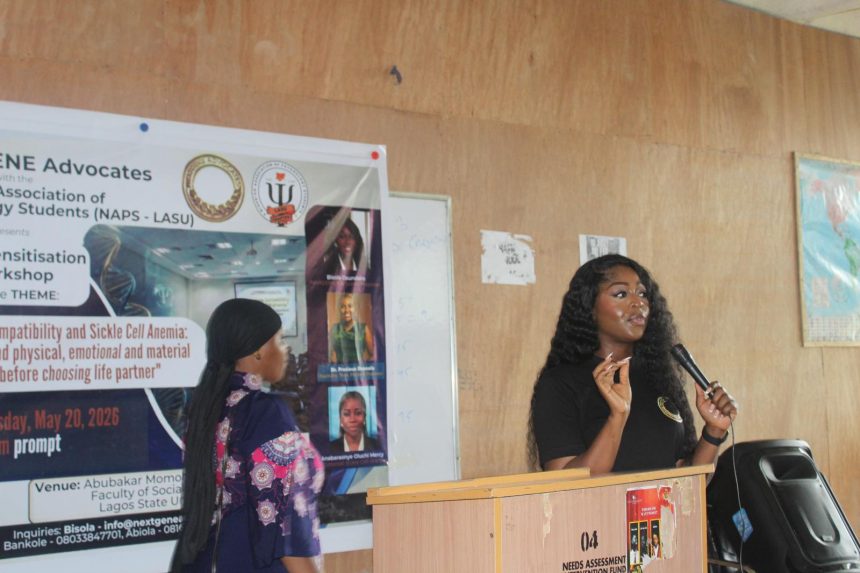
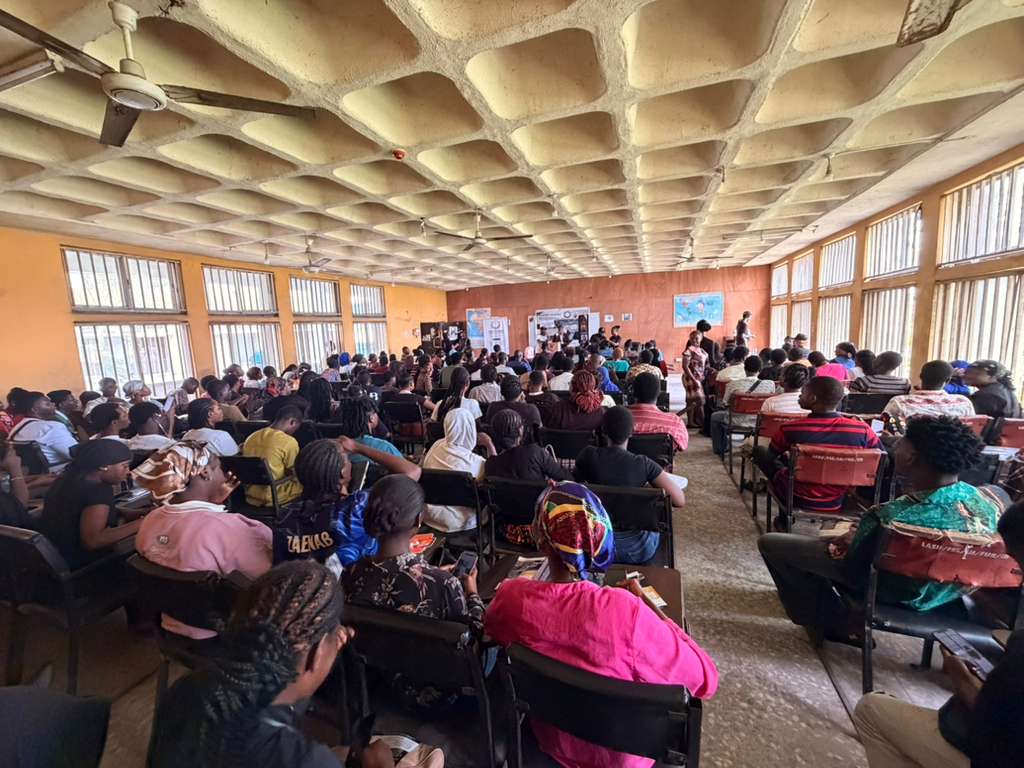
When Miss Anabaraonye Oluchi Mercy, a sickle cell survivor, stood before nearly 200 students at the Lagos State University few weeks ago to speak about her life struggles, the atmosphere inside the hall changed almost immediately.
Students who had moments earlier been distracted and quietly chatting among themselves suddenly became attentive.
For the next 30 minutes, the hall remained unusually still. Some students rested their chins on their palms. Others stared fixedly at the speaker. Many scribbled notes.
Mercy was not delivering a motivational speech. She was narrating a reality she would never wish on anyone.
Born with sickle cell disease, the young woman had lived a relatively normal life until about three years ago when recurrent crises began to take a devastating toll. Since then, she said, life had become a cycle of pain, hospital visits, interrupted dreams and mounting uncertainty.
For the first time publicly, she had summoned the courage to speak-up, about the scars left by years of injections, the businesses she lost, relationships that could not survive the strain, and the financial burden of managing a lifelong condition.
“If I open my body to you here, you will all cry for me,” she began, warning the audience who had earlier complimented her beauty and glowing fair complexioned skin.
“My painful scars and open wounds are only covered by my clothes and this beautiful face and skin.
“Is it to talk about relationships that had failed, the businesses that I had to abandon or the public solicitation for funding support when my crises became too expensive to handle? I bet you all don’t want to be in my situation,” she exhaled.
As she spoke, tears rolled down her cheeks. Occasionally, she would pause to wipe the tears away with a handkerchief before continuing.
By this point, the silence inside the hall had become overwhelming. Some students lowered their heads. Others simply stared. The message was crystal clear: avoiding genotype incompatibility while choosing life partner is but of necessity.
Watching quietly from the podium was Bisola Osundairo, the Founder and Executive Director of NextGENE Advocates, the convener of the one-day workshop on the theme: “Genotype Compatibility and Sickle Cell Anemia: Looking beyond physical, emotional, and material factors before choosing life partner.”
For Osundairo, Mercy’s testimony was more than another awareness programme. It was a painful reminder of why she founded the organisation.
Unfortunately, Nigeria carries one of the highest burdens of sickle cell disease in the world. According to the World Health Organosation, roughly one in four Nigerians carries the sickle cell trait, while between 100,000 and 150,000 babies are born with the disease every year.
For Osundairo, those figures are not merely public health data. They represent lives and a real human story – A family struggling to cope; Parents burdened by emotional and financial pressures; And a young person forced to suspend dreams and ambitions because of a condition they never chose. Hence, she has decided, preventing avoidable suffering has become the mission around which she has built her advocacy.
“I just want to do my best to help Nigeria drive down the incidences of sickle cell related sufferings and death.
And I think the best way is through public awareness campaigns and policy advocacy,” she said, exhibiting one of the rarest senses of loyalty to a country she is only affiliated to by parenting! She was born and lives in the United States of America.
As part of her strategic interventions, she is developing animated audio-visual series for children with SS, staging nationwide sensitisation campaign, and adopting and raising funds for struggling SS sufferers.
“Besides, I have equally decided to adopt fundraising programmes to provide special funding supports for sickle cell patients facing management crisis or difficulty in accessing healthcare,” she said.
Osundairo, a Nigerian American public health professional, said she did not arrive at advocacy through politics, activism or personal ambition. Rather, her decision to Lunch NextGENE Advocates was borne out of the conviction from a lifelong commitment to service and a belief that knowledge can prevent suffering.
“I have always been in the forefront, fighting for the good of humanity,” she recalled, with reference to her leadership at the university. Born and raised in Chicago, United States of America by Nigerian parents from Abeokuta, Ogun State, Osundairo is the fourth of five children.
Growing up, she said, education, discipline, empathy and service to others were values strongly emphasised in the home. That foundation would later shape both her academic pursuits and her commitment to public health.
“I am a respectful person. I smile a lot and greet people. I believe in hard work and personal integrity. There is no substitute for a life lived well and in service to humanity.”
Just as impressive her childhood, also is her educational journey. While still in high school, she participated in a dual enrolment programme that enabled her to earn an associate degree in Web Graphic Design alongside her secondary school education. She later obtained a Master of Public Health degree from the University of Illinois Urbana Champaign. At the University of Illinois Urbana Champaign, she served in the Illinois Student Senate and also worked as a community service representative for the African Cultural Association.
Her passion for service extended beyond the classroom, as she also studied in Cape Town, South Africa, volunteered in different communities and spent time in China, where she studied Wushu at Shanghai University of Sport.
Yet for all her academic achievements and international exposure, it was a simple question that continued to trouble her. Why were so many Nigerian families still experiencing avoidable pain associated with sickle cell disease? The answer, she concluded, lay partly in awareness.
“Apart from the annual commemoration of Sickle Cell Day, at nextGENE Advocates, we have resolved to stage a sustained nationwide campaign across the nooks and crannies of the country, sensitizing parents, couples, adults, adolescents, community, and religious leaders to the importance of Genotype Compatibility,” she explained.
As it is now, too many young people, she observed, approached relationships and marriage discussions without understanding the implications of genotype compatibility. Many only discover the consequences when emotions have already become deeply invested.
For Osundairo, the issue is personal. She carries the AS genotype trait herself. Unlike many young Nigerians who only learn about genotype compatibility when marriage becomes imminent, she understood early what that knowledge meant for her future. The understanding would later influence some of the most important personal decisions she would make. “Yes, in the past, I have actually turned down multiple suitors due to genotype compatibility,” she recalled.
“There was one that I felt was the full package but could not proceed due to the AS trait. Having to end what could have been was not a good feeling but I knew it was the responsible choice,” Osundairo, demonstrated the courage required to do the right thing and present the regret of a lifetime.
This particular experience reinforced a message that has now become central to her advocacy. “Love is not enough.”
The statement often generates debate. Some disagree with it. Others find it uncomfortable. But Osundairo remains unapologetic.
To her, the phrase is not a rejection of love. “It is a call for responsibility.”
While love matters, she argues, so do health, compatibility, informed decision-making and the wellbeing of future children.
“Making informed decisions is part of loving your partner and your future family.”
That philosophy was the premise upon which NextGENE Advocates was established. The organisation was founded on a simple principle: Informed decisions save lives, with the mission to educate young people about genotype compatibility, encourage early screening and normalise conversations that many families often postpone until it is too late.
Recently, that vision was put to the test during NextGENE Advocates’ first major sensitisation workshop at LASU. It was sone in partnership with the Nigerian Association of Psychology Students (NAPS). Nearly 200 students attended, including lecturers. More than 40 people volunteered to support future advocacy activities.
For Osundairo, however, the success of the programme could not be measured solely by attendance figures. What mattered most was the conversation it sparked. Many of the students had heard about sickle cell disease before. Yet few fully understood genotype compatibility or the lifelong consequences that can arise from incompatible unions. The workshop had revealed an uncomfortable reality.
In many discussions around relationships and marriage, conversations about physical attraction, finances and social status often take precedence over health considerations.
That reality concerns Osundairo deeply.
Meeting people living with sickle cell disease has transformed statistics into faces and names. She has listened to stories of interrupted education, lost economic opportunities, broken relationships and families struggling under the weight of medical expenses.
For many households, managing the condition is not only emotionally exhausting but financially devastating. Those experiences have also shaped her policy advocacy priorities.
She believes government intervention must move beyond periodic awareness campaigns.
Nigeria, she argues, requires stronger preventive healthcare systems, wider access to genotype screening, expanded health insurance coverage, improved support for people living with sickle cell disease and more robust community, based education programmes.
She also advocates the integration of genotype compatibility and sickle cell education into school curricula across the country.
For her, prevention remains the most humane and cost effective response.
“If we can prevent even one child from going through that pain, then the effort is worthwhile.”
Building NextGENE Advocates has not been without challenges. Funding remains difficult. Awareness gaps persist. Logistical obstacles are constant. Yet each challenge has strengthened her resolve. Leadership, she believes, is ultimately about service. Not titles. Not recognition.Not applause. But impact.
For Osundairo, success is measured by lives changed, knowledge shared and suffering prevented.
Somewhere in that auditorium sat young men and women who will one day make decisions about love, marriage and family.
Long after the workshop ended, many will probably remember Mercy’s tears.
That memory is precisely what Bisola Osundairo hopes remains with them. Not to frighten them. Not to discourage love. But to encourage informed choices. Choices that could spare another child from telling the same story.
And for Osundairo, that possibility alone makes the work worthwhile.