
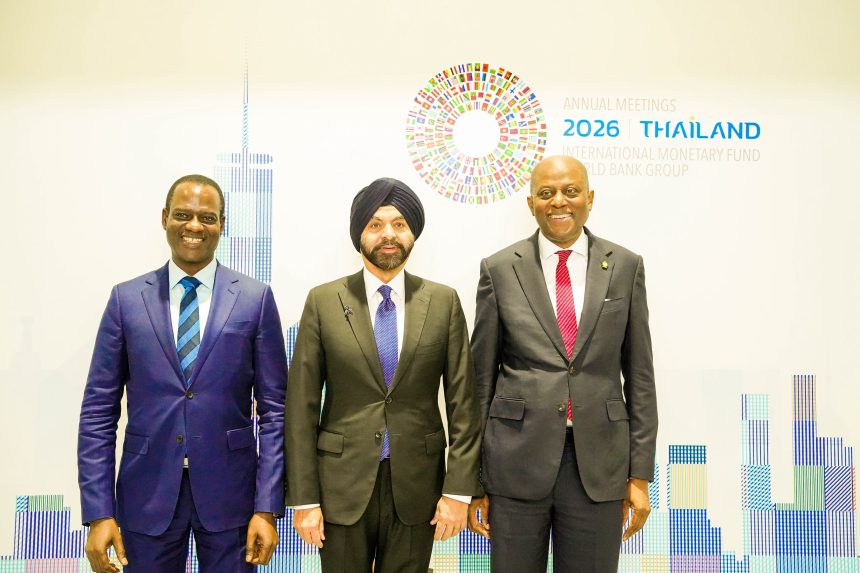
The Minister of Finance and Coordinating Minister of the Economy, Taiwo Oyedele and the Governor of the Central Bank of Nigeria, Olayemi Cardoso, met the President of the World Bank Group, Ajay Banga, on Monday on the sidelines of the 2026 IMF and World Bank Group Annual Meetings in Bangkok, Thailand.
The meeting reviewed Nigeria’s reform progress and the next phase of its agenda: turning macroeconomic stability into faster growth, more private investment and stronger domestic revenues.
Banga commended the progress of Nigeria’s reforms. He pointed to the rise in private capital inflows from about $300 million in 2023 to nearly $6 billion in 2026, a twentyfold increase.
Oyedele highlighted the rising economic growth and noted that Nigeria’s tax-to-GDP ratio rose from about 7 per cent to 12.5 per cent over the same period. This gives the government more room to fund public investment without resorting to deficit monetisation.
The meeting discussed how Nigeria can make greater use of World Bank guarantee instruments. These guarantees can unlock financing for infrastructure and draw more private capital into the domestic market.
Power infrastructure and human capital were identified as priorities for continued public investment, given their importance to business competitiveness, productivity and job creation. The meeting also stressed the quality of public spending, so that each naira delivers measurable economic and social returns.
The Ministry of Finance said Ina statement that the meeting is part of the Federal Government’s wider engagement with development partners to lock in reform gains and attract new investment. As Nigeria moves from stability to growth, the priority is to turn stronger fundamentals into productive investment, more jobs and better living standards for Nigerians.
Meanwhile, the Federal Government welcomed the World Bank Group’s efforts to mobilise up to $5.79 billion in private financing for Nigeria in fiscal year 2026, describing the initiative as an important opportunity to accelerate investment, expand economic opportunities and strengthen private sector-led growth.
The World Bank Group’s latest feature highlights how Nigeria’s ongoing economic reforms, combined with targeted investment platforms and risk-sharing mechanisms, are helping create opportunities for private capital to flow into critical sectors of the economy.
The financing initiative spans digital infrastructure, agriculture and micro, small and medium enterprises (MSMEs), with the potential to improve productivity, expand access to finance, strengthen food security and support job creation.
Key initiatives include the Building Resilient Digital Infrastructure for Growth (BRIDGE) Project, the Agricultural Value Chains for Growth (AGROW) Project and the Fostering Inclusive Finance for MSMEs in Nigeria (FINCLUDE) programme. Together, these initiatives demonstrate how public sector reforms and development finance can catalyse private investment at scale.
The Federal Government’s ongoing efforts to strengthen macroeconomic stability, improve public finances and enhance the investment climate remain central to creating a more predictable environment for businesses and investors. Sustaining these reforms will be critical to translating investment interest into productive capital, employment and improved living standards for Nigerians.
The Ministry of Finance will continue to support policies that strengthen investor confidence, deepen private sector participation and mobilise financing for Nigeria’s development priorities. The focus remains on ensuring that economic reforms deliver measurable outcomes through increased investment, stronger businesses and more inclusive growth.