
By Paul Lucky Okoku
There are moments when the way a leader leaves office deserves to be judged separately from the record he leaves behind.
On Thursday, August 27, 2026, Ibrahim Musa Gusau publicly confirmed at the NFF headquarters in Abuja that he had resigned as President of the Nigeria Football Federation. He said the decision followed consultations with family, friends and football stakeholders and was intended to make way for a comprehensive and orderly reform process in the overriding interest of Nigerian football.
I have assessed Gusau’s administration critically, and my overall view has not changed. In a recent interview, I gave his tenure 4 out of 10. That is a failing grade.
But that assessment does not prevent us from recognising an honourable decision at the end.
HIS RECORD MUST STILL BE JUDGED IN TOTALITY
Gusau’s resignation should not rewrite his presidency. His administration must still be judged on results, governance and institutional reform.
My overall assessment remains 4/10, based on a record that included:
* Super Eagles — 2026 FIFA World Cup: Nigeria failed to qualify.
* Super Falcons — 2026 WAFCON/2027 World Cup: The defending African champions were eliminated by Cameroon in the WAFCON quarter-finals and subsequently failed to qualify for the Women’s World Cup for the first time.
* Olympic Eagles/U-23: Nigeria failed to qualify for the 2023 U-23 AFCON and consequently missed the Paris 2024 Olympic football tournament.
* Golden Eaglets/U-17: Nigeria missed the 2023 FIFA U-17 World Cup and suffered further qualification setbacks at WAFU B level.
* Flying Eagles/U-20: The record was mixed. Nigeria finished third at the 2025 U-20 AFCON and reached the Round of 16 at the 2025 FIFA U-20 World Cup, but in August 2026 lost 4–1 to Burkina Faso in the WAFU B final and missed qualification for the 2027 U-20 AFCON.
* U-15/Future Eagles: This remains primarily a developmental programme rather than a FIFA/CAF qualification category and should therefore be judged differently.
* Governance: Electoral reform expanded the Congress, but the 36 State Football Associations and FCT still retained 37 of 54 votes — about 68.5 per cent — leaving one constituency with more than two-thirds of the voting strength.
There were also achievements. Gusau pointed to renewed coaching education, greater stability in the domestic league calendar, progress in refereeing and infrastructure projects, including a 68-room players’ hostel and new training pitches at the MKO Abiola National Stadium. He also cited the Super Eagles’ silver and bronze AFCON finishes and the Super Falcons’ 2025 WAFCON title.
Those gains deserve acknowledgement. But judged in totality, I still consider the tenure a failing one. If any result has been inadvertently attributed to his administration, or if any relevant achievement or failure has been omitted, the omission is unintended, and I remain open to correction.
THE VALUE OF KNOWING WHEN TO LEAVE
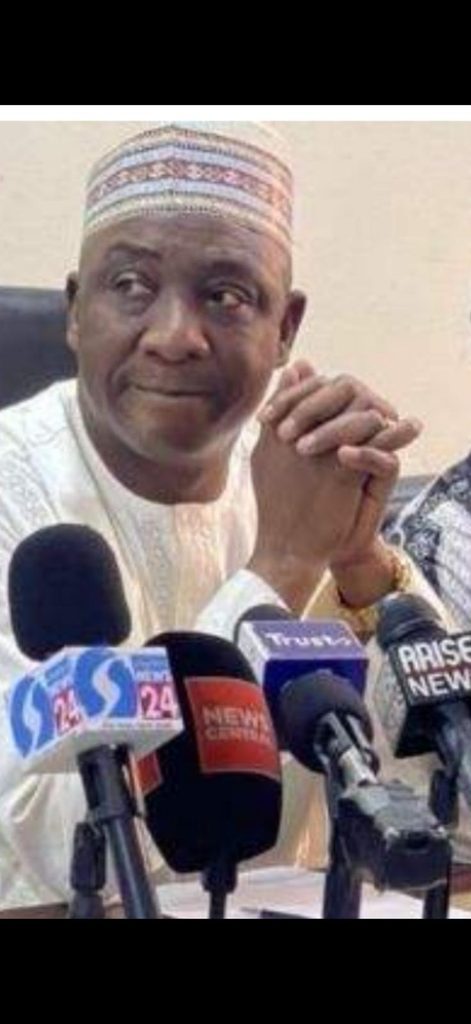
*Gusau
Nigeria has never developed a strong resignation culture. Too often, leaders remain in office despite poor results, declining confidence or demands for change. Holding on becomes confused with strength.
That is why Gusau’s decision deserves respect.
Unlike several of his recent predecessors, Gusau was not impeached, dissolved out of office or dragged through a prolonged battle for control. He announced that he was stepping aside.
Whatever ultimately contributed to his resignation — the weight of results, internal pressure, government scrutiny or other considerations — he still had choices. He could have resisted and allowed the crisis to become another prolonged institutional battle.
Nigerian football has seen domestic disputes quickly reframed as questions of government interference and elevated to FIFA. During the Aminu Maigari era in 2014, FIFA suspended Nigeria. During Amaju Pinnick’s presidency in 2018, FIFA gave Nigeria a deadline to restore the leadership it recognised or face suspension.
Even during recent debates over accountability and reform, warnings about possible FIFA consequences regularly surfaced in public commentary.
Yet Gusau did not take that route. He stepped aside.
Accountability should not automatically become a FIFA matter. If government has legitimate questions about the use of public funds or football administration, those questions should be answered transparently and lawfully. Nigerian football cannot continue treating every demand for accountability as though it must inevitably become a dispute with FIFA.
For choosing departure rather than escalation, I doff my hat to Ibrahim Musa Gusau.
THE REAL TEST IS WHAT COMES NEXT
Gusau’s resignation is not reform. Sanusi’s departure is not reform either. The real test is what comes next.
President Bola Ahmed Tinubu has now called for comprehensive reform addressing governance, stakeholder representation, development pathways, domestic competitions and accountability. He also directed the National Sports Commission to work with the NFF Secretariat and football stakeholders while safeguarding Nigeria’s obligations to FIFA and CAF.
That gives this transition a larger purpose.
If old names are merely replaced by new ones while the same imbalance, weak accountability and governance problems remain, then little will have changed.
But if this moment produces broader representation, stronger institutions and better football administration, Gusau’s final act may carry significance beyond his presidency.
His record remains 4/10 in my assessment. Yet in knowing when to leave, he has offered Nigerian football — and Nigerian leadership more broadly — a lesson worth remembering.
*Paul Lucky Okoku is a
FIFA Legend | Former Nigeria Flying Eagles Vice-Captain | Former Super Eagles International | AFCON Silver Medalist | Football Historian | Football Analyst | Journalist-at-Large | Founder & CEO, Greater Tomorrow Children’s Foundation (GTCF)