
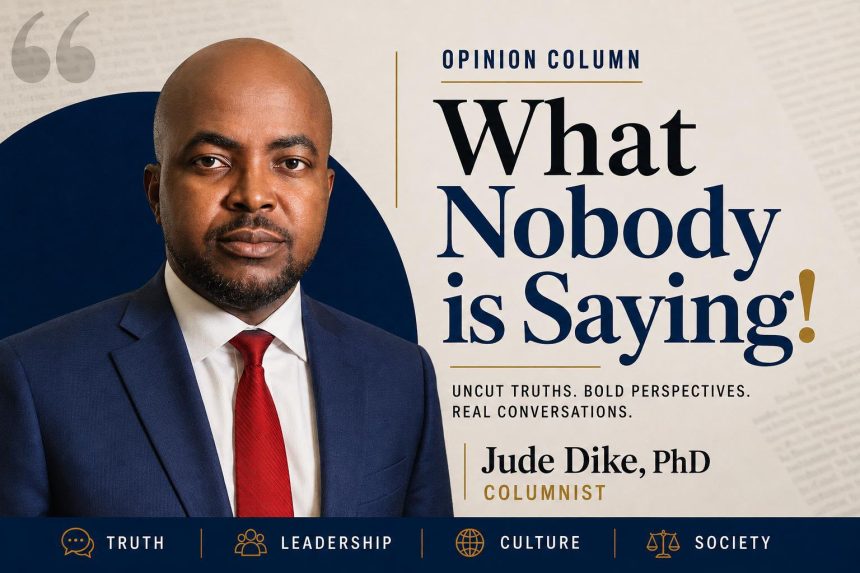
By Jude Dike, Ph.D.
There is a question Nigerians have been asking in bus parks, markets, offices, homes and petrol stations, and increasingly in the political arena:
If the fuel subsidy was removed to save Nigeria money, where is the money?
It is a deceptively simple question. It is also the question at the heart of Nigeria’s economic argument as the country moves toward the 2027 elections.
President Bola Ahmed Tinubu announced on May 29, 2023, that “the subsidy is gone.” Petrol prices rose sharply almost overnight. The reform was defended as painful medicine for a sick economy: the government could no longer afford to spend enormous sums keeping petrol artificially cheap, particularly when the subsidy was vulnerable to smuggling, fraud and unequal distribution.
There was an economic case for the policy.
But there was also a political and moral obligation attached to it: if Nigerians were asked to make the sacrifice, government had to show Nigerians exactly what their sacrifice purchased.
For too long, the first half of that bargain has received more attention than the second.
The case for removing the subsidy.
The old subsidy regime was not the social-justice triumph it was often portrayed to be.
The World Bank estimated that Nigeria spent more than ₦8.6 trillion on gasoline subsidies between 2019 and 2022. Its analysis concluded that the subsidy disproportionately benefited better-off consumers while encouraging waste, smuggling and black-market activity.
That is hardly an efficient way to fight poverty.
A poor Nigerian who does not own a car does not receive the same benefit from cheap petrol as a wealthy household running several vehicles or generators. Yet both are subsidised whenever they buy petrol.
There was another problem: the subsidy consumed fiscal space that Nigeria desperately needed for roads, schools, hospitals, electricity, security and productive investment.
The World Bank estimated in 2023 that subsidy removal could save Nigeria about ₦2 trillion in 2023 and more than ₦11 trillion cumulatively by the end of 2025.
The reform also helped eliminate the queues, shortages and smuggling incentives associated with artificially cheap petrol. By moving toward market pricing, Nigeria created a more rational environment for domestic refining and private investment.
That is the economic argument.
It is not a foolish argument.
Indeed, there is a strong argument that Nigeria should never again return to a system in which the government promises cheap petrol to everyone while quietly absorbing enormous fiscal losses.
But the economics did not end at the petrol station
This is where the story becomes uncomfortable.
Removing a subsidy does not make Nigerians richer simply because government becomes fiscally stronger.
It transfers the burden from the government budget to households unless something else is done.
And petrol is not merely a commodity in Nigeria. It is an input into transportation, food distribution, electricity generation, manufacturing and virtually every aspect of commercial life.
The immediate result was therefore predictable: the price of moving people and goods rose, businesses raised prices, households lost purchasing power and inflation accelerated.
In August 2023, shortly after the reform, headline inflation was 25.80 percent, according to the Nigerian Bureau of Statistics. By June 2024 it had reached 34.19 percent.
The World Bank reported that gasoline prices increased by an average of 163 percent following the reforms, while the naira also depreciated sharply.
So, did Nigerians fare better after subsidy removal?
On the narrow question of macroeconomic stability, increasingly yes. On the question of household welfare, the answer is much more complicated, and for millions of Nigerians, initially and painfully, no.
Nigeria’s real economy has begun to show improvement. The National Bureau of Statistics reports real GDP growth of 3.89 percent in the first quarter of 2026, up from 3.13 percent in the first quarter of 2025.
Inflation has also fallen dramatically from its 2024 peak. In July 2026, headline inflation was 15.43 percent, compared with 24.94 percent a year earlier. But food inflation was still 20.31 percent.
And there is an important distinction politicians often avoid:
A lower inflation rate does not mean prices have returned to where they were. It means prices are rising more slowly.
The loaf of bread does not become cheaper merely because inflation falls.
The World Bank estimates that more than 60 percent of Nigerians were living below the national poverty line in 2025, with an additional seven million people estimated to have fallen into poverty that year.
That is the paradox of Tinubu’s reforms: the balance sheet can improve while the family budget remains under siege.
The palliatives: good intentions, inadequate execution.
The government knew this danger.
The World Bank warned before and during implementation that compensation would be essential. It specifically cautioned that without compensating transfers, vulnerable households could be pushed into poverty and forced to cut spending on education and health.
The government announced cash transfers, CNG initiatives, wage awards and other interventions.
But the problem was not merely whether palliatives existed on paper. The question was whether they were large enough, fast enough, transparent enough and well targeted enough to offset the shock.
The World Bank later observed that implementation of targeted cash transfers to 15 million vulnerable households was slower than planned.
That is not a minor administrative inconvenience. It goes to the heart of the reform.
There is a world of difference between telling a worker that government has saved billions of naira and telling that worker: Here is your transport support, here is your food support, here is the new bus service, here is the school feeding programme, and here is the hospital that your sacrifice helped build.
That is the difference between economic reform and social contract.
Indonesia offers Nigeria a lesson.
Nigeria is hardly the first country to confront this dilemma. Indonesia repeatedly reformed fuel subsidies, but crucially, it coupled major price increases with cash transfers and social programmes for poorer households. In 2005, the Indonesian government used part of its subsidy savings to establish a large cash-transfer programme reaching poor and near-poor households. Later reforms were similarly accompanied by compensation measures.
India offers another lesson.
It gradually liberalised fuel pricing while redirecting fiscal resources toward infrastructure and other priorities. The World Bank found that fuel-pricing reform could produce fiscal, distributional and environmental gains, but also stressed the importance of better targeting of assistance.
The lesson is not that Nigeria should copy Indonesia or India. It is that subsidy reform succeeds politically when citizens can see what replaces the subsidy.
Nigeria removed the visible benefit – cheap petrol, much faster than it created visible alternatives.
Now comes the missing ledger.
This brings us to the most important development of the past week.
The Federal Government has finally put a large number on the table.
Finance Minister Taiwo Oyedele says subsidy savings mobilised ₦15.8 trillion between June 2023 and December 2025. The government says ₦5.43 trillion was attributable to the Federal Government, ₦6.52 trillion to states and ₦3.88 trillion to local governments.
This is important. But it also creates another question.
The government itself says the ₦15.8 trillion was not a pile of money sitting in a bank account labelled “fuel subsidy savings.” Rather, the savings manifested through the wider Federation revenue system, while exchange-rate reforms and other changes also affected revenues.
That distinction is economically legitimate.
But it cannot become an excuse for accounting ambiguity.
If ₦15.8 trillion is the government’s estimate of resources mobilised by subsidy reform, Nigerians deserve a reconciliation statement showing:
– what was saved from the subsidy itself;
– what resulted from exchange-rate changes;
– what resulted from higher oil production or oil prices;
– what was actually received by the Federation;
– what was distributed through FAAC;
– what was retained by each tier of government; and
– what was spent on identifiable projects and programmes?
Otherwise, “FAAC allocations increased” becomes a convenient political slogan rather than an audit trail. And there is a further reason to demand clarity.
The Federal Government says its incremental resources during the period amounted to about ₦20.4 trillion, comprising ₦5.43 trillion from subsidy savings, ₦3.12 trillion in other incremental revenues and ₦11.85 trillion in additional borrowing. Yet incremental expenditure reached approximately ₦30.64 trillion.
The government says the additional spending included ₦9.39 trillion for wage adjustments, ₦9.37 trillion in additional external debt-service costs and ₦6.5 trillion for strategic infrastructure.
That is an explanation. But Nigerians should not be expected to accept an explanation when they can reasonably demand documentation.
What about Atiku’s proposal to bring the subsidy back?
Former Vice President Atiku Abubakar has now made the subsidy question a central plank of his 2027 campaign. He has said that if elected president, he would restore the petrol subsidy, arguing that Nigerians have not seen sufficient benefit from its removal and asking where the money went.
There is an important irony here.
Atiku’s current position is different from the gradualist approach he advocated in 2024. At that time, he said he supported subsidy removal but criticised the manner and speed of implementation.
Now he proposes restoration. Should Nigerians accept it? Not automatically. Restoring a universal petrol subsidy would bring an immediate political benefit: lower pump prices, lower transport costs and perhaps temporary relief for households.
But it would also recreate the fundamental weaknesses of the old system.
It would cost enormous sums, encourage smuggling and arbitrage, benefit richer consumers as well as poorer ones, and expose the national budget once again to international oil-price and exchange-rate shocks.
It could also discourage investment in refining and create the political temptation to keep prices artificially low even when the treasury cannot afford it.
But the argument against restoration should not be confused with an argument against government intervention.
There is a better question: Why subsidise every litre consumed by everybody when government can directly subsidise the Nigerians who actually need help?
A targeted transport subsidy, expanded public transportation, school feeding, health insurance, direct cash transfers, support for small businesses and cheaper energy alternatives would be economically more defensible than subsidising the petrol tank of a wealthy Nigerian.
If global oil prices or a new external shock suddenly make fuel unaffordable, a temporary, targeted intervention could still be justified.
But a permanent universal subsidy is not economic reform. It is a recurring fiscal liability dressed up as compassion.
And where has the National Assembly been?
This is where Nigeria’s legislators must answer their own uncomfortable question.
The National Assembly is not powerless.
It possesses constitutional oversight authority. It can summon officials. It can demand documents. It can compel explanations. It can examine budgets, revenues and public expenditure.
And, to be fair, the Senate and House committees have conducted other investigations into public revenues and government spending. In 2025, for example, the Joint Finance Committees established a panel to investigate more than ₦4 trillion in revenue shortfalls associated with government waivers and unremitted revenues.
So the charge cannot fairly be that every member of the National Assembly has been completely silent about public finance.
The stronger charge is this: Where is the comprehensive, transparent, dedicated parliamentary investigation into the ₦15.8 trillion subsidy-savings account – its methodology, sources, distribution and final utilisation?
That investigation is now more urgent than ever.
Indeed, the issue has already attracted renewed demands for scrutiny. The Allied Peoples’ Movement has petitioned the National Assembly and EFCC over alleged discrepancies in the government’s figures, while the Nigeria Employers’ Consultative Association has called on states and local governments to account for the ₦10.4 trillion distributed to them.
These allegations are not proof of wrongdoing; they are, however, sufficient reason for an independent accounting exercise.
The National Assembly should not wait for a political party to make the demand. It should initiate the investigation itself.
A national emergency of accountability.
Let the Senate and House of Representatives jointly summon the Minister of Finance, the Accountant-General of the Federation, the Auditor-General, NNPCL, the relevant petroleum regulators and the FAAC authorities.
Let every state publish what it received. Let every local government publish what it received. Let citizens see the projects. Let the government distinguish subsidy savings from exchange-rate gains, ordinary revenue, oil revenue and borrowing. Let the Auditor-General independently reconcile the figures. Let the National Assembly publish the findings.
And if the money was properly spent, the government should welcome the exercise.
If it was not, those responsible should face the law. This is not an argument for Atiku. It is not an argument for Tinubu. It is an argument for Nigeria. The verdict Nigerians should demand.
The fuel subsidy removal should not be judged solely by the price at the petrol pump.
Nor should it be judged solely by the size of the government’s revenue.
It should be judged by whether Nigeria converted a costly and poorly targeted subsidy into better roads, cheaper transportation, reliable electricity, stronger schools, functioning hospitals, jobs and a measurable reduction in poverty.
That is the test.
The government may ultimately prove that the reform prevented an even deeper fiscal crisis. The evidence increasingly suggests that it did create substantial fiscal space and improve several macroeconomic indicators. The World Bank has described the reforms as necessary to avert severe fiscal and economic risks.
But avoiding catastrophe is not the same thing as creating prosperity.
A government cannot ask citizens to endure extraordinary sacrifice indefinitely on the promise that the statistics will eventually improve.
And the opposition cannot simply promise to bring back cheap petrol without explaining how it will finance it without repeating the failures of the past.
The governing party owes Nigerians an account. The opposition owes Nigerians a credible alternative. And the National Assembly owes Nigerians an investigation.
Because in the end, the most important question about subsidy removal is not whether it was removed.
It is whether the sacrifice of millions of Nigerians was converted into a better Nigeria.
If the answer is yes, show us the ledger. If the answer is no, tell us why. And if nobody can satisfactorily answer either question before 2027, Nigerian voters will have every democratic right to write their own conclusion on the ballot.
That is what nobody should be saying quietly. It is what everybody should be asking loudly.
*About the Columnist
Dr. Jude Dike is a Nigerian-Canadian economist, public policy analyst, and best-selling author.
As the columnist behind What Nobody Is Saying he brings a distinctive blend of academic expertise, government experience, international development insight, and public-policy analysis to the national conversation.
With a PhD in Economics and a master’s degree in Oil and Gas Economics from the United Kingdom, the columnist has built a versatile career spanning academia, government, international development, and policy advisory. His professional experience includes serving as a college professor, World Bank consultant, senior legislative aide, senior government adviser, political strategist and public policy analyst.
Drawing on this broad experience, What Nobody Is Saying offers incisive, independent commentary on Nigeria’s economy, politics, governance, public policy, energy sector, and the forces shaping the country’s future. Styled in the tradition of serious, analytical newspaper commentary, the syndicated column seeks to examine the issues beneath the headlines, challenge conventional thinking, and give voice to perspectives that often go unspoken.
As a Nigerian-Canadian with extensive international exposure and deep knowledge of Nigeria’s political economy, Dr. Dike brings a uniquely cross-cultural perspective to the country’s most consequential debates—asking not merely what is happening, but what nobody is saying about why it is happening and where it may lead.