

By Prof. Eugene Bakama Bope
Transitional justice in Bama, Borno State, represents one of Nigeria’s most complex and locally driven attempts to address the legacies of mass violence inflicted by Boko Haram. The devastation wrought by Boko Haram’s insurgency—ranging from mass killings, abductions, and sexual slavery to the displacement of over two million people—has generated unprecedented humanitarian and justice challenges in northeastern Nigeria.
In this context, Bama has emerged as a testing ground for community-based reconciliation processes and reintegration of ex-combatants within a broader framework of transitional justice (TJ).
This paper examines what can be learned from the transitional justice experiences in Bama, the process itself, and the extent to which the rights of Boko Haram victims have been recognized and protected. It argues that while local reconciliation efforts and reintegration programs have contributed to restoring social order, they remain constrained by limited victim participation, inadequate reparations, and weak institutional capacity.
The Context of Transitional Justice in Bama
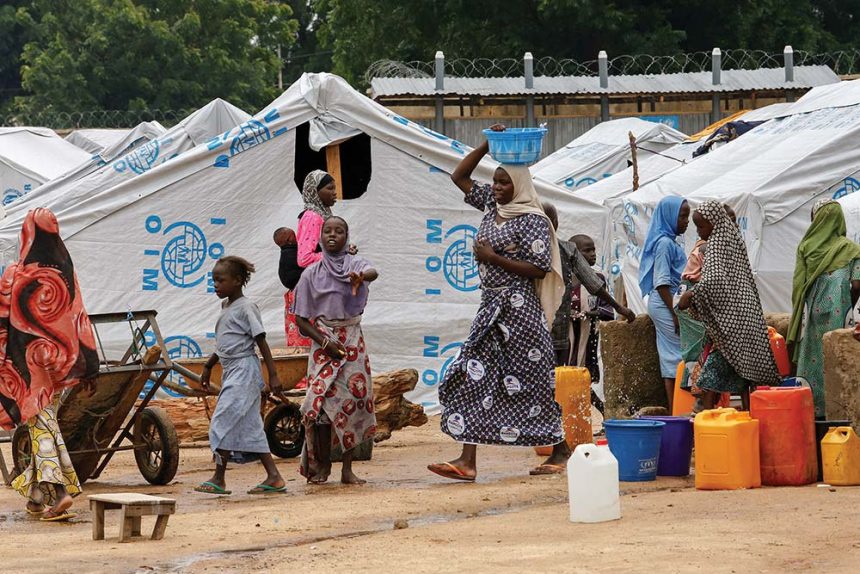
The town of Bama, once a major Boko Haram stronghold, witnessed some of the most severe atrocities during the insurgency. The Nigerian government’s military campaign to reclaim the town in 2015 led to mass displacement, leaving thousands in internally displaced persons (IDP) camps. The humanitarian crisis created a need for not only physical reconstruction but also social and psychological healing.
In response, the Nigerian government launched the “Borno Model” of transitional justice, combining military rehabilitation with community reconciliation. This initiative was implemented under the Operation Safe Corridor (OSC) program, which sought to de-radicalize and reintegrate “repentant” Boko Haram members. Local peace committees in Bama were tasked with mediating between victims and ex-combatants, encouraging forgiveness and coexistence.
Lessons from the Transitional Justice Process
The Bama experience highlights several key lessons in the practice of transitional justice within an African context marked by ongoing insecurity.
- Local Ownership and Customary Mediation
A major success factor has been the incorporation of traditional leaders, religious authorities, and women’s associations in the reconciliation process. These actors relied on customary dispute resolution methods to foster community healing. Such local ownership ensured that reconciliation was not imposed from above but emerged from shared norms of forgiveness and coexistence. This aligns with African Union transitional justice principles emphasizing local legitimacy and participatory approaches.
- The Limits of Reintegration without Accountability
However, the process also exposed the tension between reintegration and justice. Many victims perceived the rehabilitation of ex-Boko Haram members as impunity, particularly given the absence of formal prosecutions. The Operation Safe Corridor’s focus on “deradicalization” rather than criminal accountability undermined confidence in the justice process. Transitional justice, to be effective, must balance forgiveness with truth-telling, justice and reparations.
- Victim-Centered Approaches and Psychosocial Healing
Another critical lesson is the need for trauma-informed victim engagement. In Bama, victims—especially women and children—bear lasting scars from abductions, sexual violence, and displacement. Despite this, many were excluded from decision-making or reparations programs. Sustainable peace requires recognizing victims not only as passive recipients of aid but as active agents of reconciliation. Victims’ associations and civil society organizations should thus play a greater role in shaping justice mechanisms.
- Community Security and Social Reintegration
Security concerns have complicated reintegration. Many residents fear the return of ex-combatants, leading to stigmatization and renewed cycles of violence. Trust-building measures, community policing, and dialogue forums have been partially successful but need sustained institutional backing. Without addressing the root causes of radicalization—poverty, youth unemployment, and weak governance—reintegration will remain fragile.
The Rights of Boko Haram Victims
Victims of Boko Haram violence possess fundamental rights under international and domestic law, including the rights to truth, justice, reparations, and guarantees of non-recurrence. The United Nations’ Basic Principles and Guidelines on the Right to a Remedy and Reparation (2005) underscore that victims must receive effective remedies for gross human rights violations. Nigeria’s obligations under the African Charter on Human and Peoples’ Rights further strengthen these rights.
In Bama, implementation of these rights remains partial. Truth-seeking has largely occurred informally through community dialogue rather than formal commissions. Justice mechanisms remain weak due to the limited capacity of courts and reluctance to prosecute Boko Haram suspects beyond the most egregious cases. Reparations programs have been inconsistent, focusing more on humanitarian relief than restitution or compensation. Guaranteeing non-recurrence requires institutional reform—particularly in the security and justice sectors—to prevent future abuses.
Moving Forward: Strengthening Transitional Justice in Bama
To consolidate peace in Bama, transitional justice must be institutionalized through a coherent legal and policy framework. This involves integrating local peace practices with formal state mechanisms and ensuring meaningful victim participation. The Nigerian government should operationalize the National Policy on Transitional Justice (2022), which emphasizes truth-telling, accountability, and reparations. Donor agencies and civil society actors must also strengthen psychosocial support systems and livelihood programs for victims and reintegrated persons alike.
Ultimately, transitional justice in Bama demonstrates that reconciliation cannot be divorced from justice. The moral legitimacy of the process depends on whether victims feel heard, respected, and compensated.As one Bama community leader remarked, “we can forgive, but we cannot forget; justice must accompany peace.”
Conclusion
The experience of Bama, Borno State, offers crucial insights into the promise and perils of community-based transitional justice in Nigeria. It illustrates that sustainable peace requires more than security stabilization, demands acknowledgment of suffering, accountability for crimes, and empowerment of victims as agents of change. Learning from Bama, Nigeria must move toward a holistic approach that harmonizes forgiveness with justice, ensuring that the rights of Boko Haram victims remain central to post-conflict recovery.
*Eugene Bakama Bope is Associate Professor at the Protestant University of Lubumbashi, DRC, and a Transitional Justice Specialist at the African Union Commission