

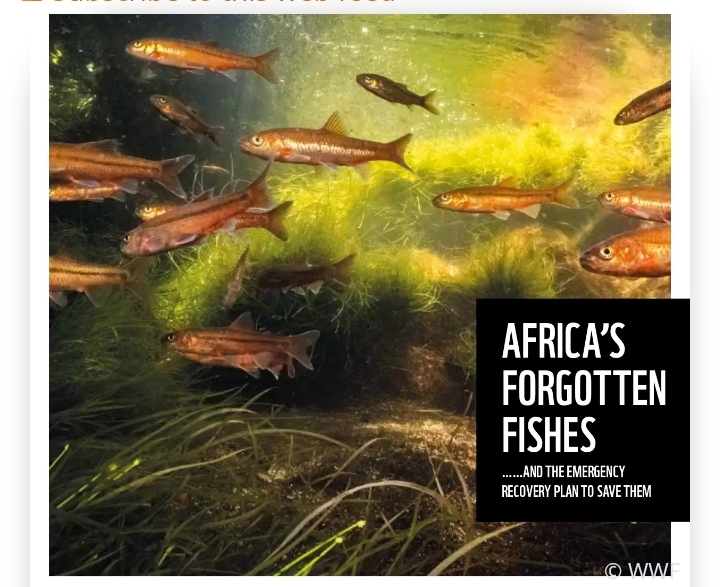
WWF today released a new reportÂin the lead-up to a major global wetlands conference in Zimbabwe, where countries will set the course for safeguarding and restoring vital freshwater ecosystems. The report, titled “Africa’s Forgotten Fishes,” reveals that 26% of Africa’s assessed freshwater fish species are threatened with extinction, with the true number potentially being much higher due to significant data gaps.
“Africa is a global hotspot of freshwater fish diversity, home to over 3,200 species, but it’s also a hotspot of risk,” said Eric Oyare, WWF Africa Freshwater Lead. “When these fish disappear, we lose much more than species: we lose food & nutrition security, livelihoods, ecosystem balance, and adaptive capacities to climate change. These declines are a red flag for the broader health of Africa’s freshwater ecosystems, which are the very life support systems for people and nature.”
Often overlooked in global conservation conversations, Africa’s freshwater fishes are ecologically remarkable. The new report highlights extraordinary species such as the African lungfish, which breathes air and can survive years buried in mud during droughts; a blind cichlid from the Congo Basin adapted to life in underground aquatic caves; the ancient bichirs, often referred to as “living fossils” for their lineage that predates the dinosaurs; and the formidable African tigerfish, a fast-swimming predator renowned for its powerful jaws and hunting skills.
Freshwater fishes play a vital role in maintaining the health of aquatic ecosystems, acting as predators, herbivores and nutrient recyclers. They are also the backbone of inland fisheries that support millions of African households, especially the most vulnerable. But these lifelines are collapsing under the weight of multiple threats:
Habitat destruction from dams, deforestation, mining, and land conversion
Pollution from agriculture, urban areas and industry
Invasive species and overfishing, including destructive gear like mosquito nets
Climate change, which alters rainfall patterns, dries out rivers and heats lakes
Across the continent, freshwater fish populations are in freefall. In the Zambezi floodplain, catches of key species have dropped by up to 90%. At the same time, Lake Malawi’s iconic ‘chambo’ tilapia, a staple food and national symbol featured on the Malawian Kwacha, has declined by 94%.
Machaya Chomba, Africa Freshwater Protection Manager at The Nature Conservancy (TNC), which helped produce the report alongside other partner organisations, said: “The disappearance of freshwater fish is not just a biodiversity crisis, it is a direct threat to food, livelihoods and cultural identity for millions across Africa. These species are the backbone of local economies and daily life. To protect them, we must restore and reconnect the rivers and wetlands that sustain both nature and people.”
WWF urges African governments and stakeholders to adopt the Emergency Recovery Plan for Freshwater Biodiversity.
This science-based, practical roadmap has been developed by leading experts to restore the health of freshwater ecosystems and the communities that rely on them
The plan outlines six urgent actions:
Let rivers flow more naturally
Improve water quality in freshwater ecosystems
Protect and restore critical habitats and species
End unsustainable resource use
Prevent and control invasive non-native species
Safeguard free-flowing rivers and remove obsolete barriers
Eric Oyare, WWF Africa Freshwater Lead, says: “These six pillars have all individually been implemented successfully in countries around the world. With bold leadership, African countries can adapt them to local contexts, helping secure freshwater biodiversity for generations to come.”
But the report also offers hope. Community-led conservation efforts are showing success in Tanzania, Zambia, Namibia, and beyond, protecting breeding zones, co-managing fisheries, and restoring degraded habitats. New global frameworks, like the Freshwater Challenge, now joined by 20 African countries, offer a path forward.
“It’s time we stopped treating freshwater fishes as an afterthought,” said Nancy Rapando, WWF Africa Food Futures Lead. “They are central to Africa’s biodiversity, development and future. We must act now before the rivers dry out.”
The Ramsar COP15, formally known as the 15th Conference of the Contracting Parties to the Convention on Wetlands (COP15), which will take place from 23rd to 31st July 2025 in Zimbabwe, will bring together governments, scientists and conservationists to tackle the rising threats facing freshwater ecosystems and chart a path toward more sustainable management.
African countries have a unique opportunity to lead by example by putting freshwater ecosystems and fish at the heart of conservation and development decisions. That means implementing the 30×30 inland waters target under the Global Biodiversity Framework, joining and accelerating the Freshwater Challenge, and adopting the Emergency Recovery Plan for Freshwater Biodiversity.
“The future of Africa’s rivers and fishes is inseparable from the future of its people,” says Itai Chibaya, WWF Zimbabwe Country Director. “We need bold action at Ramsar COP15 to restore the life support systems of this continent, starting with our forgotten freshwater ecosystems.”
The full report is available at africa.panda.org/