

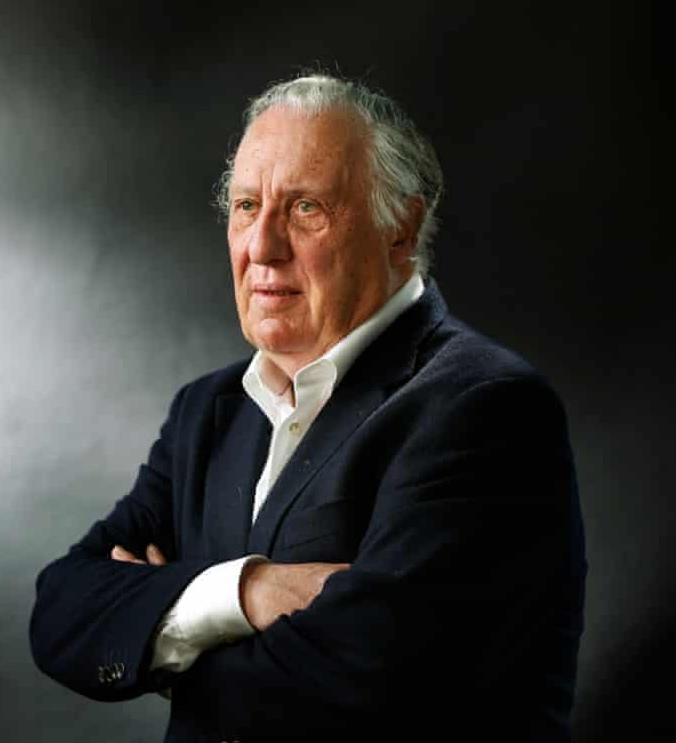
Frederick Forsyth, the author who turned his adventures as a journalist and work with MI6 into bestselling thrillers, has died after a brief illness aged 86.
Forsyth brought a reporter’s eye to his fiction, transforming the thriller genre with a series of novels including The Day of the Jackal, The Odessa File and The Dogs of War. Combining meticulous research with firecracker plots, he published a series of novels that sold more than 75m copies around the world, and won him honours including a CBE in 1997 and the Crime Writers’ Association Diamond Dagger award.
Born in Ashford, Kent in 1938, Forsyth flew fighter jets during his national service, but when the Royal Air Force couldn’t guarantee he’d stay in the cockpit he set out to see the world. While working for Reuters as a journalist, he got a lucky break. “The guy stationed in Paris got a heart murmur and had to come home,” he told the Big Issue. “A man stuck his head around the door of my office and said, ‘Anyone here speak French?’ Within days I was on the plane to Paris.”
Paris in 1961 was in turmoil, with rightwing militants threatening to assassinate Charles de Gaulle after his offer of independence to Algeria. “We were all waiting for the mega-story,” the author recalled in the Express, “the moment when a sniper got him through the forehead.” Forsyth got the inside track on the security operation from De Gaulle’s bodyguards and when a friend asked if an assassination would be successful, the writer shook his head. “It could be done,” Forsyth replied, “but only by an outsider. An assassin with no name, no face, no record, no dossier. And a professional.” The seed of an international bestseller was sown.
After spending time in East Germany, Forsyth moved to the BBC and in 1967 he was sent to Nigeria to cover the Biafran war. He arrived in the newly independent eastern region three days after the federal government’s invasion, having been told that the army would suppress the rebellion in a couple of weeks.
The Day of the Jackal returned to Forsyth’s days in Paris, following an investigation to foil an assassin’s plot to kill De Gaulle. Packed full of operational details and putting fictional characters cheek by jowl with public figures, the novel brought a new realism to the thriller genre. The Guardian hailed it in 1971 as a “chilling, superbly researched story”, asking “Or is it fiction?” It rapidly became a word-of-mouth hit and a global bestseller, with a film adaptation released two years later.
In 1972’s The Odessa File, a young German reporter goes in search of the Nazi war criminal Eduard Roschmann and stumbles on an organisation defending high-ranking members of the SS. The New York Times was scathing, suggesting Forsyth had “borrowed painful, live history in order to spring a few quick thrills”, but it quickly became a bestseller. Forsyth also claimed that the novel helped to identify Roschmann in real life.
Forsyth developed a method, researching a novel for six months then writing it quickly. His commitment to detail was not without danger: in 1974, the author was investigating the illegal arms trade in Hamburg for The Dogs of War, the story of a group of mercenaries who plot a coup in a fictional African republic. When an arms dealer recognised his portrait in a bookshop window, Forsyth was warned he had 80 seconds to leave his hotel. Grabbing his money and passport, he ran to the station and jumped on to a train as it pulled away.
Over the next five decades the bestsellers continued, with plots including nuclear weapons, the Iraqi invasion of Kuwait, the cocaine trade and Islamic terrorism. An outspoken critic of Tony Blair, Forsyth was a staunch supporter of Brexit, becoming a patron of Brexit campaign group Better Off Out, and wrote of his scepticism of climate change in his Daily Express column.
Speaking to the Times at the launch of his 2018 novel The Fox, the writer declared once more that it would be his last. But even as Forsyth insisted “the interest has gone”, there was still a hint of unfinished business. “I’ve got three unused typewriters in a cupboard at home,” he said, “enough to see me out.”
Jonathan Lloyd, Forsyth’s agent, said he last saw the writer a few weeks ago to watch a forthcoming BBC documentary of his life. Lloyd said he “was reminded of an extraordinary life, well lived.”
“Having long held The Day of the Jackal as the blueprint of the modern thriller, I was honoured to become his editor for Avenger in 2002 and have remained so ever since,” said Bill Scott-Kerr, Forsyth’s publisher. “Working with Freddie has been one of the great pleasures of my professional life,” he added. “He leaves behind a peerless legacy which will continue to excite and entertain for years to come.”
*TheGuardian