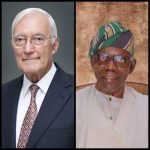


As the country marks two years anniversary of President Bola Ahmed Tinubu’s administration, Nigeria’s leading security concern Emirates Logistics, has praised the President and the National Security Adviser, Mallam Nuhu Ribadu for their commitment to prosperity, security, and sustainable development in Nigeria within two years of coming to power.
In a statement at the weekend the CEO of the company, Prince Dr. Benson Onuwaje, said Tinubu inherited a complex economic burden while Ribadu had to deal with insecurity which was almost throwing Nigerian into turmoil.
Emirate Logistics recently won the Nigeria Best Security Company of the Year 2024.
The Chief Executive Officer of the company, Dr Onuwaje said Tinubu has laid the foundation for effective growth and development of Nigeria in the last two years adding that he has created fresh and remarkable opportunities for Nigeria.
Dr Onuwaje said some of the most outstanding achievements are the rapid construction of the Lagos-Calabar Highway, the repayment of over 35 billion dollars debt owed to the International Monetary Fund, (IMF), and the transparent conditional cash transfers to millions of homes in Nigeria.
He called on Nigerians to show appreciation by supporting the President and the National Security Adviser, Huhu Ribadu.
He said Nigeria needs unity and oneness, which are necessary ingredients for peace and stability.
The CEO, Dr Onuwaje, also praised President Tinubu and the National Security Adviser, (NSA) for the creation of the Forest Guard.
He said, “The creation of forest guard is one of the greatest interventions in tackling terrorism. However, it will also have a chain impact on protection of indigenous forests, protection of land and its mineral resources, which would help Nigeria to fight climate change and solidify sustainable development.”
He said Forest Guard will also create jobs for many Nigerians, increase security capacity of many communities, and reduce the workload of the Nigerian army and police.
Dr Onuwaje said Nigerians should appreciate the exceptional work Tinubu has done within the past two years, adding that since 1999, this is the best two years Nigeria has had in terms of clear policy direction and laying of foundations for radical transformation of Nigeria.
He said from an expert perspective, security in the country is improving and there is hope.
“In the next few years, the other teething problems will be resolved,” he said.
Onuwaje also commended the NSA, Nuhu Ribadu, for his high sense of discipline, moral high ground, and deep knowledge on security affairs of the country.
“Nuhu Ribadu is one of the best NSAs Nigeria ever had. He is honest, transparent, and genuinely committed to resolving disputes amongst oil-producing communities. He has continued to demonstrate leadership.”
He also listed increased oil production in the Niger Delta as a major gain adding that with the architecture put in place, that needs some adjustments, the country can hit the 3milllion per day production mark.
He said “Today, Nigeria is standing atop as a member of Oil Producing and Export countries, OPEC. What we need is to inject more experts and professionals to tackle bunkering and vandalistion of oil pipelines. We have trust that President Tinubu and the NSA will put a final end to the challenges.’
Onuwaje called for injection of more professionals into oil and gas safety for maximum out put.
He argued that with involvement of more experts in Niger Delta pipeline protection, the oil output will increase and lead to an economic boom for Nigeria.
However, Emirates Logistics said the prices of foodstuffs and petrol remain high calling on the President for intervention.
“Nigeria needs a price control body that will stabilize the prices of things so that every home will have access. We urge state and local government to go into the production of staple food, which will help the well-being of the people. States and Local Governments should not leave everything for the Federal Government,” Dr Onuwaje said.
Nigeria, a founding member of the Organization of Petroleum Exporting Countries (OPEC) and has long been Africa’s largest oil producer until the rile shifted to Angola
However, oil production has been hampered for years by pipeline vandalism, crude oil theft, aging infrastructure, and underutilized refineries.
Dr Onuwaje said the Tinubu administration has worked hard to address the challenges in the oil industry through security interventions in the Niger Delta and policy reforms to attract investment.
He said what is needed is greater community participation in protection of oil infrastructure in the Niger Delta.
Nigeria has four state-owned refineries (in Port Harcourt, Warri, and Kaduna) with a combined refining capacity of 445,000 barrels per day, but they have remained largely non-operational for decades. The government recently pledged to rehabilitate these facilities while also backing the newly launched 650,000 barrels-per-day Dangote Refinery in Lagos, one of the world’s largest single-train refineries.
Dr Onuwaje said listed the student loans that cover 550 thousand students as the first of its kind in Nigeria.
He said “We commend President Tinubu for realizing that education is the key that unlocks the door of ignorance, as stated by Aristotle also that the seed of education is bitter, but the fruits are sweet.”
He said with the loan, a lot of children from poor homes, who have no access to education, can now benefit from the access to funds in the loan scheme.
He said oil production has increased tremendously in Nigeria, with the country potentially in the position to produce 2 million barrels of oil, although he said there is still a need for injection of more experts to realize full capacity.
As of early 2025, Nigeria has been gradually recovering oil production to about 1.5–1.6 million barrels per day after a drop to below 1 million bpd in mid-2022.
The country aims to reach 2 million barrels per day by addressing oil theft, restoring pipeline infrastructure, and completing refinery projects. The successful operation of modular refineries in the Niger Delta and investments in midstream infrastructure are also central to this goal.