

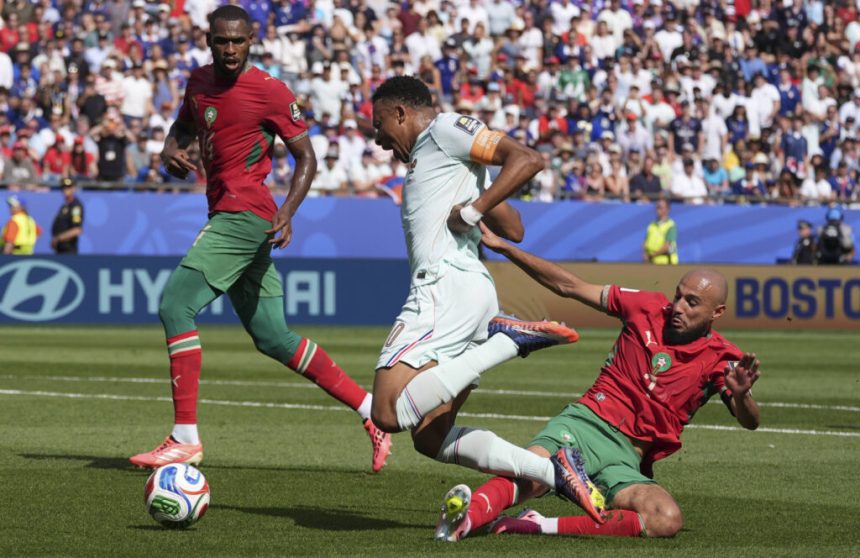
A Tactical and Technical Breakdown of a Match That Rewarded Precision Over Possession
By Paul Lucky Okoku
Football is not won by who controls the ball the longest. It is won by who uses it the best.
Possession creates possibilities. Precision creates champions.
For the second consecutive FIFA World Cup meeting between France and Morocco, the scoreboard read exactly the same.
France 2. Morocco 0.
The difference was the stage.
In Qatar 2022, France ended Morocco’s historic run in the semifinals.
In the United States 2026, France did it again—this time in the quarterfinals—booking another place among the world’s final four.
History repeated itself.
But the story behind the scoreline deserves a deeper examination.
This was not simply France defeating Morocco.
It was a masterclass in why elite championship teams continue to survive football’s biggest moments.
The Match That Hung in the Balance
For nearly an hour, this quarterfinal remained delicately balanced.
France created the better chances.
Morocco refused to panic.
Then came one of the game’s defining moments.
Kylian Mbappé missed a first-half penalty after Yassine Bounou produced an outstanding save, keeping Morocco alive.
In knockout football, moments like that often change everything.
Had Morocco scored first afterward, everyone would have pointed back to that penalty.
Championship football can be brutally unforgiving.
Miss your opportunities, and the game often punishes you.
France understood that lesson before Morocco could capitalize.
Champions Respond
Great teams rarely allow disappointment to linger.
Instead of becoming frustrated after the missed penalty, France became even more composed.
The breakthrough finally arrived in the 60th minute.
Mbappé, quiet by his extraordinary standards, curled home a superb finish to give France the lead.
Six minutes later came the decisive blow.
Ousmane Dembélé finished clinically after Morocco failed to deal with sustained pressure.
Within six minutes, the entire complexion of the match changed.
The difference between contenders and champions often lies in those brief periods when pressure is converted into goals.
France demonstrated exactly that.
Possession Without Penetration
One statistic immediately catches the eye.
Morocco actually finished with 52 percent possession compared to France’s 48 percent.
On paper, that appears encouraging.
In reality, it tells only part of the story.
Football has evolved beyond measuring dominance by possession alone.
Possession becomes valuable only when it creates clear scoring opportunities.
Morocco circulated the ball well.
France created the danger.
The statistics reinforce that difference.
France finished with:
* 22 shots
* 9 shots on target
Morocco managed only:
* 5 shots
* 1 shot on target
That single statistic explains almost everything.
Possession may impress spectators.
Shots on target decide football matches.
Talent Alone Is Never Enough
Talent alone does not win championships.
Possession gives a team the opportunity to dictate the tempo, protect a lead, and frustrate an opponent. It can help you run down the clock and control the rhythm of a match.
But possession by itself guarantees nothing.
Unless it creates chances and produces goals, it remains a statistic rather than a victory.
France understood that.
Morocco had more of the ball.
France made more of the moments.
The Difference Between Keeping the Ball and Hurting the Opponent
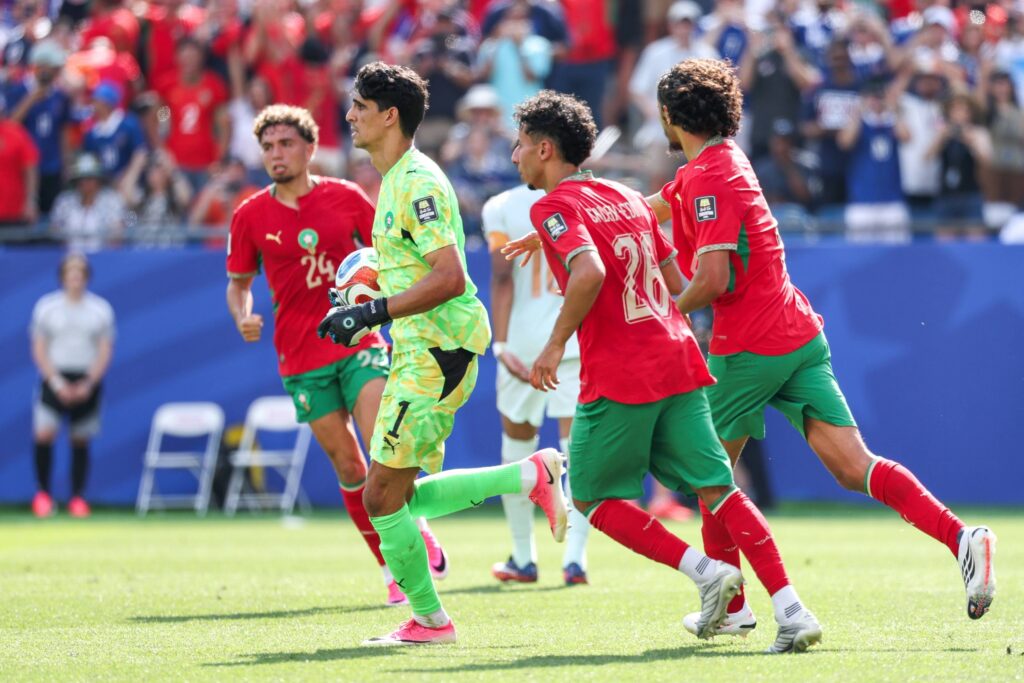
Students of football understand an important distinction.
There are two kinds of possession.
The first is attacking possession.
Its purpose is to create chances.
The second is protective possession.
Its purpose is to control tempo, deny opponents opportunities, and allow the clock to become an additional defender.
France demonstrated both.
Before taking the lead, they circulated the ball patiently until openings appeared.
After going ahead, they controlled the rhythm without surrendering defensive organization.
Morocco had the ball.
France controlled the match.
Those are two very different things.
Efficiency Wins Championships
France completed fewer passes than Morocco.
They enjoyed less possession.
Yet they were unquestionably the more dangerous side.
Their pass accuracy reached 92 percent, compared with Morocco’s 88 percent.
More importantly, almost every attacking movement carried purpose.
There was very little wasted possession.
Very little panic.
Very few poor decisions.
Championship teams do not simply attack more.
They attack better.
Why Morocco Still Made Africa Proud
Defeat should never erase achievement.
Morocco once again carried African hopes into the latter stages of the World Cup.
They defended courageously.
They remained organized.
They never abandoned belief.
Against one of the tournament favorites, they refused to be intimidated.
Sometimes football rewards effort.
Sometimes it rewards quality.
On this evening, France simply possessed more of the latter.
That reality should not diminish Morocco’s tournament.
If anything, it confirms how consistently African football now competes with the world’s elite.
With Morocco’s Exit, Africa’s Journey Ends—But Not Its Rise
Morocco’s quarterfinal defeat also brought an end to Africa’s collective dream of lifting the FIFA World Cup in 2026.
But it did not end Africa’s progress.
Far from it.
This tournament demonstrated that African football continues to close the gap on the traditional powers of the game.
There is no shame in Africa’s performance.
Only growth.
Only experience.
Only another step forward.
Africa’s first FIFA World Cup title has not yet arrived.
But after watching this tournament, that day no longer feels impossible.
It feels attainable—provided African football continues to invest in coaching, youth development, sound administration, and tactical evolution.
The journey ends here.
The progress does not.
History teaches us that sustained progress eventually produces breakthrough moments.
Every football power was once an emerging football nation. Africa’s story is still being written.
Every champion was once a contender that refused to stop believing.
The dream may be deferred, but it is no longer distant.
What Championship Teams Look Like
France offered another reminder of why they remain among world football’s most complete teams.
Championship sides usually display several common qualities:
* They remain calm after setbacks.
* They continue creating chances after missed opportunities.
* They defend collectively.
* They punish mistakes quickly.
* They rarely lose tactical discipline.
France displayed every one of those characteristics.
Even after missing a penalty, there was no panic.
Only patience.
Eventually, patience became goals.
Three World Cups, One Standard: France’s Culture of Championship Consistency
France’s victory over Morocco represents more than qualification for another semifinal.
It extends one of the most impressive periods of sustained excellence in modern international football.
In 2018, France defeated Croatia 4–2 to become world champions.
In 2022, Les Bleus returned to the final and came within a penalty shootout of retaining their crown, eventually losing to Argentina after one of the most dramatic championship matches in World Cup history.
Now, in 2026, France has reached the semifinals once again.
That means three consecutive World Cups have produced three deep French runs:
* 2018 — World Cup champions
* 2022 — World Cup runners-up
* 2026 — World Cup semifinalists, with the journey still continuing
That is not merely a successful generation.
It is the establishment of an elite championship standard.
Players have arrived.
Players have departed.
Veterans have aged.
Young stars have emerged.
Roles have changed, and expectations have grown.
Yet France’s level has remained remarkably consistent.
That is the sign of a football nation whose success is larger than any single player.
Talent alone cannot sustain excellence across three World Cups. It requires a dependable development system, continuity of philosophy, tactical adaptability, squad depth, institutional stability, and a culture in which every new player understands the standard he is expected to uphold.
France does not rebuild from nothing whenever one generation begins to fade.
It replenishes.
One outstanding player replaces another. A younger footballer enters an established structure rather than being asked to create one. The names may change, but the expectation does not.
Reach the latter stages. Compete for the trophy. Behave like champions.
That is what football’s truly elite nations do.
They do not measure success by one memorable tournament.
They return four years later and prove that the previous achievement was not an accident.
France has now done that twice.
Whether Les Bleus ultimately lift the trophy in 2026 remains to be seen. But reaching the semifinals after winning in 2018 and finishing second in 2022 confirms something already visible in their football:
France is no longer experiencing a golden moment. It has built a championship era.
Big-Time Players Make Big-Time Plays in Big-Time Games
One of the oldest sayings in American sports has echoed throughout this World Cup:
“Big-time players make big-time plays in big-time games.”
There is another expression heard in locker rooms, boardrooms, and corporate America:
“Show up.”
At first glance, those two words appear ordinary.
They are anything but.
To show up means far more than simply being present.
It means delivering when your team needs you most.
It means accepting responsibility when the pressure is greatest.
It means refusing to disappear when championships are on the line.
That is exactly what has separated many of football’s biggest stars during this tournament.
When the knockout rounds arrived, the elite players answered.
Kylian Mbappé responded after missing a penalty by scoring the breakthrough goal against Morocco.
Ousmane Dembélé followed with the decisive second goal.
Lionel Messi has continued to inspire Argentina with decisive performances deep into the tournament.
Harry Kane has repeatedly delivered for England in pressure matches.
Erling Haaland has carried Norway into the latter stages with his relentless finishing.
Vinícius Júnior has been Brazil’s attacking spark whenever the Seleção needed inspiration.
Folarin Balogun has rewarded the United States with crucial goals despite the Americans ultimately falling short.
Even Cristiano Ronaldo
, in what may be his final World Cup, reminded the football world that greatness does not disappear simply because time moves forward.
Championship tournaments are rarely won by tactics alone.
Systems matter.
Preparation matters.
Teamwork matters.
But eventually, someone must produce the decisive moment.
That is why football still celebrates its biggest stars.
Not because they are famous.
Because when everything is on the line… they show up.
Leading Stars — Goals Through the Quarterfinals
As of the completion of the France–Morocco quarterfinal, the tournament’s leading stars include:
* Lionel Messi (Argentina) — 8 goals
* Kylian Mbappé (France) — 8 goals (after scoring against Morocco)
* Erling Haaland (Norway) — 7 goals
* Harry Kane (England) — 6 goals
* Ousmane Dembélé (France) — 5 goals
* Vinícius Júnior (Brazil) — 5 goals
Folarin Balogun (United States) and *Cristiano Ronaldo (Portugal) also produced important goals and influential performances during the tournament, even though their teams have now been eliminated.
The Semifinal Awaits
France now advances to the 2026 FIFA World Cup semifinals, where they will meet the winner of Spain versus Belgium, scheduled for Friday, July 10, 2026.
Both present entirely different tactical challenges.
Spain would likely offer a possession-heavy technical battle.
Belgium would present physicality, transitions, and attacking directness.
Either way, France arrives with growing confidence.
When Precision Defeats Possession
Football is often described as a game of inches.
A missed penalty.
A missed clearance.
One lapse in concentration.
One moment of brilliance.
Those fine margins separate victory from elimination.
Morocco competed with courage, discipline, and belief. They even enjoyed more possession for much of the evening. But possession alone does not win knockout matches.
Championship football rewards the team that makes fewer mistakes, remains composed under pressure, and converts opportunities when they matter most.
France did exactly that.
They remained patient after a missed penalty.
They stayed tactically disciplined.
When the decisive moments arrived, they were clinical.
That is what champions do.
And that is why Les Bleus are returning to the FIFA World Cup semifinals.
Final Reflection: A Chess Match Played at Full Speed
Football is often called the beautiful game.
At the highest level, it is also a game of chess.
Every substitution.
Every tactical adjustment.
Every defensive line.
Every attacking run.
Every decision is another move on the board.
Morocco played with courage, discipline, and conviction.
France played with those same qualities—but added the precision that separates outstanding teams from world champions.
The scoreline will forever read France 2, Morocco 0.
But beneath those two goals lies the real story:
Championship football is won not simply by possessing the ball, but by knowing exactly what to do with it.
On this occasion, France made the better moves.
Africa’s journey ends, but not its progress. Morocco leaves this World Cup with its pride intact, having carried a continent’s hopes with courage, conviction, and dignity.
France marches on with its ambitions alive, reminding the football world that championships are earned not simply through talent, but through precision, patience, and execution.
The Atlas Lions reaffirmed that Africa belongs among football’s elite. Les Bleus demonstrated why the path to lifting the FIFA World Cup is won one decisive moment at a time.
The road now grows narrower, history grows heavier, and only those who continue to make the right moves will remain standing when the final whistle of this tournament is blown.
Share Note
If you enjoyed this tactical analysis, please share it with fellow football supporters, coaches, players, and students of the game. Follow Paul Lucky Okoku’s World Cup 2026 coverage for in-depth match analysis that goes beyond the scoreline to explore the tactics, technical details, psychology, and championship decisions that shape football’s biggest stage.
*Paul Lucky Okoku is a FIFA Legend | CAF Africa Cup of Nations Silver Medalist | Former Nigerian Super Eagles & Flying Eagles International | Former Olympic Qualifying Team Member | Football Analyst | Founder, Greater Tomorrow Children’s Fund (GTCF)