

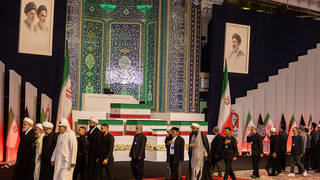
A week-long state funeral for the Islamic Republic’s late supreme leader, Ayatollah Ali Khamenei, has begun in Iran, more than four months after he was killed in US-Israeli airstrikes. The ceremonies mark the end of nearly four decades of Khamenei’s leadership. Millions of mourners are expected to attend, and it could be one of the largest funeral gatherings in modern history.
Khamenei was assassinated on February 28, when US-Israeli strikes hit his residential and official compound in central Tehran during the first wave of the US-Israeli attack on Iran. The 86-year-old cleric was killed alongside several members of his family, including his daughter, son-in-law, and 14-month-old granddaughter. His son, Mojtaba Khamenei, who formally succeeded him as supreme leader weeks later, was also reportedly injured in the attack and has not appeared publicly since.
Khamenei’s funeral was postponed because of the war and the security situation, Iranian officials said. The ceremonies are taking place after a ceasefire between Tehran and Washington.
The delay was unusual, as Islamic tradition generally calls for burial as soon as possible after death. The authorities said Khamenei’s body was preserved in accordance with religious requirements. It remains unclear whether Mojtaba Khamenei will attend his father’s funeral.
Iranian officials have presented the funeral as both a period of national mourning and a demonstration of national unity. Pezeshkian called on Iranians “of every ethnicity, religion, preference, and political tendency” to attend, saying a large turnout would send “a clear message to the world.”
Images and videos from Tehran have shown thousands of people gathering for the ceremonies, while officials have estimated attendance could reach between four million and 15 million mourners. The funeral could end up as one of the largest in modern history, according to media reports.
Ayatollah Ali Khamenei served as Iran’s supreme leader from 1989 until his assassination in February 2026. Succeeding Ayatollah Ruhollah Khomeini, the founder of the Islamic Republic, he led the country for nearly 37 years, making him one of the region’s longest-serving leaders.
Although Iran has an elected president, the supreme leader is the country’s highest political and religious figure, with the final say on major state affairs, including the armed forces, foreign policy, and the judiciary.
Khamenei was also a senior Shia cleric whose role went beyond politics. During his rule, Iran expanded its regional reach while facing decades of Western sanctions and confrontation with the US and Israel.