

By Jude Dike, Ph.D.
The Special One never asked to become football’s most successful election campaign. It just happened.
By the time the ballots were counted in Madrid on Sunday night, a troubling question was echoing across European football.
How many elections is one man allowed to win without actually standing for office?
Not presidential elections.
Not parliamentary elections.
Football elections.
The increasingly strange political genre in which José Mourinho has emerged as the most valuable campaign asset since the invention of promises.
The latest evidence arrived at Real Madrid.
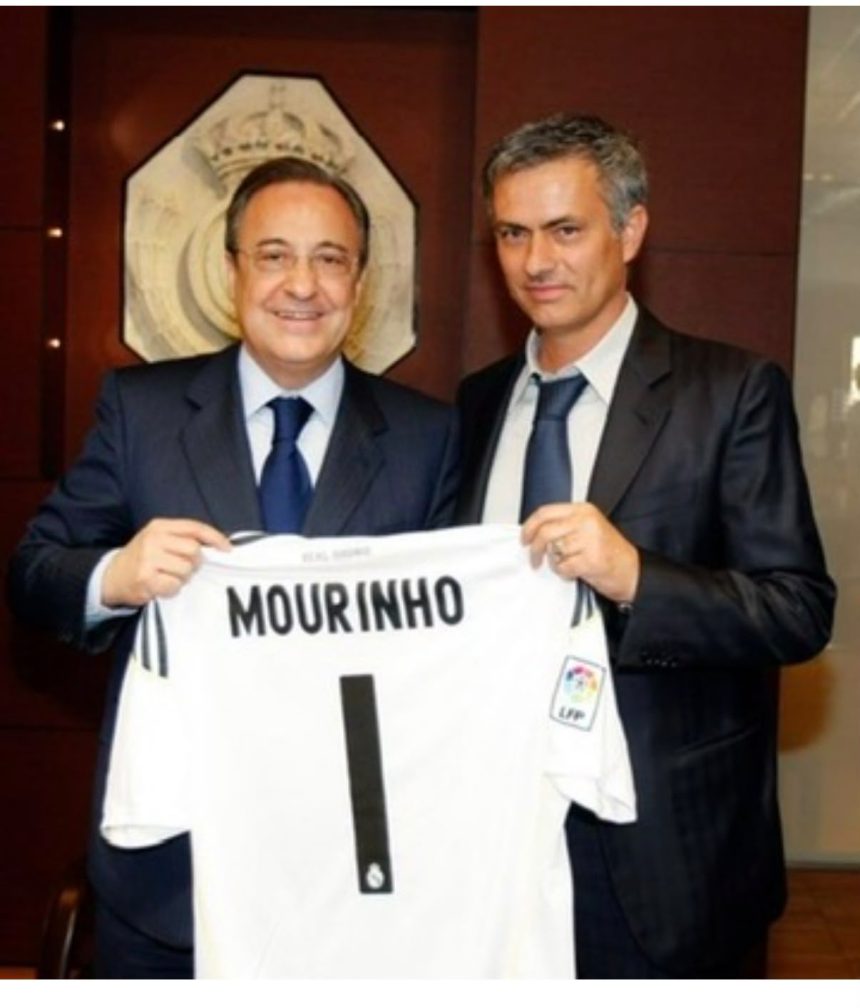
Florentino Pérez secured re-election after repeatedly presenting Mourinho’s return as a cornerstone of the club’s next chapter. The message was elegantly simple.
Vote for continuity.
Vote for ambition.
Vote for the future.
Vote for Mourinho.
The voters complied.
Again.
A year earlier in Portugal, Benfica president Rui Costa had stumbled upon the same electoral cheat code.
As the campaign intensified, one name hovered over every discussion about the club’s future.
José Mourinho.
Not merely as a coach.
As a possibility.
As a dream.
As an emotional investment vehicle with an unusually high rate of return.
Costa won.
Mourinho arrived.
Benfica proceeded to march through the Portuguese league without losing a single match.
An unbeaten season.
The Invincibles.
The sort of achievement that transforms campaign slogans into holy scripture.
Suddenly, Mourinho was no longer a candidate’s promise.
He was proof of concept.
And before Portugal came Turkey.
The place where football elections first began looking less like democratic contests and more like auditions for the role of Mourinho’s future employer.
During Fenerbahçe’s famous presidential election, something extraordinary occurred.
Every candidate seemed to be campaigning with some version of the same message.
“I can bring Mourinho.”
“No, I can bring Mourinho.”
“No, I can bring Mourinho.”
For a brief moment, Turkish democracy appeared to enter what scholars may someday call the Mourinho Primary Era.
The eventual winner triumphed.
Mourinho was hired.
And an entire continent quietly took notes.
At this point, the pattern is becoming difficult to ignore.
Mention Mourinho.
Win election.
Repeat.
Political scientists study incumbency.
Economists study financial influence.
Football administrators may soon be forced to study Mourinho.
For younger readers and for the millions of non-football fans wondering why grown adults seem prepared to reorganize institutions around a football coach, a brief introduction is necessary.
Who exactly is José Mourinho?
Imagine a movie character written by someone who believed subtlety was overrated.
Imagine a strategist with the confidence of a Roman general and the media instincts of a Hollywood producer.
Imagine a manager who once walked into England and introduced himself to the nation as “The Special One.” Then imagine him immediately winning enough trophies to make the nickname seem conservative.
Mourinho first shocked Europe by leading Porto to the Champions League, one of football’s greatest modern miracles.
At Chelsea, he transformed English football.
At Inter Milan, he produced the legendary treble-winning season still revered across Italy.
At Real Madrid, he accepted perhaps the hardest assignment in sport: confronting Pep Guardiola’s Barcelona, a team many consider the greatest ever assembled.
He won league titles in Portugal, England, Italy and Spain.
European trophies followed.
Records followed.
Controversies followed.
Headlines certainly followed.
Most managers become successful.
A handful become famous.
Mourinho became something stranger.
Recognizable.
People who have never watched ninety minutes of football know his face.
People who cannot explain the offside rule know his name.
Some sporting figures transcend their profession.
Muhammad Ali did.
Michael Jordan did.
Mourinho somehow did it as a football manager.
Which explains why presidents crave association with him.
Football supporters are not really voting for a coach.
They are voting for what Mourinho represents.
Possibility.
Relevance.
The intoxicating belief that tomorrow could be glorious.
And maybe a little chaotic.
Especially the chaotic part.
The irony is that Mourinho himself never campaigned for this role.
He did not set out to become football’s most powerful electoral endorsement.
He simply became so successful, so recognizable, and so mythological that his name acquired a second life.
It stopped being a name.
It became a campaign strategy.
Today, in Istanbul, Lisbon, Madrid, and all over Europe, club presidents can point toward Mourinho and ask supporters to imagine greatness.
Increasingly, supporters respond by imagining a victory at the ballot box first.
Future elections may become wonderfully uncomplicated.
Candidates will no longer need manifestos.
No more lengthy strategic documents.
No more financial projections.
No more promises.
Just a stage.
A microphone.
And seven magical words.
“I have spoken to José Mourinho.”
The election may already be over.
The Special One spent two decades collecting trophies.
Without intending to, he appears to have started collecting presidents.
History will record that José Mourinho never ran for office.
History may also record that nobody won more elections.
*Jude Dike, Ph.D., is a sports enthusiast and analyst