

*Ambassador Akinremi Bolaji with the Minister of State in the Ministry of Foreign Affairs (MFA), Ambassador Bianca Ojukwu (2nd left) and his wife Mrs. Bolaji at a farewell reception in Abuja recently
By Kingsley Dike
Nigeria as a country has had the unique good fortune of having very astute diplomats
and individuals whose training, performance and force of personality not only catapulted
them to national acclaim but global recognition.
From Chief Simeon Adebo, Jaja Nwachukwu, Emeka Anyaoku of Nigeria’s first republic to Ambassador Peter Onu, Ambassador Hope Harriman, Ambassador Omotayo Ogunsulire, Ambassador Dove- Edwin to Ambassador Ibrahim Gambari. These individuals and many others served as foundational pillars in establishing Nigeria’s Foreign policy in peacekeeping, international law and regional cooperation.
But there are a new generation of accomplished Nigerian diplomats whose dedication and devotion to service and statecraft is no less. They have sustained time honored traditions of excellence and dedication to international relations, conflict resolution and more importantly as stalwarts of the Nigerian state and public servants.
Ambassador Akinremi Bolaji, who retired recently from Nigeria’s foreign service, was the
face of this new generation. Amongst the first graduates of the Department of International Relations, Obafemi Awolowo University, Ile-Ife to join the Nigerian foreign service, they became the fulfilment of the dreams of the likes of Professor Olajide Aluko, first professor of international relations in Africa, south of the Sahara, to strengthen Nigeria’s foreign relations with qualified home-grown and trained personnel.
They were the modern pedagogical success, of which was the principal aim of the Ife School of
International Relations, to train students not only with “knowledge for global harmony”
but self-esteem, a patriotic, national and cultural flavor in the articulation and execution
of Nigeria’s foreign policy objectives.
Ambassador Bolaji is the embodiment of this self-esteem that followed his very successful career. In the social media era where simple interactions with the Nigerian community gone
awry will sometimes paint the picture of underperforming diplomatic service, Ambassador Bolaji excelled in the field in all his foreign postings with this awe of simplicity, of setting a personal tenor that consular services must be efficient and effective through customer service and feedback from the Nigerian community and members of the public that they serve.
The story is told of how Ambassador Bolaji as Nigeria’s High Commissioner to Singapore will go incognito in the consular reception and holding area to interact with visitors and hear firsthand how their issues are being taken care of by the Nigerian High Commission. From this regular interface he implemented a system that ensured fasterturnaround in issuance of visas and all other consular services.
As he learnt, waiting times and no feedback explanations for delays in processing were some of the problems. During his last position as Director of Reforms and Innovation in the Ministry of Foreign Affairs (MFA), Ambassador Bolaji developed a cutting-edge blueprint for its
reforms based on his varied experiences, that of others and extant knowledge on the best practices elsewhere to reflect change in its culture and policies particular service
delivery. The hope is to herald a new culture of prompt service delivery commensurate
with what our people get in their host countries.
He was also very deliberate in making
sure what is best in the foreign service is preserved. A tradition of excellence through
diversity in recruitment of the best into its cadre, continuous training while on the job
and a pan-African, and pax nigeriana worldview is maintained. Tradition is said to be the
ultimate democracy because it extends the franchise to future generations and ensures
the hard-earned wisdom of the past and today is preserved.
Ambassador Bolaji became a caricature heroic figure at the onset of the Russia-Ukraine
war and the humanitarian crisis that developed with stranded Nigerian students. When
Russia invaded Ukraine in February 2022, thousands of Nigerians, especially students
studying in Ukrainian universities, found themselves in a rapidly deteriorating security
situation. With airports closed and safe evacuation routes limited, many Nigerians were
forced to flee on foot or seek refuge in neighboring countries such as Poland, Romania,
Hungary and Slovakia.
Many of the fleeing Nigerian students flooded messages online and reports of being denied access to trains and bomb shelters and faced
discriminations at border crossings. The situation was hell.
As Director of the Consular and Legal Department at the Federal Ministry of Foreign
Affairs, Ambassador Bolaji was appointed coordinator of the federal government’s
evacuation operation for Nigerians stranded in Ukraine and the bordering states.
In this role, he was one of the senior officials responsible for organizing and supervising the
logistics and diplomatic elements of the evacuation of over 5000 stranded fellow
citizens. He coordinated with Nigerian embassies and foreign missions in countries
receiving evacuees to ensure safe transit and accommodation before flights home.
Ambassador Bolaji managed the field logistics, such as gathering evacuees scattered in various hotels and border areas so they could be transported to evacuation flights, a process that sometimes meant adjusting flight schedules to ensure all were assembled and ready to depart.
It was such a flawless operation involving so many citizens with such a short time but
dire consequences for delays, omission and possible abandonment in the war zone as
the bombs keeping falling in several cities across Ukraine.
It was a difficult time but one of the finest moments for the Nigerian foreign service responding adequately to citizens in distress, ensuring the safe return of thousands of Nigerians from the conflict zone in a period of global uncertainty. As the public face of the evacuation initiative in the media and arrival ceremonies Ambassador Bolaji was in constant communications with international and host country authorities to secure authorizations for flights and safe passage across borders.
Delays at times occurred because airline crews were bound by international flight duty time regulations if gatherings were slow. Even then, he tried to overcome this limitation by liaising with Nigerian government officials and airlines such as Air Peace and Max Air, which were contracted to carry evacuees from neighboring
countries back to Nigeria under federal arrangements.
Usually, as head of government delegation welcoming and receiving evacuees at the Nnamdi Azikiwe International Airport in Abuja, updating the public on the progress of operations and reassuring families that more evacuations were underway. At every turn Ambassador Bolaji explained the unique challenges such as coordinating large and dispersed groups honestly and professionally, underscoring that the government was committed to bringing as many Nigerians home as possible. Under his coordination, Nigeria’s
evacuation efforts were not limited to just its own citizens.
Nigeria deployed its capacity to assist other West African nationals, including Ghanaians, Togolese and others, demonstrating a broader Pan-African diplomatic and humanitarian commitment.
At the time, the Minister of State in the Foreign Affairs Ministry Ambassador Bianca Ojukwu described Ambassador Bolaji as one of the brightest and best in the MFA commending his unique skills and abilities in handling complex assignments.
Ambassador Bolaji’s impact as a diplomat is multidimensional. But most notable is
effective leadership in building and sustaining partnerships between Nigeria and key
international stakeholders. Through high-level diplomatic engagements, he facilitated
mutually beneficial cooperation in governance, economic development, and
international collaboration, ensuring that Nigeria’s national interests were clearly
represented while fostering trust and long-term collaboration.
His genius is the ability to align government priorities with international partnership frameworks enhanced Nigeria’s credibility as a reliable partner and helped create enduring platforms for cooperation across public and institutional sectors.
For instance, on his final return to Abuja after my foreign service, he was appointed Director of the Consular and Legal Department and later Director of Economic, Trade, and Investment at the Ministry of Foreign Affairs. In these roles, he moved from representing policy abroad to shaping policy at home. There, he became one of the architects of Nigeria’s modern economic diplomacy, working to ensure that foreign
relations translated into domestic benefits.
At a time the country is facing economic
challenges, Economic diplomacy, is more than semantics but in practice, meant more
than attending trade forums or signing agreements; it meant asking, “How does this
engagement create jobs, expand markets, or strengthen industries in Nigeria?”
Ambassador Bolaji was at the forefront of Nigeria’s engagements with global
organisations such as the United Nations and ECOWAS, consistently pushing for
Africa’s economic fairness and investment-friendly frameworks that aligned with the
continent’s long-term development goals. He sought to harmonise Nigeria’s bilateral and
multilateral positions so that the country spoke with one coherent, strategic voice.
“My most enduring imprint in this period lay in championing of the African Continental
Free Trade Area (AfCFTA), a historic vision of a single African market. Through deft coalition-building, policy advocacy, and thought leadership, I helped align Nigeria’s trade
diplomacy with Africa’s continental integration project”, Ambassador Bolaji reiterated.
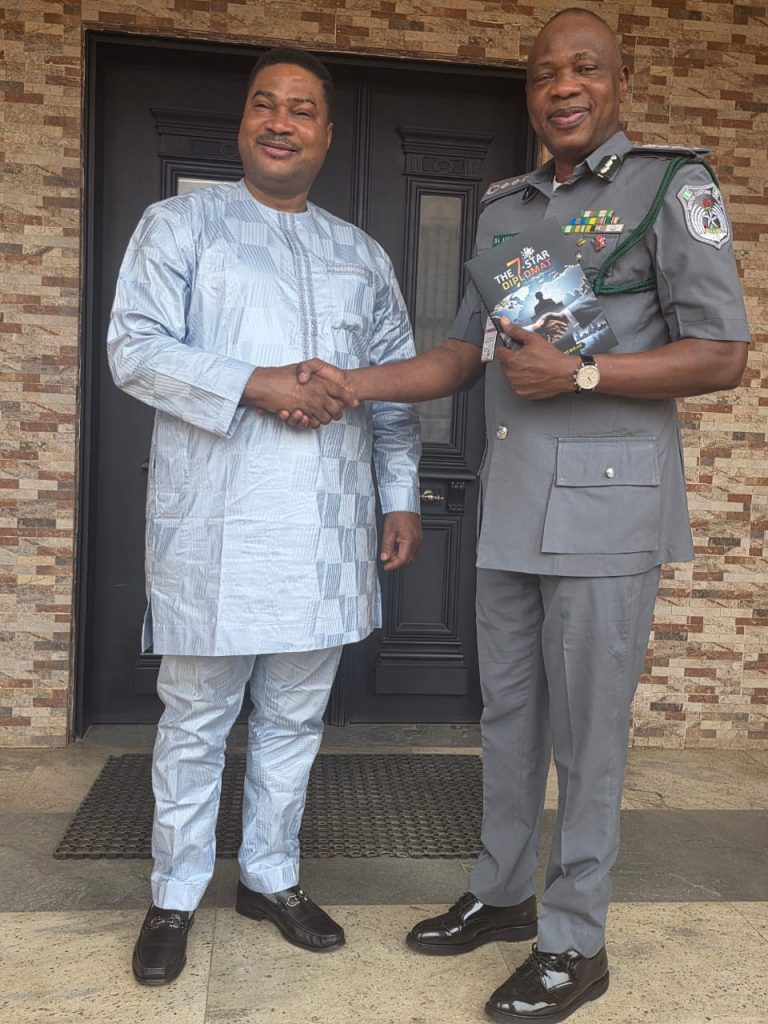
*Ambassador Akinremi Bolaji (left) with his friend and classmate Mr. Adewale Adeniyi, Controller General Nigerian Customs Service
Another trail blazer and classmate of Ambassador Bolaji at the Department of International Relations, Mr. Adewale Adeniyi, the Controller General of Nigeria Customs Service (NCS), agrees that AfCFTA’s promise of a $3 trillion market is not mere statistics; it is a platform for redefining Africa’s place in global value chains and for anchoring Nigeria as a central player in the continent’s economic future. In high-level dialogues, Ambassador Bolaji argued that Nigeria must not stand at the margins of Africa’s integration, but shape its
rules, protect its interests, and seize its opportunities.
Indeed, Mr. Adeniyi congratulated Ambassador Bolaji for his unique diplomatic imprints during this phase , saying his methods are often described “strategy in motion”, a blend of intellect and empathy that moves people and policies alike.
To the extent the Customs Controller General alluded that Ambassador Bolaji could sit with technocrats and talk data, then engage politicians and speak in terms of vision and legacy, and later meet business leaders to discuss risk, profit, and partnership.

*Ambassador Akinremi Bolaji (left) with Kingsley Dike during one of his many stop over at Atlanta, Georgia USA
But for this writer, it is Ambassador Bolaji’s friendship or what we called informal diplomacy that is brilliant and illustrates perfectly the depth of his commitment to the
country and ideas to make it better.
Anytime, he was on official business in the United States, he would stop over for coffee or lunch at our restaurant, ChicknCone, Emory
Point and long conversations on Nigerian foreign policy challenges or just catch up on
the state of our department as both alumni of Department of International Relations,
Obafemi Awolowo University, Ile-Ife.
At other times he would officially invite me to meet with members of Nigerian Senate committee on Foreign Affairs on oversight visits to Nigerian Embassy and consulates in the United States.
Here is wishing Ambassador Bolaji happy retirement and best wishes in his future endeavours.
Ambassador Akinremi Bolaji graduated from Obafemi Awolowo University- OAU ( then called University of Ife) where he obtained a Bachelors of Science (B.Sc) and a Master of Science (M.Sc) degrees in International Relations in 1988 and 1990 respectively. He later obtained a law degree as a serving foreign officer.
Ambassador Bolaji attended the Nigerian Foreign Service academy in Lagos and later India Foreign Service academy in New Delhi. Ambassador Bolaji served in several key high-level roles at the Ministry of Foreign Affairs (MFA) including: High Commissioner of Nigeria to Singapore, Director of Economic, Trade and Investment, Chief Protocol Officer to the Vice President of Nigeria, Director of Reforms and Innovation at the MFA.
He hard a full court experience as representative of Nigeria at major global forums, including the United Nations (UN), World Trade Organization (WTO), African Union (AU), and played a major role in supporting the implementation of the African Continental Free Trade Area (AfCFTA).
*Kingsley Dike is a former Foreign Affairs Editor of the Nation newspaper and retired
intelligence analyst with the United States Army. He wrote from Atlanta, Georgia, USA.
*Ambassador Akinremi Bolaji (left) with his friend and classmate Mr. Adewale Adeniyi, Controller General Nigerian Customs Service