


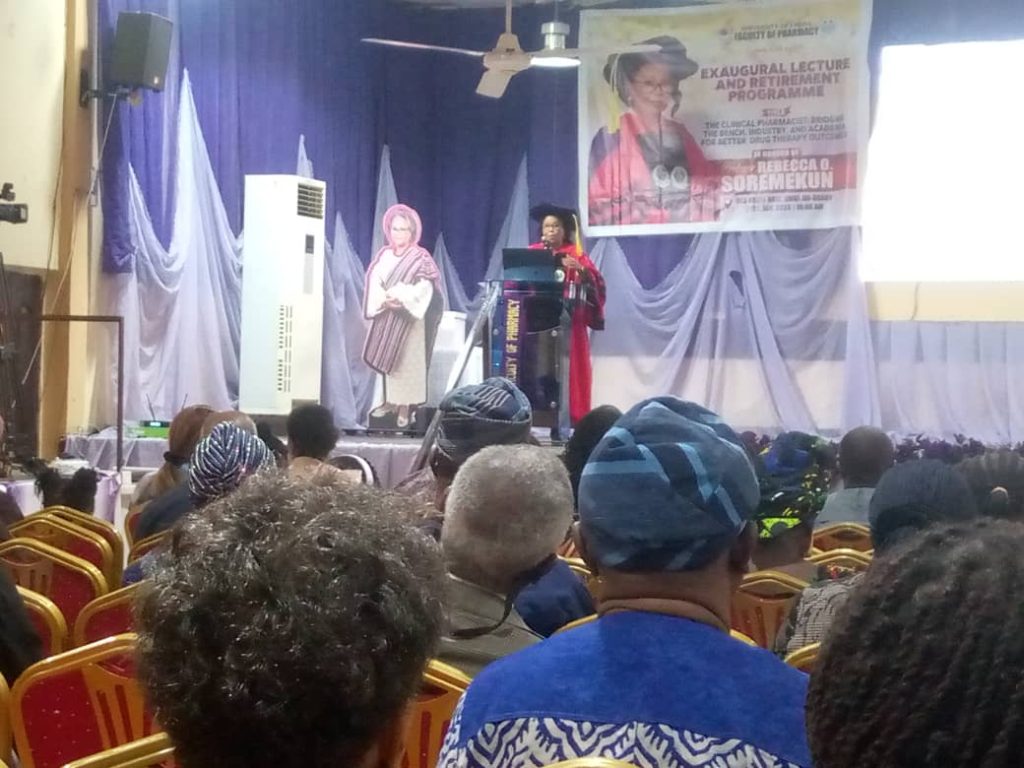
*Prof Rebecca Soremekun (centre) flanked by her husband, Prof Kayode Soremekun (2nd right) and other guests
By Shakirudeen Bankole
Professor Rebecca Soremekun, PhD, one of Nigeria’s renowned professors of Clinical Pharmacy, has raised alarm over what she described as weak governance structures in the administration of pharmaceutical interventions on patient treatment and recovery across the country.
Speaking at her exaugural lecture at the College of Medicine, University of Lagos, on Tuesday, Professor Soremekun said her over two decades of teaching postgraduate students, conducting research, and mentoring young professionals have shown that little to no attention is paid to the effective administration of medicines for patients within public health institutions in Nigeria.
The theme of the lecture was: “The Clinical Pharmacist: Bridging Bench Industry, and Academia for Better Drug Therapy Outcome.”
The Professor of Clinical Pharmacy noted that even in Lagos State, widely regarded as Nigeria’s economic hub, patients who ought to recover through appropriate drug therapy are instead experiencing complications and, in some cases, death, due to operational failures in prescription and medication management.
According to her, these outcomes are linked to the failure to develop and operationalise ethical governance structures that should guide drug prescription, procurement, dosage, usage, monitoring, and patient compliance, alongside clear deterrent measures for breaches across the therapeutic value chain.
She said there are glaring gaps in both knowledge and practice regarding pharmaceutical interventions within public healthcare delivery, warning that the consequences would worsen if not urgently addressed.
Professor Soremekun however recommended the development and integration of Antimicrobial Stewardship Systems in all public and private hospitals.
She explained that the system provides enforceable regulatory guidance on prescription practices, dosage, review processes, and stop dates, and is critical to improving treatment outcomes and patient recovery.
She also noted that improper drug therapy is a global challenge and remains a major contributor to preventable patient harm and mortality.
According to the World Health Organisation, unsafe medication practices account for one in every ten patient injuries worldwide and contribute significantly to an estimated 2.6 million deaths annually in low and middle income countries.
The burden is particularly severe in Africa, where weak health systems, limited clinical pharmacy support, and poor regulatory enforcement increase the risk of medication related injuries. Nigeria, she said, reflects these systemic vulnerabilities.
Professor Soremekun explained that medication related fatalities often arise from a combination of counterfeit medicines, duplication of therapy, inappropriate prescription, under dosage or over dosage, self medication, and non adherence to prescribed treatment routines.
According to her, under dosage may lead to treatment failure or persistence of disease, while over dosage can increase drug toxicity through harmful chemical interactions with vital organs, potentially resulting in organ damage or death.
She added that the situation is further compounded by frequent changes in duty doctors, heavy workloads, and limited time for patient review, leading to inadequate attention to medical history before new prescriptions are issued. The shortage of clinical pharmacists relative to patient volume, she said, remains a major challenge.
On self medication, Professor Soremekun said many patients purchase and administer drugs without professional guidance, often in an attempt to avoid hospital bills, only to worsen their conditions and eventually return to the same hospitals with more severe complications.
She also highlighted low medication adherence among patients managing chronic conditions such as HIV and diabetes. Studies, she said, have identified barriers including work related challenges, stigma, and financial constraints.
“Some patients fear that taking medication at work may expose their health status and subject them to suspicion, discrimination, or even job loss. For others, affordability remains a major issue. Poverty, stigma, and cultural factors continue to undermine treatment adherence and must be addressed urgently,” she said.
The clinical pharmacist further identified poor or rushed clinical trials in drug development as another contributing factor, citing the COVID 19 and Ebola outbreaks as recent global case studies where emergency responses raised concerns about safety oversight.
Drawing from her academic and research experience, Professor Soremekun said several studies she has conducted, both individually and collaboratively, underscore the urgency of reforming drug therapy governance.
She referenced a 2024 joint study with Eriobu, yet to be published, which examined antibiotic prescription practices across 15 primary healthcare centres in Lagos State. The study involved a purposive selection of facilities and a review of 30 patient records in each centre.
According to her, the findings revealed significant administrative weaknesses affecting drug efficacy and patient recovery, particularly the absence of structured systems for regulating antibiotic prescription at the primary care level.
She said the study showed that most prescribed antibiotics were broad spectrum drugs, with 56 percent falling within the WATCH category of the WHO Access, Watch, Reserve classification, while the remaining prescriptions were within the ACCESS category. No antibiotics from the RESERVE category were prescribed.
Professor Soremekun stated that the findings highlighted the urgent need to strengthen antibiotic prescription controls, stressing that WATCH category antibiotics should not be prescribed at primary healthcare centres and that patients requiring such drugs should be referred to higher levels of care.
She called for the implementation of antibiotic stewardship education programmes and the establishment of committees to develop policies that would guide antibiotic use and enforce stewardship practices across health facilities.
She also recalled that in 2023, she, alongside two other clinical pharmacists, Professor Arinola Kids and Dr Busola Okugbake, partnered with the Antimicrobial Stewardship Committee of the Lagos University Teaching Hospital to secure a grant from the Commonwealth Pharmacists Association and partners. The initiative focused on developing strategic educational tools to promote antimicrobial stewardship across public primary and secondary healthcare systems in Nigeria.
As part of the project, she said a cross sectional survey using electronic data collection was conducted to assess the knowledge and practices of pharmacists and prescribers in large tertiary health facilities.
Out of 176 drug prescribers who participated, mostly registrars, senior registrars, and pharmacists, she said two thirds demonstrated basic awareness that antibiotics are effective against bacterial infections, while 48.6 percent understood the causes of antimicrobial resistance.
Nearly all respondents, representing 97.1 percent, agreed that antimicrobial stewardship is essential.
She noted that three quarters of the respondents reported confidence in identifying inappropriate prescriptions and had advised colleagues or participated in stewardship activities.
However, only 62.9 percent reported fully or mostly changing their practices following training, while 26.5 percent had participated in World Antibiotic Awareness Week.
The study, she said, also revealed the influence of commercial pressures within the pharmaceutical sector, with 66.7 percent of prescribers, mostly doctors, reporting being pressured to prescribe antibiotics even when not clinically indicated.
Sources of information used by prescribers in managing infections were largely previous clinical experience and local clinical practice guidelines, while pharmaceutical representatives, social media, and digital platforms were among the least utilised.
She added that the majority of prescribers expected pharmacists to query prescriptions when concerns arise, reinforcing the importance of inter professional collaboration.
Professor Soremekun emphasised that the benefits of collaboration between academia and the community have been clearly demonstrated through research, product development, and clinical evaluation.
She noted that Nigeria possesses abundant local raw materials, including medicinal plants, that can be developed into effective pharmaceutical formulations.
She stressed that research must be tailored to address the needs of local communities and the nation at large, adding that stronger collaboration between researchers, pharmaceutical manufacturers, and clinicians would significantly improve drug safety, efficacy, and patient outcomes.