

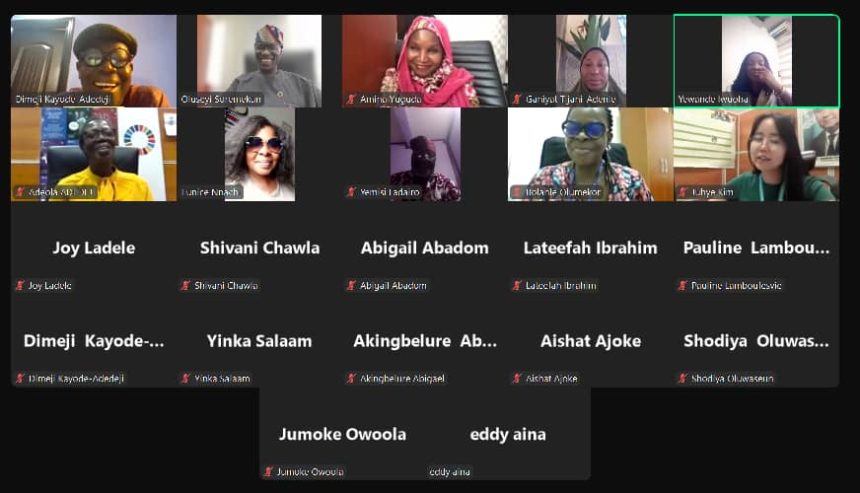
Leaders in the media industry have emphasized on the need for self-regulation as a way to address unethical use of Artificial Intelligence (AI) which is emerging as a key driver of misinformation and disinformation.
This was part of resolutions at a webinar organised by the United Nations Information Centre (UNIC) Nigeria in collaboration with Penpushing Media to commemorate the World Press Freedom Day under the theme, “Reporting in the Brave New World – The Impact of Artificial Intelligence on Press Freedom and the Media.”
The theme was interrogated by a panel of discussants comprising of media experts in the academia and practice.
These include Sir Eddy Aina, a member of the editorial board of Penpushing Media and former Director National Broadcasting Commission (NBC); Ms Amina Yuguda, the Group Head Documentaries and Features at the Media Trust Group, the publishers of Daily Trust and Dr. Ganiyat Tijani-Adenle, Senior Lecturer at Faculty of Communication and Media Studies, Lagos State University, Ojo.
The discussants were unanimous in acknowledging that AI is transforming journalism, providing tools that enhance investigative reporting, content creation, and fact-checking and it allows for greater efficiency, multilingual accessibility, and improved data analysis, however, noted that these advancements equally bring risks as
Artificial Intelligence (AI) also possesses the capacity to generate fake and misleading contents.
The other key outcomes and recommendations of the webinar stated to establish an “AI and Media Observatory” comprising of experts from diverse media backgrounds, AI policy makers, AI ethics experts, Fact-checking experts, among others, to monitor the media landscape for AI-generated misinformation and disinformation, deepfakes, biased content moderation, and surveillance threats to journalists.
The recommendations include to organise training for journalists and other media practitioners on the use of Artificial Intelligence (AI) in news/programme production and dissemination, launch of a nation-wide integrated public awareness campaign on Artificial Intelligence (AI) and news consumption and distribution with emphasis on Media and Information Literacy competencies to curtail mass distribution of fake contents in the social media and other digital platforms.
Country Director of UNIC, Roland Kayanja stressed the importance of celebrating the work of journalists on this year World Press Freedom Day(WPFD) commemoration.
The Director acknowledged them working on a very difficult condition and made reference to UNESCO’s records of those journalists who lost their lives in the line of their duties, highlighting the importance of journalist with reference to the SG’s words that there will be no strong democracy without the journalists.
Kayanja stressed the need for professional journalism to address the proliferation of misinformation, disinformation and hate speech, however, mentioned the challenges and opportunities as technology evolves and with Artificial Intelligence(AI).
“With the proliferation of misinformation, disinformation and hate speech, we need professional journalism more, not less in these days because we need to expose the truth, to be able to know the truth between the truth and lies that digital media and even increasing AI will expose us to”, he said.
The Chairman Editorial Board of Penpushing Media Funke Fadugba urged practitioners to embrace Artificial Intelligence (AI), but with caution to avoid erosion of originality.
The board chairman, a veteran journalist pointed out that despite the enormous advantages of Artificial Intelligence (AI) such as providing data needed to widen scope of reportage, bridging the gap of time that would have been spent traveling to search for information.
Fadugba added that journalists need to sustain the humanity aspect of reporting and highlighted that in a democracy there is a need for interaction and socialisation, which Artificial Intelligence (AI) cannot functionally provide.
The Director General of United Nations Educational, Scientific and Cultural Organization, (UNESCO) Audrey Azoulay, noted that the advent of the Internet and social networks has considerably facilitated individual expression and democratized the production of online content.
Represented by Ms Yachat Nuhu, Azoulay said it also posed increased risks to information integrity, and these risks have been amplified by algorithms.
‘These circumstances are all the more relevant given that, in a study conducted by UNESCO in 2023, 56% of the people surveyed said that they used digital platforms as their principal source of news’, he stated.
The UNESCO reaffirms its longtime commitment to supporting journalism and independent media
The Founder of Penpushing Media Prince Dimeji Kayode-Adedeji expressed appreciation to UNIC for partnering with Penpushing Media, adding that the partnership has remain added value to the organization
He assured that the organization will not derail from its policy of responsible journalism and not relent in its effort in fight against fake news and the purveyors, stressing that the era of social media is becoming threat to the profession.
He also called on media houses to introduce corporate social responsibility as part of their policy, for them to emulate Penpushing Media in that regard having been proactive in corporate social responsibility.
“On behalf of the Management, Editorial Board of Penpushing Media I want to profusely appreciate United Nations Information Centre for this partnership. This is not the first and I can openly say here the partnership has remain added for us at Penpushing Media and we promise that we won’t derail in providing qualitative and responsible journalism. We would not relent in fight against fake news and purveyors”, Kayode-Adedeji stated
The well attended webinar was moderated by Dr Oluseyi Soremekun, National Information Officer United Nations Information Centre (UNIC) Nigeria.