

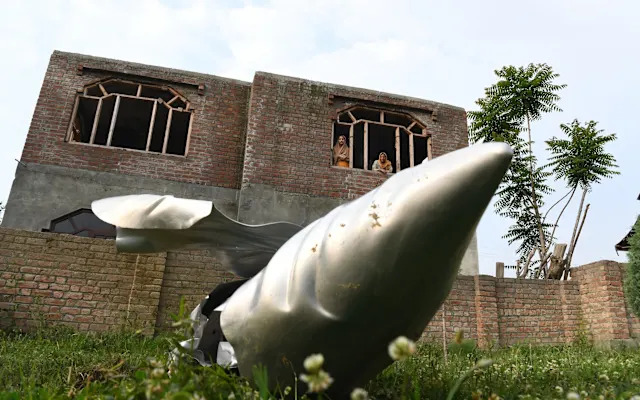
*Wreckage of an Indian Rafale in Indian kashmir
Pakistan had reportedly shot down several Indian aircraft within hours by using previously untied Chinese J-10C fighter jets.
“Our jet fighters… shot down three Indian Rafales, three Rafales [that] are French,” Ishaq Dar, Pakistan’s foreign minister, told parliament on Wednesday. “Ours were J-10C.”
India has not officially responded to reports that it lost as many as five fighter jets, but several wreckages of jets have been recorded within Indian territory. And the apparent involvement of Chinese aircraft in shooting down a Rafale has ricocheted through defence circles – and sent stock in its maker, Chengdu Aircraft Corporation, surging by as much as 20 per cent.
The PL-15 missile, carried by the J-10C jets, has never been used in combat before
The PL-15 missile, carried by the J-10C jets, has never been used in combat before
Until now, Chinese weaponry had not been field-tested against Western-made systems like the Rafale. The Indian Air Force (IAF) operates a fleet of 36 Rafale F3Rs, the most advanced model of the aircraft.
A French intelligence source confirmed to CNN on Wednesday that at least one had been shot down, marking the first time a Rafale has been lost during combat.
In an official statement, China’s foreign ministry said it was “not familiar with the matter” when asked whether Chinese jets were involved in the India-Pakistan conflict.
If it is confirmed that a Chinese J-10C took out the French jet, it would also mark the aircraft’s first known air-to-air kill. It has been described as a “4.5 generation fighter”, like the British Eurofighter Typhoons and almost at the level of fifth generation systems like the US-made F-35.
Hu Jixin, the former editor of the Chinese state-owned Global Times, said the battle showed that “China’s level of military manufacturing has completely surpassed that of Russia and France”, adding that Taiwan should feel “even more scared”
For pilots in the Pakistani Air Force, the PL-15 missile has several advantages. Once fired, it has a large rocket booster that briefly propels the projectile to above Mach 5, or hypersonic, speeds.
In the middle of its flight, it is guided to target by an active electronically scanned array (AESA) radar that can be held on the launch system or a separate vehicle. Close to the target, it switches on its own AESA radar, locks on, and homes in with deadly accuracy.
A dual-pulse motor means that, after the initial blast falls away, a second burst of speed can be generated within 10 or so kilometres from the target.
Because they are very, very fast, they basically have what you call a ‘no-escape zone’,” Mr Hoffmann said.
The switch from the first radar system to the missile’s onboard version also allows the jet that launched it to turn away from the target and flee any counterfire.
“There’s survivability for the [launch] platform, but also lethality for the [missile] itself.”
In recent years, the two nations have rapidly diverged in terms of where they source their weaponry, with Pakistan favoring China at the expense of its former ally, US.
Now, Islamabad buys the vast majority of its arms from China. Some 82 per cent of imports between 2019 and 2023 came from China, according to the Stockholm International Peace Research Institute (SIPRI), which tracks global arms flows. Imports from the US, meanwhile, have collapsed and the US builds a stronger relationship with India.
At the same time, Delhi has stepped up arms purchases from Western allies and reduced its reliance on Russia. Since 2006, purchases from France, Israel and the US have surged. Imports from Moscow have fallen from 75 per cent of the total to 36 per cent, according to the SIPRI.
Early Thursday, both nations also fired artillery and drones at each other.
Thursday’s exchanges and back and forth claims and counterclaims came a day after India said it launched precision strikes on what it called “terrorist infrastructure” inside Pakistan. Indian Defence Minister Rajnath Singh told an all-party meeting on Thursday that “100 terrorists” had been killed; the claim could not be independently verified.
New Delhi’s operation followed a deadly attack in Indian-administered Kashmir two weeks ago, which killed 26 people. India blamed Islamabad for the attack – a charge Pakistan strongly denies.